
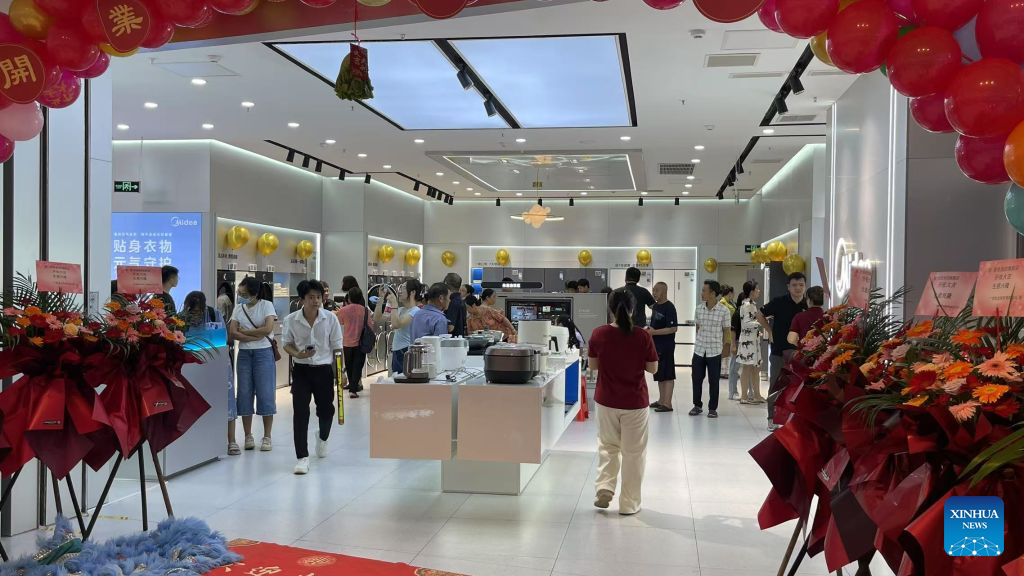
Consumers shop for household appliances at a shopping mall in Beihai, south China's Guangxi Zhuang Autonomous Region, May 23, 2026. (Xinhua)
NANNING, Aug. 2 (Xinhua) -- Urged by their daughter to replace the decade-old air conditioner in their apartment in Nanning, south China's Guangxi Zhuang Autonomous Region, Zhu Chengyi, 72, and his wife Li Lan, 71, were initially hesitant.
Today, the couple can adjust the temperature in their bedroom with a simple voice command or a tap on their smartphone. Purchased with a government trade-in subsidy, their new inverter-equipped unit also allows their daughter in Shenzhen in neighboring Guangdong Province to monitor it remotely via an app. "It was our daughter who pushed for it," Zhu said. "Now we see why."
Their experience reflects a wider shift underway across China this summer, as a more targeted trade-in program and an early heatwave have accelerated the replacement of aging appliances with more efficient, smarter models -- a push that underscores an upgrade in the quality of consumption.
Total retail sales of consumer goods, spanning online platforms and brick-and-mortar stores, reached 24.87 trillion yuan (3.66 trillion U.S. dollars) in the first half of 2026, up 1.3 percent year on year, according to the National Bureau of Statistics (NBS).
China's national trade-in program, funded via ultra-long special treasury bonds disbursed in three tranches this year, generated 1.1 trillion yuan in sales and benefited 150 million consumers in the first half of 2026, NBS data showed. Authorities have narrowed the program's scope to raise the subsidy's take-up rate and steer demand toward greener products, rather than spreading the funds too thinly.
Under the 2026 rules, subsidies apply to six core appliance categories, including air conditioners, and only to products meeting the top-tier Grade 1 efficiency standard. Consumers receive a subsidy of 15 percent of the final discounted price, capped at 1,500 yuan per unit, and limited to one item per category per person.
At the flagship Suning store in Nanning, manager Huang Bentao reported stronger foot traffic than last year, particularly for models offering voice control, gentle airflow and remote monitoring options. "Customers, especially older ones, ask about smart features and energy savings," he said. "The subsidy makes the better machine affordable, and they notice the difference in daily running costs."
Wen Qiang, head of marketing at Suning's Guangxi branch, said the shift has become increasingly clear in the company's sales data. "Grade 1 air conditioners are becoming the norm, and demand for greener products, such as smart kitchen appliances and more efficient refrigerators, is rising fast," he said. "Even customers whose air conditioners are still functional will often replace them once running costs start climbing."
Smaller retailers report the same pattern. At a household appliance shop in Nanning, Dou Zhihong, Midea's general agent for the region, said buyers are increasingly focused on Grade 1 ratings and smart functions. "Many come in with the subsidy in mind and leave with inverter models that offer quieter, more even cooling," he said. Average transaction values have risen as customers opt for premium units rather than basic replacements.
Retailers have layered their own incentives on top of the national subsidy. "We add our own top-ups," Wen said. "For air conditioners, that includes extra compensation for the old unit, up to 1,000 yuan. Our recycling service is free of charge and unrestricted by location. Customers simply file a request online, and a technician comes to assess and collect the old machine."
Driven in part by the program, Grade 1 energy-efficient products have become the mainstay of the trade. Industry data reveal that top-rated energy and water efficiency models now account for over 92 percent of total sales among eligible appliances under the program, with broader data suggesting Grade 1 products consistently exceed 90 percent of overall replacements nationwide.
"The subsidy lowers the barrier to better technology, and the technology lowers the cost of running it every day," said Dou. "Older customers are adopting smart features faster than we expected. In a region where a long, scorching summer keeps people indoors much of the day, reliable cooling is less a luxury than a daily necessity."
The upgrade drive has also reached regions with historically low air-conditioner ownership. In China's northeast, where penetration has long lagged, sales in many cities surged by up to threefold for a while this year following an unusually severe heatwave, according to industry data.
This momentum is visible beyond China's borders as well. Customs data show that Chinese air-conditioner exports to the European Union reached a record high of 3.76 billion U.S. dollars in the first half of 2026, up 43.2 percent year on year.
Meanwhile, installation-free portable air conditioners, ideal for rental properties and older housing stock, were among the fastest-growing segments on the continent, with exports jumping by more than 70 percent. Chinese brands saw their market share rise from 27 percent in 2023 to 41 percent this year.
For Zhu and Li, it is the small technical details that matter most. The "windless" mode on their new unit diffuses cool air gently across the room rather than blowing it directly, sparing them the joint discomfort they once felt.
"It does not feel like an appliance anymore," Zhu said. "It feels like it is looking after us." ■
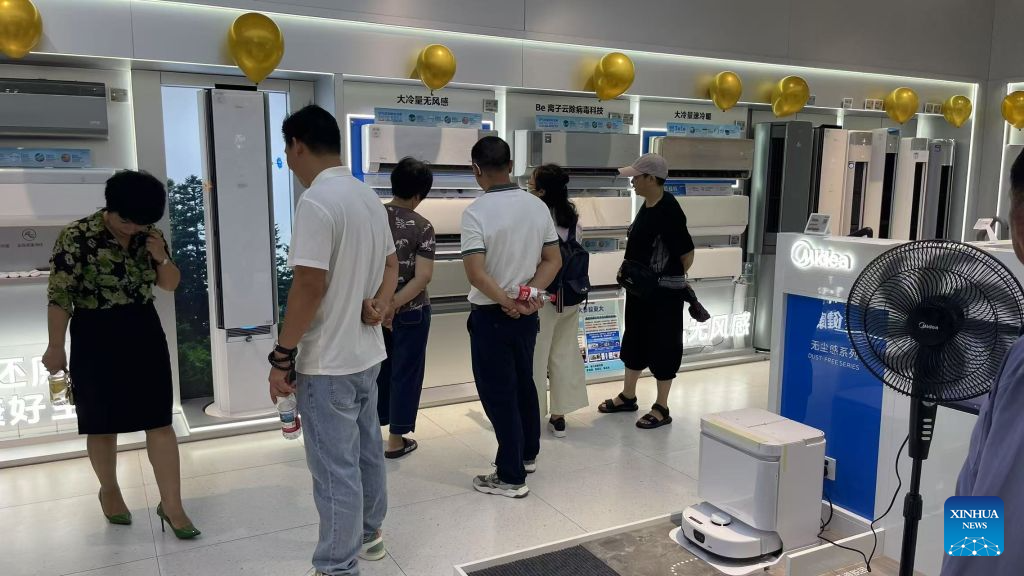
Consumers shop for household appliances at a shopping mall in Beihai, south China's Guangxi Zhuang Autonomous Region, May 16, 2026. (Xinhua)


