HANGZHOU, July 31 (Xinhua) -- At a "school" in Hangzhou, east China's Zhejiang Province, "teachers" hold remote controls, sensors record every move, and "students" drill the same task again and again until they get it right.
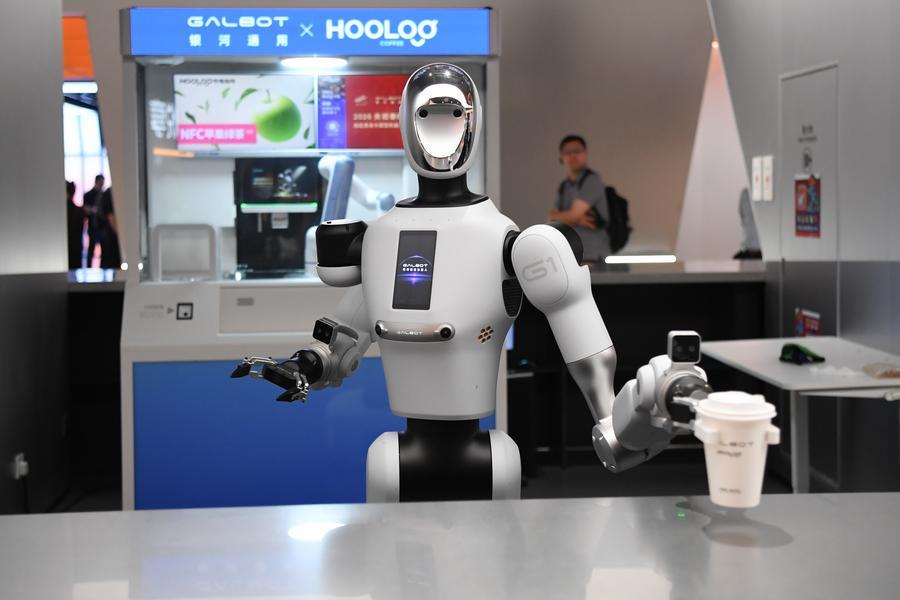
Those "students" are actually robots. More than 140 of them are currently training at the National Pilot Base for Embodied AI Applications in over 40 job-oriented scenarios, which include smart kitchens, warehouses, farms and a dimly lit mock mine tunnel.
Chinese robots have wowed audiences with backflips, boxing and dance routines. The real test now is whether they can hold down regular jobs. A long-standing headache for the industry is that robots performing well in simulation often stumble when faced with the messiness of real-world settings.
To bridge that gap, this base sitting between laboratory research and wider deployment can provide shared settings where technologies can be tested, refined and validated before full-scale rollout.
Inaugurated on May 16, the national-level facility dedicated to moving embodied artificial intelligence (AI) -- machines that sense, move and act in the physical world -- from laboratories into daily use is also dubbed a "national vocational training ground" for robots.
The plaque, in fact, arrived after the students. On May 16, when the base opened for its trial operation, nearly 40 embodied-AI companies and more than 10 universities and research institutes were already on site for development and training work.
The base runs a dual-track approach combining real-scenario training with high-fidelity virtual simulation. In physical scenarios, technicians teleoperate robots through tasks over and over, with every successful move recorded by sensors as "raw teaching material" for model training.
A lightweight alternative needs no robot at all: an operator simply puts on data gloves and a motion-capture suit to harvest movement data.
In a simulated smart kitchen, Hangzhou Big Data Cloud AI Technology Co., Ltd. has been teaching robots a full restaurant routine since last November: taking orders, fetching ingredients, stir-frying a dish in three to four minutes, then plating it and collecting used dishes.
Yang Jiandang, co-founder of the company, said developing a customized catering application from scratch could require several million yuan in research and development. Since the base already provides some of the underlying facilities and technical capabilities, his team can begin with a lower-cost feasibility test.
The cost matters. "In the past, developing a single application scenario could cost a company more than 10 million yuan (about 1.5 million U.S. dollars) in training data alone," said Zhang Haiwei, founder of the motion-capture firm Chingmu. "Now companies based here get one-stop access to the resources they need."
Chingmu, which moved in during the trial phase, has seen orders roughly doubled from a year earlier, with its value reaching some 50 million yuan in the first half of 2026.
Other scenarios are filling up. At DexRobot's dexterous-manipulation zone, an exoskeleton platform maps human motion onto robots across 65 degrees of freedom -- 18 in the arms, 42 in the hands and five in the waist -- with millimeter-level precision. The company said one of its robotic hands completed 1 million full-load cycles in a durability test, marking a key step in getting these components ready for long-term use.
Logistics firm Transfar and robot maker Unitree jointly run a warehouse scenario where wheeled humanoid robots pick, scan and carry goods of varying shapes. Elsewhere, smart forklifts stack cargo with positioning accuracy up to 1 mm, and harvesting robots pick ripe fruit around the clock.
What makes the "school" so attractive to these companies? Zhou Chen, DexRobot's CEO, likened their predicament to equipping a warhorse in a classic Chinese folk ballad. "You buy the saddle from one vendor, the harness from another, the reins from a third, but end up with a pile of parts and no idea how to assemble them. That's exactly why we need a platform, and this pilot base brings everything together."
"The base is like a library for robotics," he said. "You come here because everything you need is on the shelves."
The clustering pays off in speed. Chingmu and dexterous-hand developer DexRobot, located within the same building, have established a joint laboratory.
"The moment they iterate a new product, we can put it to use. If something in yesterday's data needs re-collecting, we respond the same day," Zhang said during an interview.
"Upstairs and downstairs are upstream and downstream. Our next-door neighbor is our partner," said Zhou, adding that the joint lab gives companies a low-stakes space to test the waters on a small scale. With so many firms clustered in one place, they can help make preliminary assessment and slash the decision-making cost.
Beyond the base, Hangzhou already offers a glimpse of what a robot's "job" can look like. Since May 1, a fully operational squadron of 15 traffic-management robots has been on duty at key intersections and tourist areas, including the West Lake scenic area.
Each robot can work continuously for eight to nine hours, taking on routine traffic guidance and public-service tasks alongside human officers. The robots deliver around 3,500 voice reminders and handle over 500 public interactions each day. They have logged over 10,000 hours of operation, supporting events such as the West Lake marathon and the college entrance exam.
With technical standards for data collection, communications and hardware interfaces still evolving in the robotics industry, the base is working with industry partners on practical rules intended to make technologies and data easier to test and connect.
Li Xingteng, deputy general manager of Hangzhou Embodied Intelligence Pilot Base Technology Co., Ltd., the base's operator, said the platform aims to turn companies' specialized strengths into integrated solutions by linking firms across the robotics chain.
Institutional support is expanding, too. In June, the Ministry of Industry and Information Technology and the State-owned Assets Supervision and Administration Commission launched a 2026 initiative to promote real-scenario training and regular deployment of humanoid robots and other embodied-AI products. China's first local regulation on the industry also took effect in Hangzhou on May 1.
The base is one node in a wider push. Hangzhou is now home to more than 700 robotics-related companies, and its embodied-AI cluster generated an output of 106.8 billion yuan (about 15 billion U.S. dollars) in 2025, official data showed.
Li said mature embodied-AI solutions trained at the base would eventually be deployed in experimental communities, where problems could be identified and addressed through real-world use.
For the robots at this "school," the scenarios are only meant to be their first class. The world outside is the next step in their education. ■