
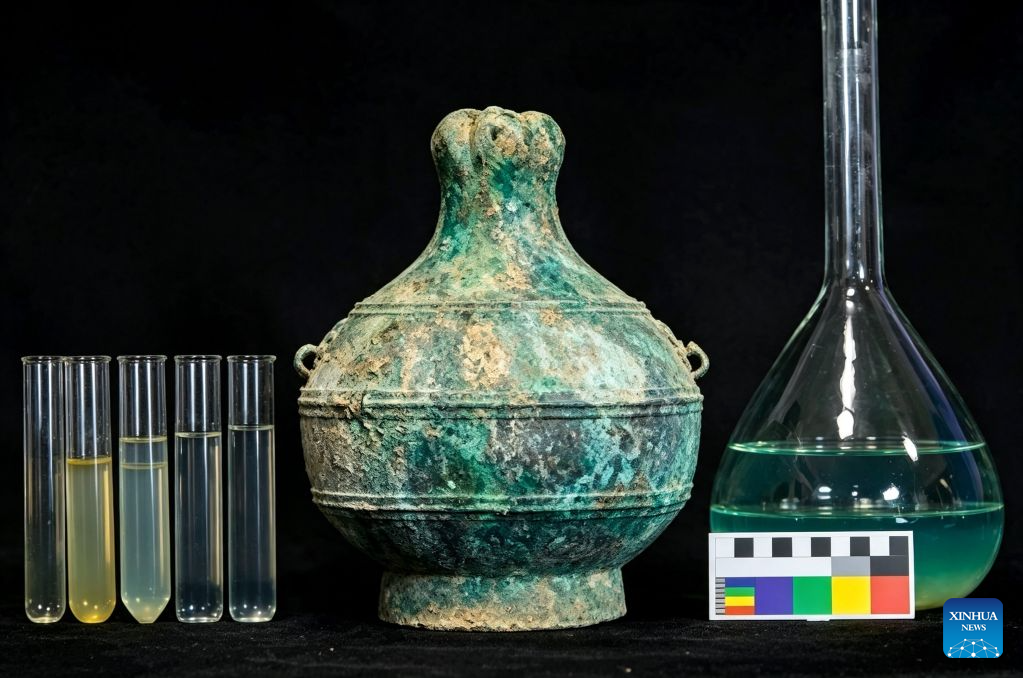
This photo taken on Aug. 6, 2024 shows the residue of a grain-based alcoholic drink from the Warring States Period (475 BC-221 BC) in Guyuan, northwest China's Ningxia Hui Autonomous Region. (Xinhua)
YINCHUAN, July 30 (Xinhua) -- Archaeologists have identified residue of a 2,300-year-old grain-based alcoholic drink from the Warring States Period (475 BC-221 BC) in northwest China's Ningxia Hui Autonomous Region, offering new insights into ancient Chinese brewing technology.
The discovery was made at the Shanjiabu cemetery of the Qin State of the period in the city of Guyuan, where researchers found the liquid preserved inside a bronze garlic-head-shaped pot -- a distinctive vessel of Qin culture, according to the regional department of culture and tourism.
Through a combination of archaeological research and advanced scientific analysis, researchers confirmed that the 3,740 ml of liquid extracted from the vessel was a grain-based alcoholic beverage produced during the Warring States Period.
The sample is believed to be China's best-preserved liquid alcohol relic from the era publicly reported to date, filling a gap in archaeological research on ancient brewing in Ningxia.
The cemetery is located near the Great Wall built by the Qin State during the Warring States Period, with 183 tombs excavated as of 2024.
The bronze vessel adopted a dual sealing structure lined with textile fabrics and coated with organic mud. The sophisticated sealing isolated external contaminants, allowing the ancient liquor to survive with minimal volatilization after more than two millennia, archaeologists said.
To uncover the drink's ingredients and brewing process, a joint research team from the Ningxia Institute of Cultural Relics and Archaeology and the School of Cultural Heritage at Northwest University conducted detailed tests using technologies that included infrared spectroscopy, ultra-high-performance liquid chromatography-mass spectrometry, and microscopic analysis of starch grains, phytoliths and yeast microfossils.
The analysis identified 24 categories of compounds, including organic acids, amino acids and carbohydrates. Researchers found that the organic acid profile matched that of artificially aged rice liquor, confirming the liquid as a fermented grain-based alcohol.
Further examination showed that wheat and barley starch grains in the sample had been processed, such as grinding, heating and microbial degradation.
The findings indicate that Qin people had already mastered the use of grain-based fermentation starters, allowing saccharification and fermentation to occur simultaneously, which is a sign of advanced brewing skills for the time.
Researchers said the discovery provides physical evidence of the sophistication of ancient Chinese grain fermentation and offers valuable clues for studying agriculture, food culture and craftsmanship during the pre-Qin period, which refers to the period before the Qin Dynasty (221 BC-207 BC) was established. ■


