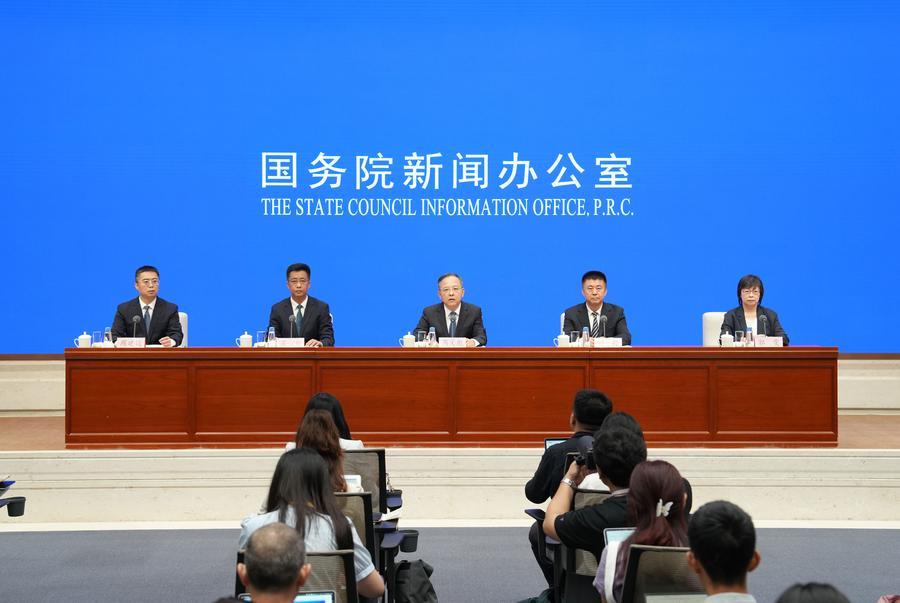
BEIJING, July 29 (Xinhua) -- China plans to continue strengthening intellectual property rights (IPR) protection to support emerging and future industries, the country's top intellectual property regulator said on Wednesday.
The protection of IPR will be central to fostering comprehensive innovation, high-quality development, and high-standard opening up, as well as economic and social development, according to the China National Intellectual Property Administration (CNIPA).
Rui Wenbiao, deputy head of the administration, told a press conference that the plan for IPR protection and utilization for the 15th Five-Year Plan period (2026-2030) will be implemented in the near future. It will serve the country's development priorities across all aspects of IPR, including creation, protection, utilization, management, services and international cooperation.
The plan emphasizes its supportive role in new quality productive forces development, breakthroughs in key core technologies, and cultivation of industries with unique advantages. It also highlights a high-quality development orientation, quick response to technological innovation demands, and coordinated regional development.
CNIPA's senior officials noted at the press conference that emerging and future industries, as new engines of economic growth, will continue to get strong support from IPR protection.
According to Rui, emerging and future industries, such as artificial intelligence (AI), quantum technology, new-generation information technology, and biomedicine, feature rapid technological iteration and cross-sector integration, posing new requirements for IPR protection systems.
CNIPA will focus on the development practices of different industries in emerging fields, and provide more effective IPR authorization and confirmation models, define clearer ownership, scope, and forms of protection, as well as provide smoother collaborative protection systems and infringement response mechanisms.
Taking AI as an example, Rui said that China will continue to advance institutional innovation in AI-related IPR, revise the guidelines for AI-related patent applications at a proper time, and improve patent examination standards for emerging and future industries related to AI, such as embodied intelligence and brain-computer interfaces.
During the 15th Five-Year Plan period, China will also deeply engage in international cooperation on AI-related IPR, actively participate in the formulation of relevant international rules, technical standards, and governance frameworks, and promote AI technology for the greater benefit of humanity, Rui added.
Liu Yi, head of CNIPA's treaty and law department, said that to promote the deep integration of AI and other industries, the administration will optimize the examination of AI-related patents and trademarks, focusing on future industries such as embodied intelligence, brain-computer interfaces, and 6G technology. It will continue to improve patent examination standards regarding complex and emerging issues such as AI ethics, subject matter and disclosure sufficiency.
In terms of international cooperation, Liu said China will actively integrate into the global innovation system, strengthen multilateral and bilateral cooperation, and actively contribute Chinese solutions in emerging technology fields such as AI, medical diagnostics, and green technology.
It will also continue to expand and optimize the Patent Prosecution Highway (PPH) cooperation network to serve domestic innovators in their overseas IPR layout. Meanwhile, it will also look to strengthen examination exchanges and rule research with Belt and Road partner countries.
Liang Xinxin, head of CNIPA's strategic planning department, noted that the administration will continue to strengthen IPR protection for integrated circuits to solidify the foundation of the digital economy. Specific measures include implementing the newly revised regulations on the protection of integrated circuit layout designs, in-depth research on data IPR systems, and exploring the establishment of data IPR protection rules.
Liang added that China will continue to strengthen research on foreign IPR legal systems and policy environments, and keep improving the guidance system for overseas IPR dispute response, providing more support for Chinese companies going global.
At the same time, the country will deeply align with high-standard international economic and trade rules, adhere to equal and non-discriminatory protection for both domestic and foreign-funded enterprises, strengthen IPR cooperation with major trading partners, and foster a world-class business environment that is market-oriented, law-based, and aligned with international standards. ■