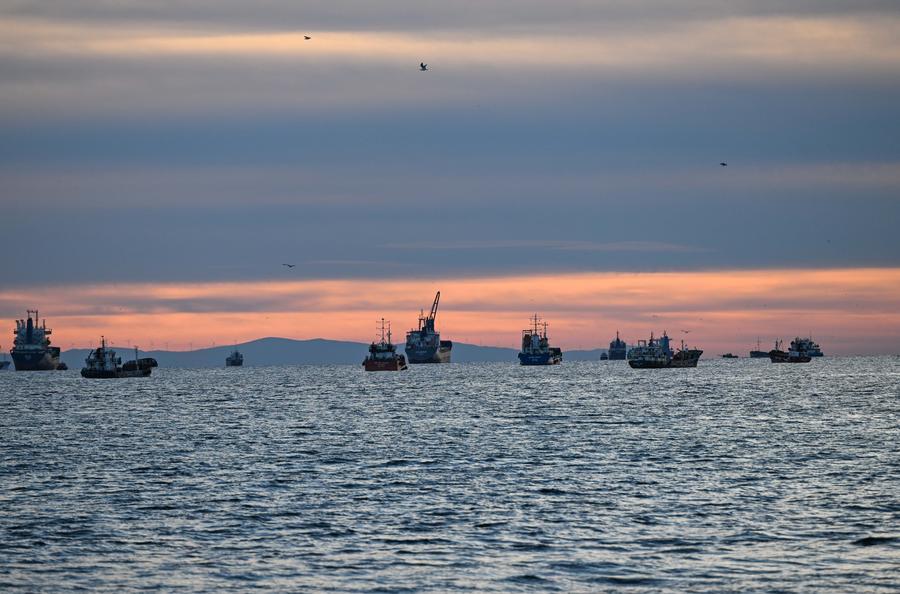
ISTANBUL, July 27 (Xinhua) -- Escalating attacks on merchant vessels in the Black Sea amid the Russia-Ukraine conflict are raising concerns over regional trade and maritime security, prompting renewed calls for international action.
Highlighting the growing threat, the Turkish Shipowners' Association reported that "136 commercial vessels have come under attack in Russian and Ukrainian ports and elsewhere in the Black Sea in recent months."
Describing the security risk as having reached "unacceptable" levels, the association advised its members against making voyages to Russian and Ukrainian ports, urged them to adopt a "wait-and-see" approach toward new freight contracts, and called on the International Maritime Organization, relevant United Nations bodies, and other national and international authorities to take urgent steps to prevent further attacks on commercial vessels.
"This is not just a problem for Black Sea littoral states," Baris Doster, an international relations analyst at Türkiye's Marmara University, told Xinhua. "It is a global issue that affects all states trading with the countries in the region, regardless of whose flag the ships fly."
The attacks have severe consequences for regional security, stability and the economy, Doster said. He advocated for a regional initiative, saying it would be preferable for Black Sea littoral states to work together to address the issue.
The impact is already being felt across the region's shipping industry, creating a growing bottleneck. According to data from the Association of Shipowners and Operators, out of a total of 759 mini-bulkers active in the Black Sea, 312 are currently unladen.
The stagnation is directly affecting Turkish exporters. Mustafa Gultepe, president of the Turkish Exporters Assembly, warned that escalating attacks on commercial vessels pose growing risks to regional trade, noting that 57.4 percent of Türkiye's exports to Russia and 35 percent of its exports to Ukraine rely on maritime transport.
"A bottleneck in maritime logistics risks affecting our leading export sectors to Russia, namely chemicals, fresh fruits and vegetables, and machinery, as well as our shipments to Ukraine, particularly in the chemical, steel and electronics sectors," Gultepe said. "Given this dangerous trajectory, it is crucial to accelerate initiatives with the relevant countries."■