
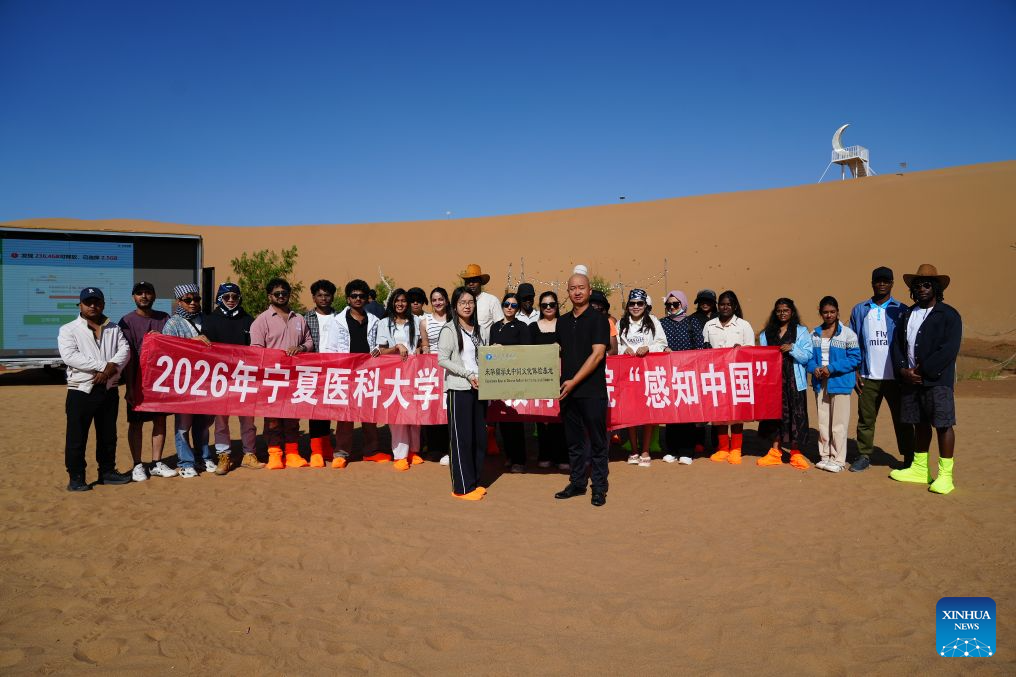
International students of the 2026 "Experience China" cultural exchange program pose for a group photo in Zhongwei, northwest China's Ningxia Hui Autonomous Region, July 21, 2026. (Xinhua)
YINCHUAN, July 26 (Xinhua) -- Under a scorching summer sun on the fringes of the Tengger Desert, a group of international students knelt on the sand, pressing bundles of dried wheat straw into the dunes to form a checkerboard pattern.
This simple grid, developed in the city of Zhongwei, northwest China's Ningxia Hui Autonomous Region, more than 70 years ago, has become one of China's signature methods for stopping desertification. By trapping shifting sand and reducing wind erosion, the low-cost technique has helped transform vast stretches of barren land into stable ground.
The students, from 19 countries including Yemen, Fiji, Mali and India, visited Ningxia this month as part of the 2026 "Experience China" cultural exchange program, gaining a firsthand look at China's long-running campaign to combat desertification.
Zhongwei, on the southeastern edge of the Tengger Desert, was once among China's hardest-hit areas in terms of encroaching sand. In the early 1950s, dunes stood just a few kilometers from the city, swallowing farmland and threatening to encroach upon the Yellow River and the Baotou-Lanzhou Railway, China's first rail line through a desert.
The need to protect the railway prompted local engineers and workers to pioneer the straw checkerboard method, laying the foundation for one of China's best-known ecological restoration projects.
Over the past seven decades, workers have installed straw grids across more than 430,000 mu (about 28,700 hectares) of desert in Ningxia and planted over 100 million drought-resistant shrubs. Last year, the region completed a 153-kilometer-long sand-control belt along the edge of the Tengger Desert, further strengthening its defenses against desert expansion.
"It's incredibly smart to use inexpensive wheat straw to stabilize the sand," said Ledua Michelle Evelyn, a 25-year-old student from Fiji, after trying the technique for the first time.
The students also visited a solar power station of Ningxia Hannan Photovoltaic Power Co., Ltd., where more than 60,000 photovoltaic panels stretch across rolling dunes. Beneath the panels, grasses and shrubs now cover land that was once bare sand.
Engineer Wang Lei, who works for the company, explained that the panels create shade, reduce wind speed and help retain soil moisture, creating a more favorable environment for vegetation.
Large temperature swings between day and night also cause moisture to condense on the panels, with droplets reaching the soil below and providing an additional source of water. When vegetation becomes too dense, nearby herders bring sheep into the solar farm to graze, said Wang.
For Alqais Mohammed Abdulkarem Mohammed Mohsen, a doctoral student from Yemen, the project demonstrates how renewable energy and environmental restoration can reinforce each other.
"It produces clean energy while restoring the ecosystem," he said. "This is something many Arab countries could learn from."
After decades of restoration, Zhongwei has reclaimed around 1.5 million mu (100,000 hectares) of desert, pushing the edge of the Tengger Desert back about 25 kilometers.
The improved environment has also opened new economic opportunities for locals. Solar power, desert tourism and outdoor recreation, including camping, stargazing and bonfire experiences, have become fast-growing industries, with tourism now supporting nearly 70,000 jobs in the city.
"China has brought life back to the desert," said Srinivasan Malliga Ajay, a student from India. "It's inspiring to see how science, persistence and long-term planning have turned such a harsh landscape into one with new possibilities." ■


