
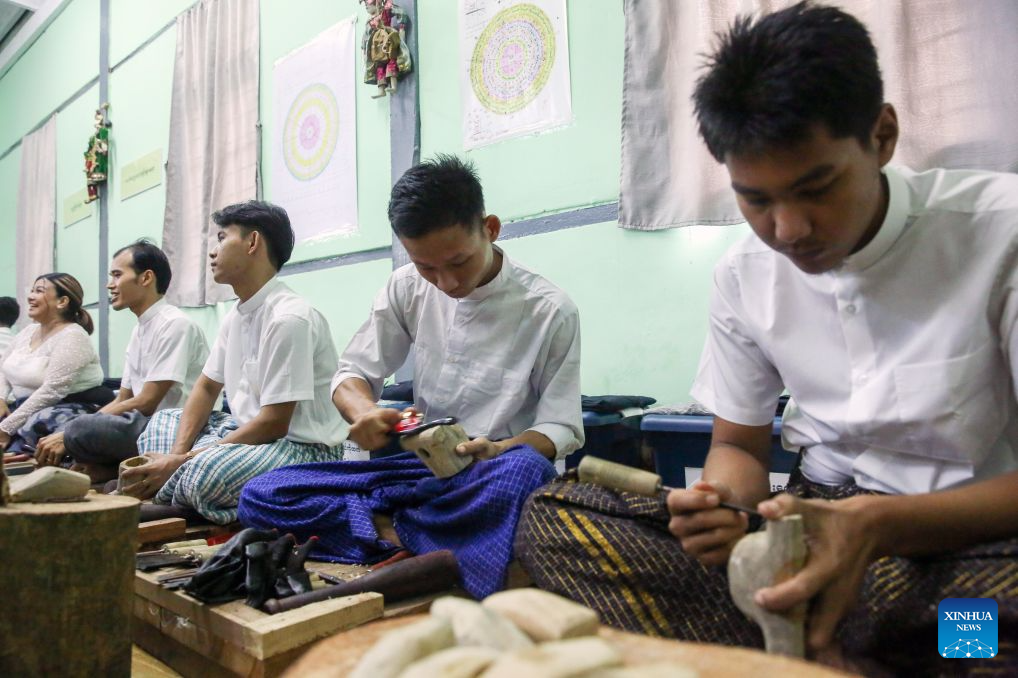
Trainees attend a traditional puppet-making craft workshop in Yangon, Myanmar, July 26, 2026. (Xinhua/Myo Kyaw Soe)
YANGON, July 26 (Xinhua) -- The rhythmic scrape of chisels echoes through a workshop at the State High School of Arts in Yangon, where blocks of wood gradually take shape under the careful hands of students learning one of Myanmar's oldest artistic traditions.
In the workshop, the trainees study sketches, measure proportions and carve rough forms into expressive faces and figures. They are among the first participants in a newly launched one-year course designed to revive the increasingly rare craft of making Myanmar's traditional string puppets.
Myanmar's traditional string puppets, known as Yoke thé, are intricate marionettes with carved wooden bodies, colorful royal costumes and 18 to 19 control strings.
Jointly organized by Myanmar's Ministry of Hotels, Tourism and Culture and the Myanmar Cultural Heritage Trust (MCHT), the program has enrolled 10 students to help preserve a tradition threatened by a dwindling number of skilled puppet makers.
For 22-year-old Pyae Phyo Wai from Sagaing region, the course offers an opportunity to develop his artistic skills while helping preserve his country's cultural heritage.
"I am happy to attend the course because I can learn puppet making," he said, expressing his hope that more young people would take up the craft.
Among the trainees is 27-year-old Saw Yan Naing, a puppeteering instructor at the National University of Arts and Culture in Mandalay. Although experienced in performing with marionettes, he said he had never learned how to craft them.
"I know how to operate the puppets, but I don't know how to make them. So, I joined the course to learn the craft," he said.
He said puppet making is an important part of Myanmar's cultural heritage but is now practiced by only a few artisans.
"Those who make the puppets are rare now. We should preserve this tradition," he said, adding that he plans to pass the skills on to his students after completing the course.
He explained that Myanmar's traditional puppetry involves far more than operating marionettes. It includes carving wooden figures, painting them, designing and sewing costumes, mastering string control and understanding the music that accompanies performances.
For 38-year-old Rain Hlwan Yee, the only woman in the class, the training also supports her business. She owns a blind box shop featuring products inspired by Myanmar's cultural heritage and traditional village life.
Her shop already sells handcrafted items based on scenes from Myanmar households in the 1990s, including wooden toys and traditional household objects. She hopes to add a traditional puppet blind box to the collection.
"The most challenging part for me during the training is wood carving," she said.
She believes the future of the craft depends on stronger market demand. "When demand grows and artisans receive fair prices, the puppet tradition can flourish again," she said.
The course was introduced in response to the growing concern over the declining number of puppet makers, although puppeteering is still taught at arts schools and universities in Yangon and Mandalay.
The course covers the creation of all 28 traditional puppet characters, including deities, royalty, animals and mythical figures used in Myanmar marionette performances.
For 56-year-old puppet master U Aung Than Tun, teaching the course is a continuation of his family's legacy.
He learned the craft from his father, a puppet maker and performer, by observing and practicing from an early age.
"Puppetry was very popular in the past. I learned it from my father," he recalled. With only a handful of traditional puppet makers remaining in Myanmar, he believes the course offers hope for the survival of the craft.
"It is the first training program of its kind. The course will produce a new generation of puppet makers," he said.
Daw Sanda Khin, founder and chair of MCHT, said the program aims to ensure that the knowledge is passed on to younger generations.
"Only a few puppet makers remain in Yangon and Mandalay, making this training essential to safeguarding the craft," she said.
Speaking at the opening ceremony, Union Minister for Hotels, Tourism and Culture U Maung Myint described Myanmar's traditional puppetry as an ancient art form that once entertained royal events, festivals and state ceremonies, and later gained recognition at home and abroad.
"As puppet makers have become rare, it is essential to train a new generation to preserve this cultural heritage," he said. ■


