
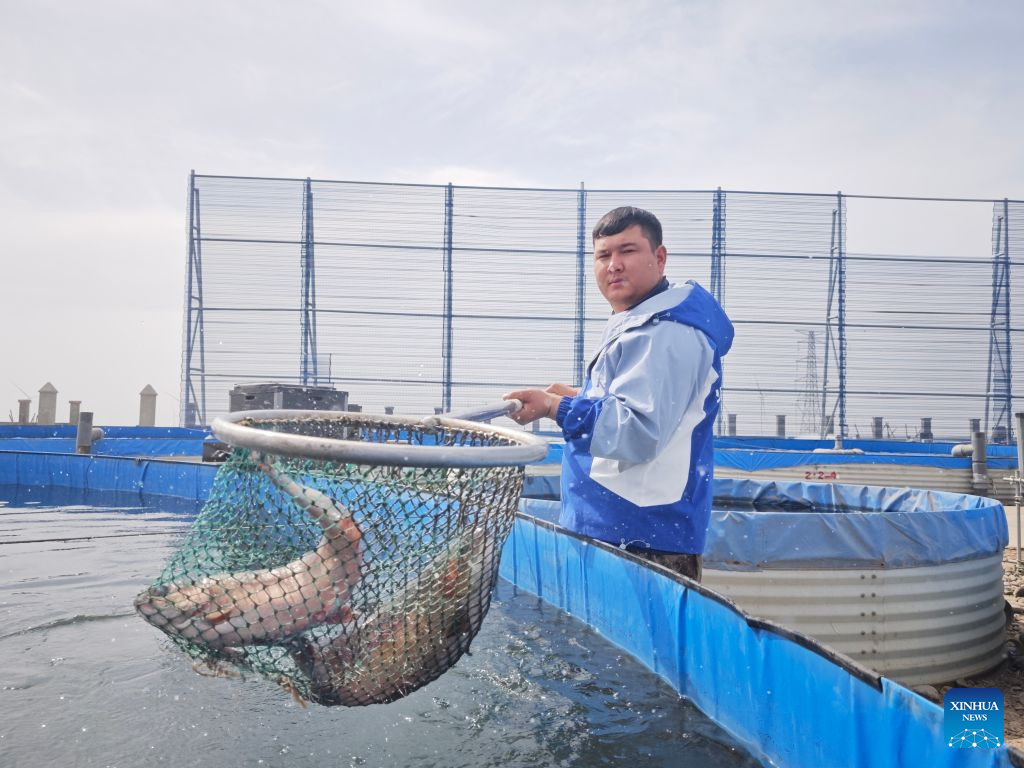
A worker catches fish at a salmon breeding base in Turpan, northwest China's Xinjiang Uygur Autonomous Region, April 9, 2025. (Xinhua/Gou Lifeng)
URUMQI, July 25 (Xinhua) -- The Turpan Basin in northwest China has long been known as a "hotspot" for its scorching heat.
In the classic novel "Journey to the West," the Monkey King borrowed a magic fan to cool the Flaming Mountains there. This summer, Turpan's temperatures have topped 50 degrees Celsius, earning it the nickname "Land of Fire."
However, this basin in Xinjiang Uygur Autonomous Region has recently gone viral online for a seemingly unlikely catch: a harvest of salmon, perch and trout. These cold-water species are now thriving in ponds across this fiery land.
The secret lies in a 2,000-year-old underground water channel system still in use today -- the Karez Wells.
The wells consist of vertical shafts linked to underground channels that surface as ditches and ponds. Stretching for dozens or even hundreds of kilometers, the channels are fed by meltwater from the nearby Tianshan Mountains. Lying underground, they shield water from sunlight, minimizing evaporation and keeping it cool and clear at 15 to 19 degrees Celsius year-round, even when ground surface temperatures soar to 70 degrees Celsius.
"That is perfect for cold-water species," said Song Zhijun, a local fish farmer.
Cold-water fish generally refer to species that inhabit waters north of 45 degrees latitude and at high altitudes, where water temperature does not exceed 20 degrees Celsius.
Song started his fish farming business in 2006, when he noticed high demand but few fish farmers in the northwestern region. In most water-rich areas of northern Xinjiang, winter ice shortens the fish growth cycle. Song then turned to Turpan, one of the world's driest and hottest places, yet home to the Karez Wells. In 2021, he moved to the foot of the Flaming Mountains to develop his aquafarm.
The farm sits on a natural gradient in Turpan's Shanshan County, where water from the Karez outlet flows directly into the fishponds. Song raises river perch, largemouth bass and rainbow trout.
In northern Xinjiang's natural lakes, river perch often take three years to reach market size. In Turpan, thanks to stable water temperatures, they mature in just 18 months.
Compared with common species, cold-water fish have delicate meat and command higher prices, offering better economic returns. Song said his production cost for river perch is about 35 yuan (5.15 U.S. dollars) per kilogram, while the selling price reaches 55 yuan. Such profit margins have drawn more farmers to this model.
According to the local government, Turpan's fish are now shipped to cities including Shanghai and Qingdao in east China, and Xi'an in the northwest, and even exported to overseas markets. In 2025, Turpan's total output of salmon and trout reached nearly 1,000 tonnes, and is expected to exceed 3,000 tonnes in 2026.
Benefiting from this ancient irrigation system, modern farmers make the most of every drop. Water flows from the Karez outlet into the fish tanks, then onward to irrigate nearby vineyards -- grapes being another treasure of Turpan.
After raising cold-water fish, the water becomes rich in elements such as nitrogen, phosphorus and potassium, which boost fertility and further promote grape growth, noted Zhang Jiazhi, deputy manager of a local company specializing in Karez salmon fisheries.
The Karez Wells system was recognized as a World Heritage Irrigation Structure in 2024. It has since become a popular scenic attraction, where visitors can explore demonstration zones to observe the ancient engineering works and learn about its history of cross-ethnic craftsmanship.
In the 1840s, Lin Zexu, an official known for leading the fight against opium smuggling, went to Turpan and oversaw the digging of new wells, integrating central China's shaft-digging techniques with local traditions.
Generation after generation has contributed to the survival and evolution of the Karez Wells. To local farmers, the ancient wells offer far more than precious water, as they also serve to connect time-honored wisdom with modern ecological agriculture, paving a sustainable path to prosperity. ■
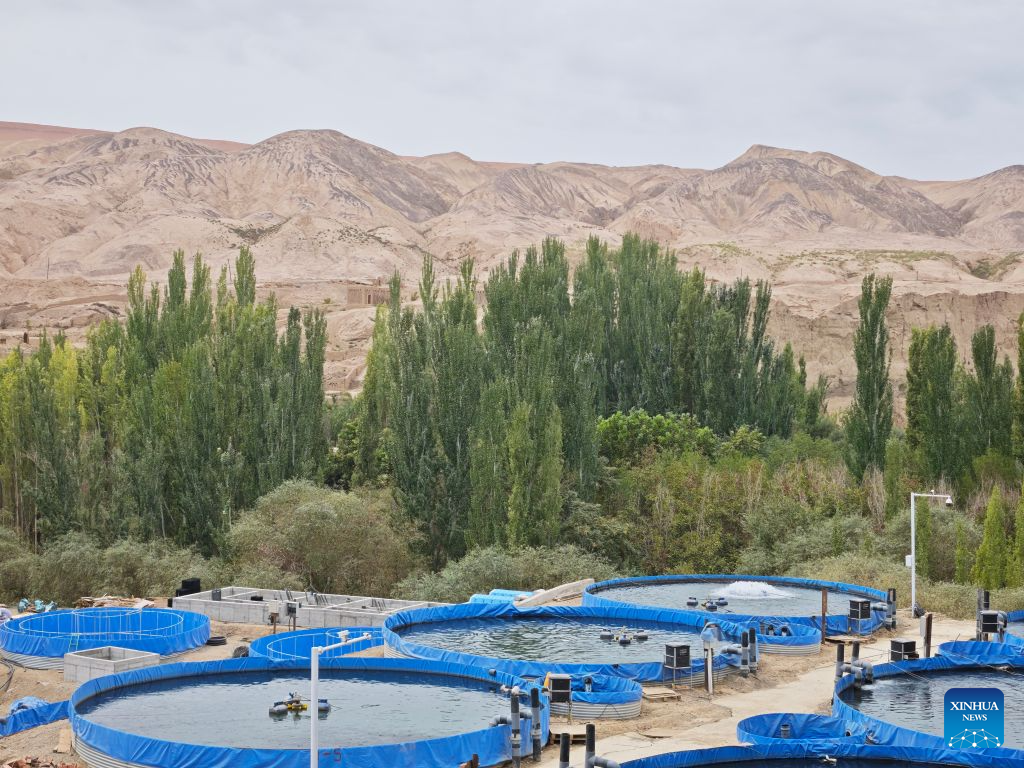
This photo taken on Aug. 21, 2025 shows a cold-water fish breeding base in Turpan, northwest China's Xinjiang Uygur Autonomous Region. (Xinhua/Gou Lifeng)


