
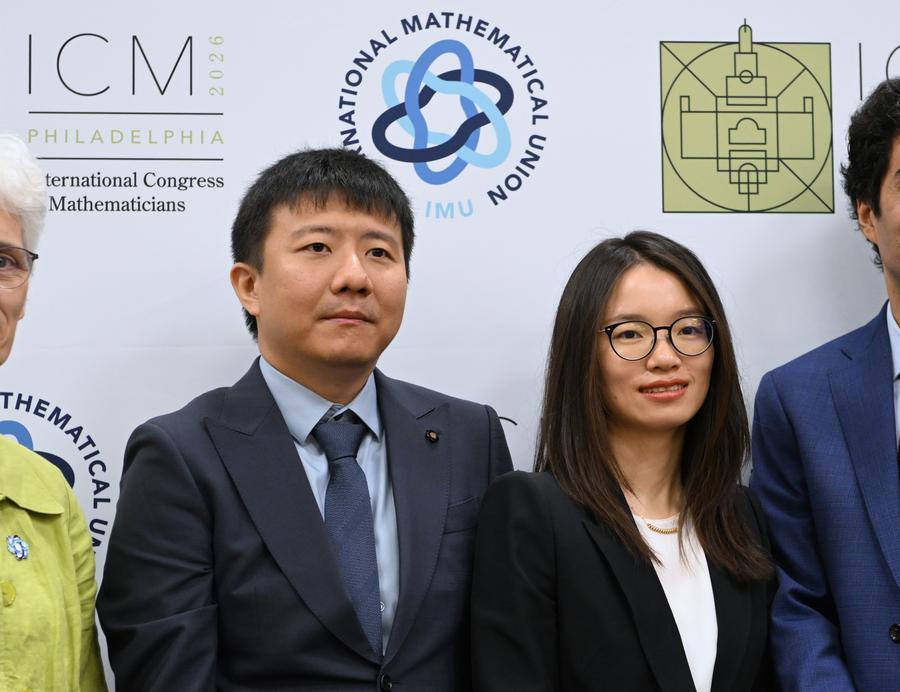
BEIJING, July 24 (Xinhua) -- The news that mathematicians Wang Hong and Deng Yu have become the first Chinese nationals to win Fields Medals has sparked widespread excitement among scholars, teachers, students and science enthusiasts, with many hailing the achievement as both a milestone for Chinese mathematics and an inspiration for young people pursuing their dreams.
"Chinese mathematics has made continuous progress since the launch of reform and opening-up," said Shing-Tung Yau, the first mathematician of Chinese descent to receive a Fields Medal. "We were once far, far behind the world's leading mathematical powers. Today, thanks to the efforts of several generations, we have come close in many respects."
"The essential part of both laureates' education was completed in China," said Efim Zelmanov, a foreign member of the Chinese Academy of Sciences (CAS) and a Fields Medal laureate. "Their remarkable achievement is a powerful recognition of China's fundamental and rapidly growing role in the world of mathematics," he added.
The International Mathematical Union (IMU) announced the recipients of the Fields Medals at the opening ceremony of the 2026 International Congress of Mathematicians in Philadelphia, the United States, on July 23.
The accolade, awarded every four years to two to four mathematicians under 40, is widely regarded as the Nobel Prize in mathematics.
Both Wang and Deng entered Peking University's School of Mathematical Sciences as undergraduates in 2007. Wang, now a permanent professor at France's Institut des Hautes Études Scientifiques, worked with Joshua Zahl to solve the Kakeya set conjecture in three dimensions in 2025. Deng, a professor at the University of Chicago, and his collaborators solved the narrow form of Hilbert's sixth problem.
For teachers and students from China's top universities, this breakthrough has made the world's highest mathematical honors feel less distant.
Professor Zhang Jiping, an academician of the CAS and a professor at the School of Mathematical Sciences at Peking University, said, "This win by Chinese mathematicians demonstrates that the achievements and capabilities of Chinese mathematicians have been acknowledged and recognized by the global mathematical community. This is a major historic breakthrough for Chinese mathematics and marks a milestone."
"What struck me the most was when Wang Hong said that in her mathematical research, she would try out every single idea she has," said Gu Kaiyuan, a student at the same school where both winners once pursued their undergraduate studies. "This courage to tackle difficult problems and the ability to engage in long-term, profound reflection in the face of failure are precisely the hallmarks of a mature mathematician."
Lu Rui, a Ph.D. candidate in the Department of Automation at Tsinghua University, described it as a historic breakthrough that has deeply inspired him during a live broadcast on the Fields Medal. Lu, who runs a math popularization channel, Meditation Math, on the YouTube-like platform Bilibili with 1.4 million followers, earned over 10,000 interactions across his three Fields Medal-related posts, as online users flooded in to congratulate Wang and Deng in the comments.
The news also ignited discussions on other social media platforms. A blogger named Hanlu wrote on the microblogging platform Weibo that "Two of the medalists are Chinese nationals -- they've made history. Salute!" The post had received more than 2,000 interactions.
Comments pouring in under Xinhua and CCTV's Weibo posts were filled with congratulations: some noted they had witnessed history and praised the prowess of Chinese mathematicians, while others observed Deng had grown into a public role model. Many more regarded Wang as a source of pride and a role model for young women in China.
The medalists have also helped enhance China's international standing in basic research. As Zhang Jiping put it, "this award is like a beacon that has greatly boosted our national confidence and demonstrates that China, too, can become a leading force in global mathematics."
In a phone call with Wang, French President Emmanuel Macron told her: "My admiration for your work can only grow, and for young girls, you're a wonderful role model."
Yau said he expected more scholars to return to China and train a new generation of young researchers, adding that he believes Chinese mathematics could reach the global forefront within five years.
While welcoming the achievement, Yau also called for greater appreciation of interdisciplinary research in China. He said the country should encourage such research to flourish while enabling mathematicians and theoretical scientists to create original directions and approaches of their own by drawing insights from different disciplines. ■