BEIJING, July 23 (Xinhua) -- Gao Chengliang still remembers the moment the powered pontoon bridge came into view.
When Typhoon Maysak triggered severe flooding in south China's Guangxi Zhuang Autonomous Region earlier this month, thousands of students and faculty members including Gao were stranded at the Guangxi Logistics Vocational and Technical College, where flood water rose to as high as five meters.
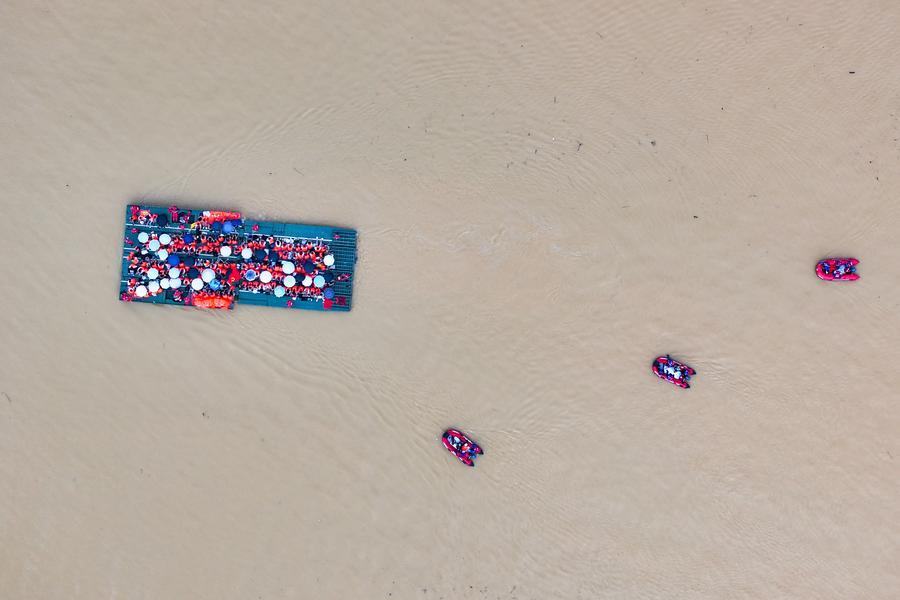
In the past, the stranded students were evacuated on inflatable boats, which can ferry six or seven people at a time. This time, a foldable, self-propelled pontoon bridge capable of carrying 300 people in a single trip came to the rescue.
"Now we can evacuate many more people on each trip. That gives us much more assurance in times of such disasters," said Gao, who helped coordinate the evacuation.
The novel equipment, which became a talking point on social media, was one of three dispatched by China Anneng Group to an educational zone in Guigang City, where more than 10,000 teachers and students were stranded across seven schools.
In the ongoing flood season this summer, new technologies ranging from drones to artificial intelligence (AI) have figured prominently in China's efforts to improve disaster rescue, monitoring and early warning.
Nowhere was that more evident than in Guangxi, where the latest round of typhoon-triggered flooding cut off roads to many villages. Residents were left in urgent need of drinking water, food and other essential supplies. Drones were widely deployed to deliver emergency supplies before the arrival of human rescuers.
In Guigang, a heavy-lift drone transported two 230-kilogram generators to the rooftop of the city's water resources bureau, restoring power to the local flood-control headquarters in a mission that took about 15 minutes. The same task used to take more than two hours.
In Zhejiang Province, where Typhoon Bavi made landfall twice, drones equipped with infrared cameras scanned a major flood-control levee, while AI systems identified leaks, landslides and other hazards and relayed their locations to inspectors on the ground.
"A full inspection used to take three days on foot. Now drones can cover the entire embankment in just two hours, including areas hard to reach," said Sun Long, an official with a local forestry and water resources bureau. "That leaves us more time to assess risks and respond."
In the island province of Hainan, AI, big data and cloud computing are being integrated into weather forecasting. Data from weather satellites, radar, automatic weather stations and ocean-observation equipment feed into a province-wide monitoring network that tracks typhoon paths, rainfall and other hazardous weather in real time.
"The goal is to shift disaster prevention from passively reacting to hazards to taking precautions," said Wu Yu, chief forecaster at the Hainan meteorological observatory.
These efforts align with China's broader efforts in disaster response. Under a national plan released last month, the country aims to build a modern emergency management system centered on prevention by 2030, with significantly enhanced intelligent and digital capabilities.
Yet technology is only part of the equation. Experts say China's disaster management highlights both application of new technologies and mobilization of grassroots officials and community volunteers to conduct field inspections, inform residents and organize evacuations.
During Typhoon Bavi, more than 2.21 million people were evacuated across Zhejiang Province. In Gehai Village, the village Party chief twice visited an 81-year-old woman who initially refused to leave her home, before helping her down the hillside to a shelter.
No matter how advanced technology becomes, local officials, Party members and volunteers will always remain on the front line, said Wang Qiqing, director of the Qionghai emergency management bureau in Hainan.
"Particularly in rural areas that have not yet fully adopted intelligent technologies, we rely on people to go door to door, deliver early warnings and ensure that no one is left behind," Wang said. ■