

*In recent years, a term Shuyun was coined to describe the summer travel boom, sparked by the overlap of school summer breaks and peak travel season, as people seek getaways to escape the summer heat.
*Various destinations have created diverse consumption scenarios, such as study tours, health care, sports and cultural events, which also provide windows for overseas tourists to gain a deeper understanding of China.
*The super-sized modern transportation network, paired with supply-side innovations, including summer tourism special trains and customized transport services, has converted potential travel demand into real mobility of hundreds of millions of people.
BEIJING, July 23 (Xinhua) -- Beijing middle school students briskly trekked through thick woodlands at the foot of northeast China's Changbai Mountain, where the temperature was a mere 22 degrees Celsius, much less stifling than in their home city. They were learning to test water quality and collect plant specimens as part of their summer field trip.
"This forest expedition gives us hands-on experience taking plant specimens ourselves," said Zhao Siheng, a student from Beijing's Tsinghua University High School. "Everything we've learned from textbooks suddenly feels tangible out here."
Thanks to its pristine, thriving forest ecosystems, the Changbai Mountain in Jilin Province has become a popular summer escape in recent years, attracting students with field study programs and families on leisure trips.
As schools across the country are now on summer break, China has entered its two-month summer travel peak, which started in early July. The surge of visitors to destinations like Changbai Mountain has significantly lifted domestic consumption, enhanced people-to-people exchanges and injected new vitality into local economies.
Chunyun, which literally means Spring Festival travel rush, is recognized as the world's largest annual human migration, marked by homeward journeys of people working outside their hometowns during the Chinese most important family-reunion occasion.
In recent years, a similar term Shuyun was coined to describe the summer travel boom, sparked by the overlap of school summer breaks and peak travel season, as people seek getaways to escape the summer heat.
According to China State Railway Group Co., Ltd., the country's railways are expected to handle 1.01 billion passenger trips during the 62-day summer travel rush ending on August 31, with an average of 16.29 million trips per day.

DUAL DRIVERS
Students are a major passenger group. According to Tongcheng Travel, a leading Chinese online travel agency, family and student travelers remain the dominant groups this summer. Family travelers account for about 38 percent of domestic air passengers, while students make up roughly 29 percent, together exceeding 60 percent of the total.
As an old Chinese saying puts it: "One can gain as much insight from traveling 10,000 miles as from reading 10,000 books." As of July 2, search queries for study tours themed on ancient Chinese poetry and classic texts on Tongcheng Travel have jumped by more than 130 percent year on year.
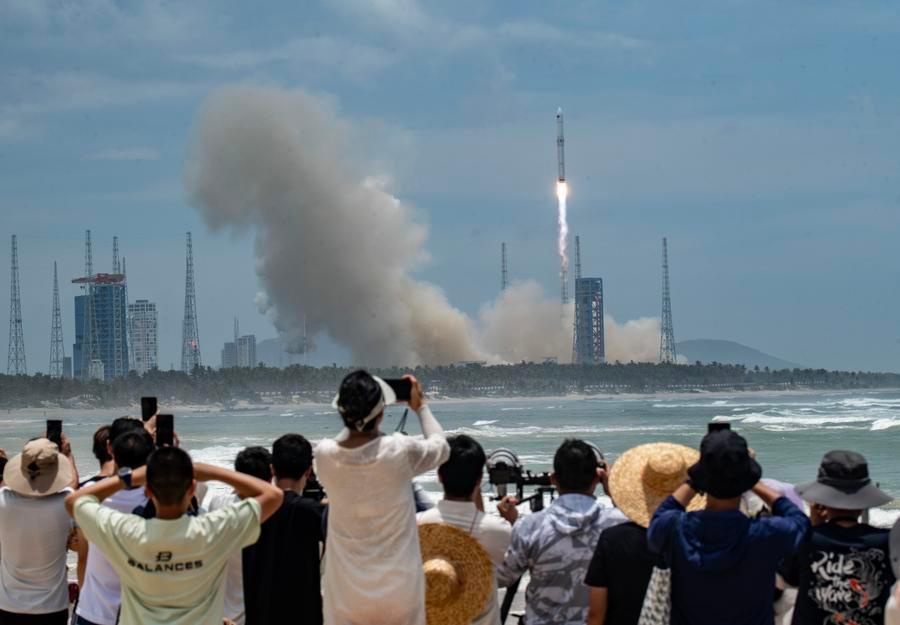
Tourist attractions across China are ramping up efforts to appeal to family travelers. Wenchang City in south China's island province of Hainan, home to China's only coastal low-altitude rocket launch base, is currently in its busiest launch window of the year. The local launch viewing center has rolled out a slate of interactive activities, including water rocket making sessions, to help children gain a better understanding of rocket launch operations.
"Visitor volumes during the summer peak hit three-to-four times the off-season average," noted Zhu Xunqing who is in charge of operation and management at the Wenchang Space Science Popularization Center.
Elderly people escaping summer heat form another big passenger group.
Li Yixiang, a 62-year-old photography enthusiast from east China's Zhejiang Province, embarked on a five-day trip to Changbai Mountain with her friends this summer. The direct flight from Shanghai near her hometown to the mountain resort takes only three hours.
"The air here is crisp and the scenery is stunning," she said. "Even if I spend several hours taking photos every day, I never feel stifled by the heat. It is a highly suitable travel destination for seniors like us."
During the summer travel season between July and August, the airport of Changbai Mountain has launched new routes and increased flight frequencies on multiple existing services, including connections between the renowned alpine resort and Beijing, Shanghai, Jinan and Wuhan. Projections show the airport's total flight volume during the season will rise by more than 15 percent year on year.
NEW TRAVEL PATTERNS
Xinjiang Uygur Autonomous Region, with its diverse natural landscapes and rich, vibrant ethnic culture, is another highly sought-after summer travel destination for vast numbers of domestic travelers across China.
Local railway authorities project that a total of 12.7 million rail passenger trips will be made across the region between July 1 and August 31, up 240,000 trips, or 1.9 percent, year-on-year from the same period in 2025.
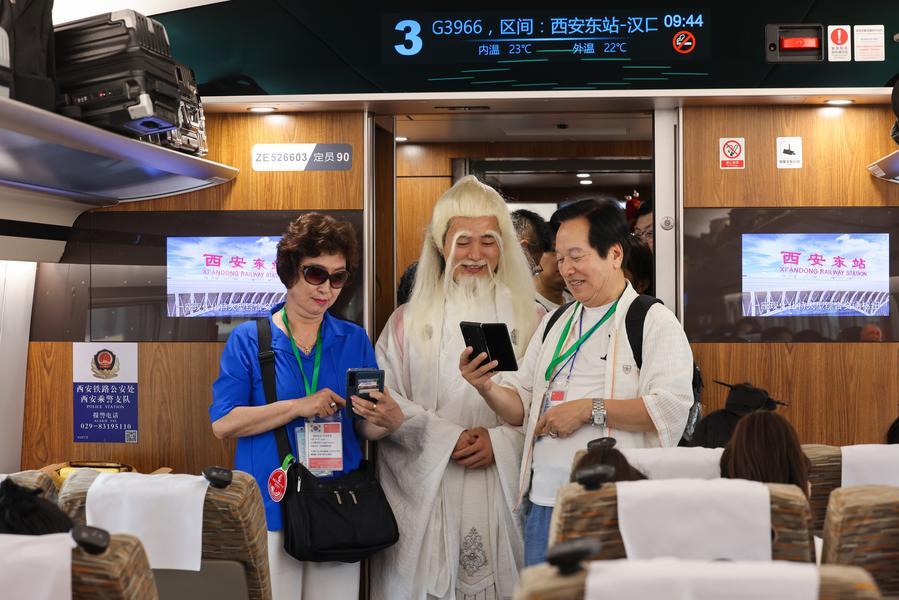
Railway operators are leveraging dedicated tourist trains to integrate transport services with tourism offerings.
On the evening of July 9, tourist train Y913 departed Urumqi, capital of Xinjiang, kicking off an 11-day journey that traverses a string of iconic scenic spots, including Kanas, Sayram Lake, Narat Grassland, Bayanbulak and the Pamirs. Dubbed as China's New Oriental Express, the luxury train offers not just transport and accommodation, but also a host of onboard amenities: dining cars, pubs, and entertainment facilities ranging from chess and card tables, massage chairs to KTV lounges.
According to Lin Wen, an official with Xinjiang Railway Tourism Development Group, railway authorities have increased the operation frequency of tourist trains during the peak travel season, with 28 trains scheduled for the entire summer travel rush.
"A wide range of activities will be held onboard, including lectures and workshops on Xinjiang's general profile, folk customs, and health care tips, as part of our efforts to advance the high-quality integrated development of culture and tourism," Lin noted.

International visitors are also joining the rush.
"We are currently in talks with travel agencies in Vietnam and Thailand, who have shown interest in the attractions of southern Xinjiang," said Zhang Jie, deputy general manager of a local travel agency, adding that while previous tour packages primarily featured natural scenery in northern and eastern Xinjiang, international travelers are increasingly prioritizing in-depth experiences centered on local history and culture.
The growing appetite of international visitors for deep dives into Chinese culture is echoed by Yang Lina, head of a tourism operator based in Toushan Village, which sits at the foot of the Changbai Mountains in Yanbian Korean Autonomous Prefecture.
The village has seen a steady influx of international study tour groups this summer. More than 200 Russian teenagers just wrapped up their visit, during which they participated in a wide range of activities that included outdoor exploration, off-road driving and hot spring experiences.
"With the continued effects of visa-free policies and other facilitation measures, more overseas tourists and students are choosing China as a preferred summer destination," Yang told Xinhua.
China has expanded visa-free policies in recent years, allowing longer stays and wider travel, while also introducing conveniences such as instant tax refunds for departing visitors.
Data from the National Immigration Administration show that in the first half of 2026, visa-free entries by foreign nationals surged 30.6 percent year on year to surpass 17.8 million. In 2025, China received more than 150 million inbound tourist visits, up over 17 percent year on year.
BEHIND THE TRAVEL BOOM
Sun Zhe, an associate professor with the Economics School of Jilin University, believes summer travel in China is shifting from "enjoying the scenery" to "experiencing life". Various destinations have created diverse consumption scenarios, such as study tours, health care, sports and cultural events, which also provide windows for overseas tourists to gain a deeper understanding of China.
"The emergence of the summer travel boom reflects China's economic and social progress," said Tong Yun, a professor with the College of International Tourism and Public Administration at Hainan University.
He noted the trend mirrors the country's consumption upgrading and evolving public lifestyles. "Underpinning the boom is the steady growth of residents' disposable income and continuous improvement of the paid leave system," he said. "Travel has become an active choice for residents to expand their life experiences and improve the quality of life."
Also, the summer travel boom is a result of the coordinated development of China's comprehensive transportation network and the cultural tourism sector, Tong said. "The super-sized modern transportation network, paired with supply-side innovations, including summer tourism special trains and customized transport services, has converted potential travel demand into real mobility of hundreds of millions of people," he added.
Over the 14th Five-Year Plan period (2021-2025), China has developed a more integrated and multidimensional transport network. By the end of 2025, China's railway network had reached 165,000 km in total operating length, and highways stretched to 5.58 million km, over four and 139 loops of the Equator, respectively. Certified civil airports increased to 270 by the end of 2025.
Spanning two months, the summer travel season features a diverse passenger structure and wide-ranging travel demands, while also facing uncertainties that include typhoons, heatwaves and heavy rainfall, Tong said.
"The application of digital tools, such as big data scheduling and dynamic capacity allocation, has effectively ensured the smooth and orderly flow of large passenger volumes, marking that China's governance of super-large population mobility is transitioning from experience-based scheduling to a more precise, data-driven new stage," he said. ■
(Reporting by Bai Xu, Xu Yushen, Fang Ning, Shao Meiqi and Zhang Yu)