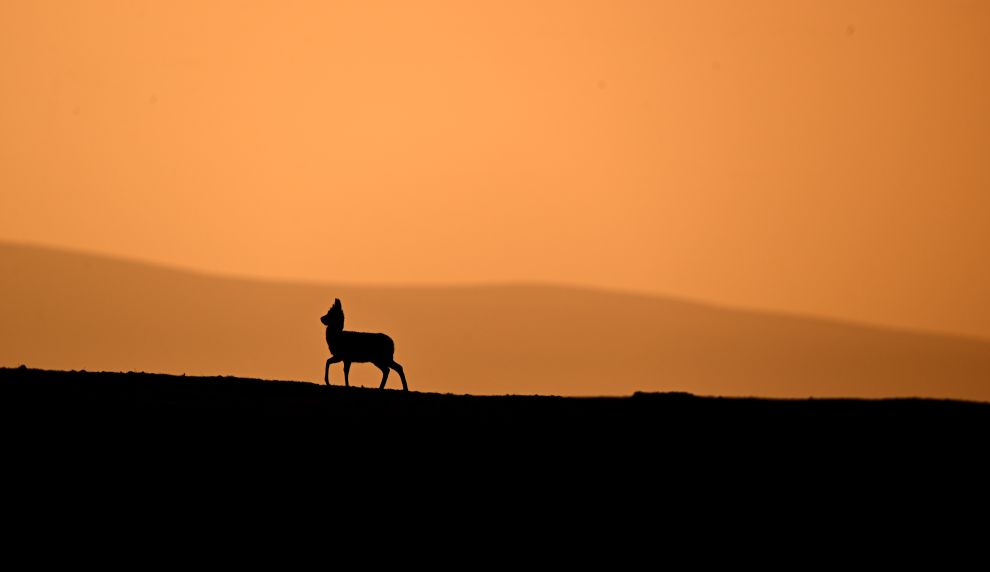
XINING, July 19 (Xinhua) -- On the Qinghai-Xizang Railway, passengers gazing out of the window at dawn can spot male Tibetan antelopes grazing near the tracks, with their straight black horns bobbing against a pale sky. But three decades ago, this peaceful scene was unthinkable.
In the 1990s, Hoh Xil was a poaching hotspot. This remote wilderness averages nearly 4,900 meters in altitude and spans 45,000 square kilometers on the Qinghai-Xizang Plateau. The driving force behind the killing was the "shahtoosh" shawl, a luxury accessory that could pass through a wedding ring and sold for up to 50,000 U.S. dollars in European and American markets. Each shawl required the fleece of three to five adult Tibetan antelopes.
Within years, poachers had reduced the antelope population from more than 200,000 to fewer than 20,000. Without intervention, Hoh Xil's entire ecosystem faced collapse.
In 1992, Sonam Dargye, a county Party official in Qinghai Province in northwest China, stepped forward. He formed China's first armed anti-poaching task force and made 12 expeditions into Hoh Xil, capturing eight armed poaching gangs. Tragically, Sonam Dargye lost his life in 1994 at the hands of poachers.
His brother-in-law, Tashi Dargye, took over and led the task force, cracking 62 cases and arresting 240 offenders in three years. But tragically, in 1998, he was also shot and killed while protecting the Tibetan antelopes.
Their sacrifices galvanized public awareness. In 1995, Hoh Xil was designated a provincial nature reserve, and two years later it was elevated to the national level. It was incorporated into the piloted Sanjiangyuan National Park in 2016. A year later, it was inscribed as a UNESCO World Natural Heritage site.
Today, six protection stations, consisting of five permanent facilities along National Highway 109 and one temporary station near Zonag Lake, are staffed by about 50 rangers. They rotate between station duty and backcountry patrols, conducting small-scale line inspections every three days and at least one major expedition each month. The antelope population has rebounded from under 20,000 to more than 70,000, and its conservation status has been downgraded from "endangered" to "near threatened." No gunshots have been heard in Hoh Xil since 2009.
Chupel Tashi, Sonam Dargye's nephew and Tashi Dargye's son, walked into Hoh Xil as a ranger. Born in the 1980s, he belongs to the generation that inherited the mission in its most difficult transitional years. In the early days, he learned three important skills: camping in extreme cold, cooking noodles with snow, and prying open frozen car door locks.
The harsh environment took a heavy toll on his body. At medical checkups, he joked with colleagues: "Don't count how many parts of us are still good, but count how many are still usable." Yet he always added: "I am much luckier than my uncle and my father."
Today, working conditions have improved dramatically. Instead of flimsy tents, the protection stations now have kitchens, dormitories, stable electricity and internet signals, meaning rangers no longer go months without contact with their families as they are now able to make video calls. During the summer calving season, surveillance cameras at Zonag Lake help monitor antelopes remotely.
Despite these advances, Chupel Tashi remains relentless. Now the head of law enforcement for the Hoh Xil management bureau, he still leads young rangers on patrols more than 200 days a year.
One of the next generation rangers is Tsesok Kyab, currently chief of the Sonam Dargye Protection Station. Born in 1996, he is a native of the region. His skin is tanned deep brown by the plateau sun, while his body is stout and nimble despite an altitude of 4,600 meters. He rarely saw antelopes in his childhood. "They were so timid," he recalled. "If they spotted a human from miles away, they would bolt."
Inspired by Sonam Dargye's story, he joined the ranger corps at 19.
The job almost broke him at first. "We do at least one major patrol every month. In winter, when it hits minus 40 degrees Celsius, every breath hurts. Tears freeze instantly. We're often too exhausted to cook. We just chew cold bread or instant noodles. I once regretted it. I thought, even if I worked in a city, at least I'd have hot water when I got home."
But his love for wildlife won in the end. One patrol at Zonag Lake changed everything. Riding his motorcycle, he heard a thunderous rumble. Climbing a slope, he saw a sight that moved him deeply: "The entire grassland had turned tan with antelopes everywhere, their calls and footsteps merging into one great roar. That was when I truly understood why Hoh Xil is called the 'Kingdom of Animals.' My predecessors handed me this baton with their lives. If I ran away, who would take it?"
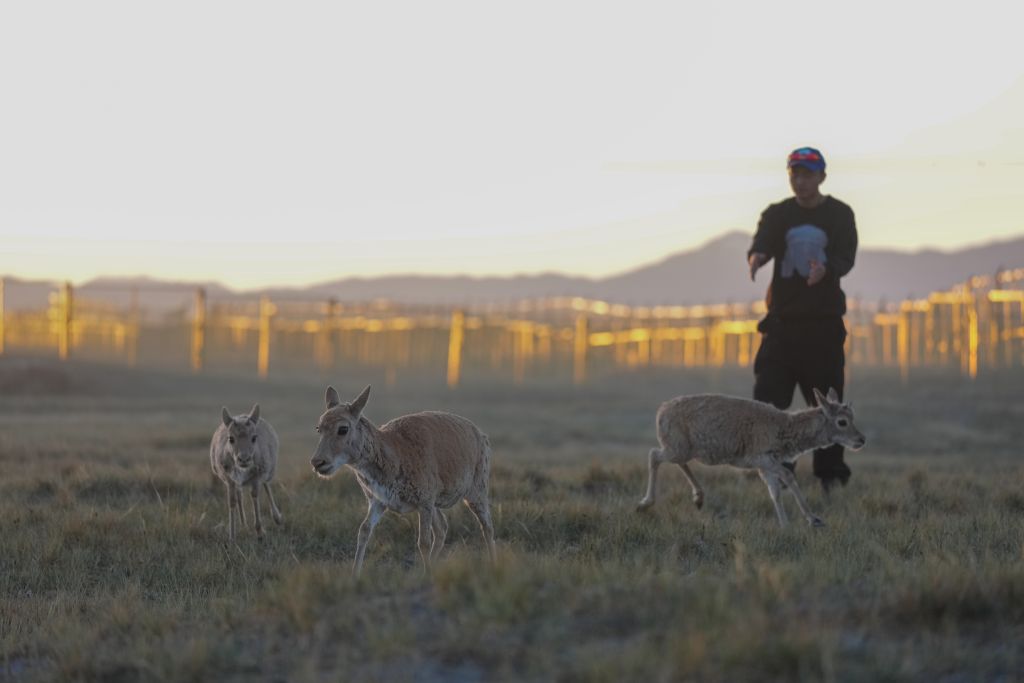
The mission for this generation has shifted from anti-poaching to wildlife rescue and ecological protection. The Sonam Dargye station's wildlife rescue center has saved more than 800 animals since 2000, mostly antelope. Rangers have developed a scientific rewilding program, raising orphaned calves in staged enclosures that gradually prepare them for life back in the wild.
"Every calving season, when we see so many antelopes nursing, grazing peacefully, and leading their young back to their home ranges, it brings us real joy," Tsesok Kyab said. "You can see so many species living together harmoniously right by the roadside."
But new challenges have emerged. As public awareness of wildlife grows, more tourists drive along National Highway 109 hoping to spot antelopes, wolves and other animals. Many offer sausages and snack cakes to the wildlife out of kindness. That has become a new duty for rangers: persuading visitors not to feed the animals.
On the road back from the Sonam Dargye station, a wolf, once too frail to hunt, waited by the roadside for easy handouts. It stood there, gentle and docile, its eyes empty of any predator's edge. Today, the pack numbers about ten.
"Wild animals are the original inhabitants of this land," Tsesok Kyab said. "Every species is a link in the food chain. If wolves lose their wildness because they're fed by humans, one broken link can unravel the entire ecosystem, and that would be an irreversible disaster for this land. We must keep the food chain whole and leave a clean, intact Hoh Xil for our children." ■