
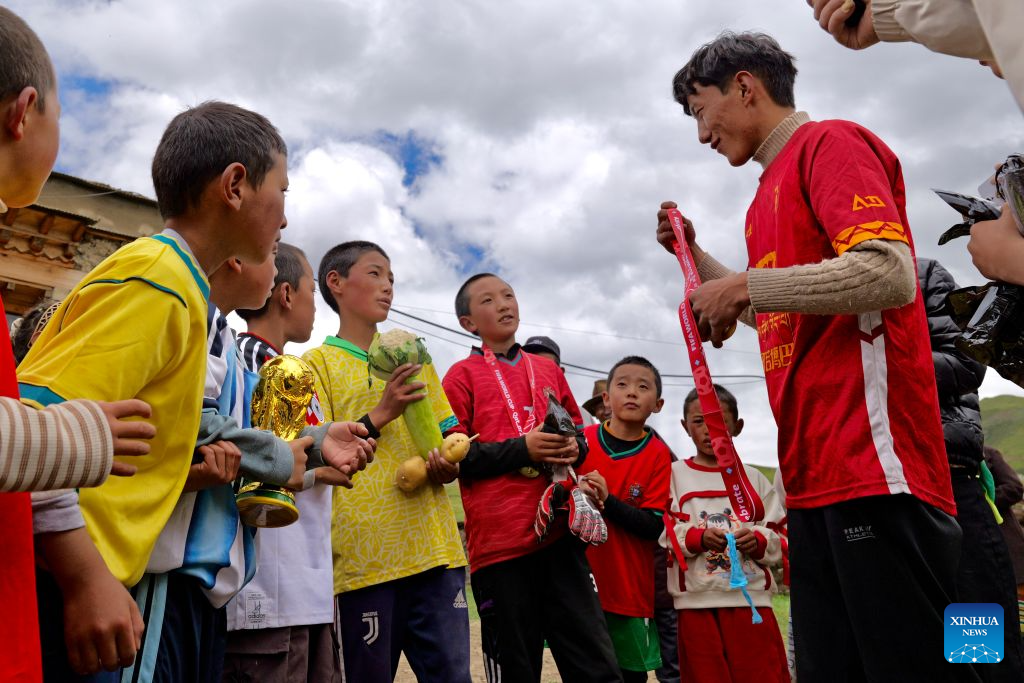
Sonam Jigme (1st R) presents the champion team members with a model of the World Cup trophy, a homemade vegetable cup and medals after a match in Zangbi Township of Lhari County, Nagqu, southwest China's Xizang Autonomous Region, July 18, 2026.(Xinhua/Zhou Yulong)
by Xinhua writer Zhou Yulong
LHASA, July 18 (Xinhua) -- While football fans around the world are focused on the FIFA World Cup and its stars, spectacle and golden trophy, I stood next to a cattle pen at 4,700 meters above sea level, watching children chase a different kind of football glory. The winners' prize is not the World Cup trophy, but bananas, apples or perhaps laundry detergent. Half a world away from the showpiece in North America, the joy that football brings is exactly the same in this spot in Xizang Autonomous Region in southwest China.
Since last year, when I moved to Xizang to work as a news reporter, I have been constantly moved by the sheer passion for football among the children here. On work trips, as our vehicle winds through towns and villages in this mountainous region, I often spot football pitches of all sizes, where young figures run wild and free, chasing a ball.
At the foot of Mount Qomolangma, the world's highest peak, I interviewed children in Dingri County playing on a newly built pitch a year after a devastating earthquake. "Playing football again made life feel normal," they told me. In Lhorong County, Qamdo, meanwhile, I watched a village "Super League" tournament that drew migrant workers home from across China -- simply to kick a ball.
This time, I traveled to Zangbi Township in Lhari County, where a patch of cleared earth next to a cattle pen became a pitch, with earthen walls for lines and wooden sticks for goalposts. There were no stands or proper goals.
The man who oversees matches here is Sonam Jigme, a 22-year-old herder who also serves as the children's coach, referee and match organizer on weekends, when the kids return to the pasture from school.
The prizes are bananas, watermelons, cabbages, laundry detergent or whatever else Sonam Jigme has managed to procure.
The matches have names, as well. If the prize for the winners is a bunch of bananas, the match becomes the Banana Cup. If it is a watermelon, it is the Watermelon Cup. The podium is made of cardboard boxes, and a traditional herding sling serves as the winner's sash.
When the whistle blew, the children all sprinted forward. One kept running even though his shoelace had come loose. Another fell, brushed off the dust and got back up. The passes were not always accurate, and the shots often went wide, but no one stopped trying.
After scoring, one player spread his arms and ran across the field, copying Cristiano Ronaldo's signature celebration. On the sidelines, younger children shouted and cheered. The wind carried their voices away, and another cheer soon followed.
Even after a year in Xizang, the altitude here still hits me harder than expected. My head was pounding, my chest felt tight, and I was out of breath after walking just a few steps. But as I got drawn into the match, watching the children fall, get back up and shout with joy after each goal, the discomfort seemed to fade for a while.
Among these players was 9-year-old Drolkar Lhamo, who started playing at the age of 7 alongside two of her elder brothers. She plays as a defender and admires Cristiano Ronaldo and Neymar for their flair.
"I dream of becoming a professional, playing in the regional capital Lhasa and other places," said the Tibetan girl, a Cabbage Cup winner.
Her school, some 20 km away, has a small pitch. But it is this simple patch by the cattle pen that gives her and the other children a place to play on weekends.
In July 2025, Sonam Jigme began preparing the patch for the children little by little: clearing stones, setting up wooden posts and marking boundaries.
For children from pastoral areas, the pitch moves with them. They play on the summer pasture in summer and the winter pasture for the rest of the year, so most training and matches happen there.
Sonam Jigme tries to make every match feel like a proper game.
Before kickoff, Sonam Jigme walks the children through a match routine, requiring them to line up by team, shake hands, take their positions and start. He films their pre-match introductions on his phone, asking each player to say their name and team.
Every weekend, Sonam Jigme runs training sessions for more than 20 children. He shows them videos of world-class matches and tells them much about famous players, ranging from their names and hometowns to their stories. That is how the children on the pasture learned about stars like Lionel Messi and Lamine Yamal.
Sonam Jigme fell in love with football in primary school, when his school had no pitch and he had no boots. A pitch came later in high school, but proper coaching did not. During his first year of senior high, he briefly trained at a sports school in Xizang.
"As children, most of us probably had wild dreams -- becoming astronauts or sports stars playing in front of thousands," Sonam Jigme told me. "What I'm doing may not change their lives overnight, but it makes them realize that the things they love deserve to be taken seriously."
This year, videos of the children playing football that Sonam Jigme posted have begun circulating online. People who saw them sent new balls and jerseys. A hairstylist even came and gave each child the stylish haircut they wanted, making them look more like their idols.
Sonam Jigme hopes more people will notice these children via his videos. "If any of them are found to have talent, they may receive better training one day and step onto a bigger pitch," he said.
In recent years, football has become a bigger part of children's lives across Xizang. Standard pitches, school courses and youth training programs are developing. In 2025, 13 schools in Xizang were named national-level schools with special football programs. By the end of last year, the region, with a population of more than 3 million, had 1,136 football pitches, including 180 11-a-side ones, according to the regional sports bureau.
Soon, at the New York New Jersey Stadium, the winners will lift the World Cup trophy. Meanwhile, in Zangbi Township, week after week, children on the plateau also step onto their own podium and receive bananas, watermelons and grapes as their prizes. To me, this is what makes football so moving: it can belong to world champions, and it can also belong to children running their hearts out near a cattle pen. ■
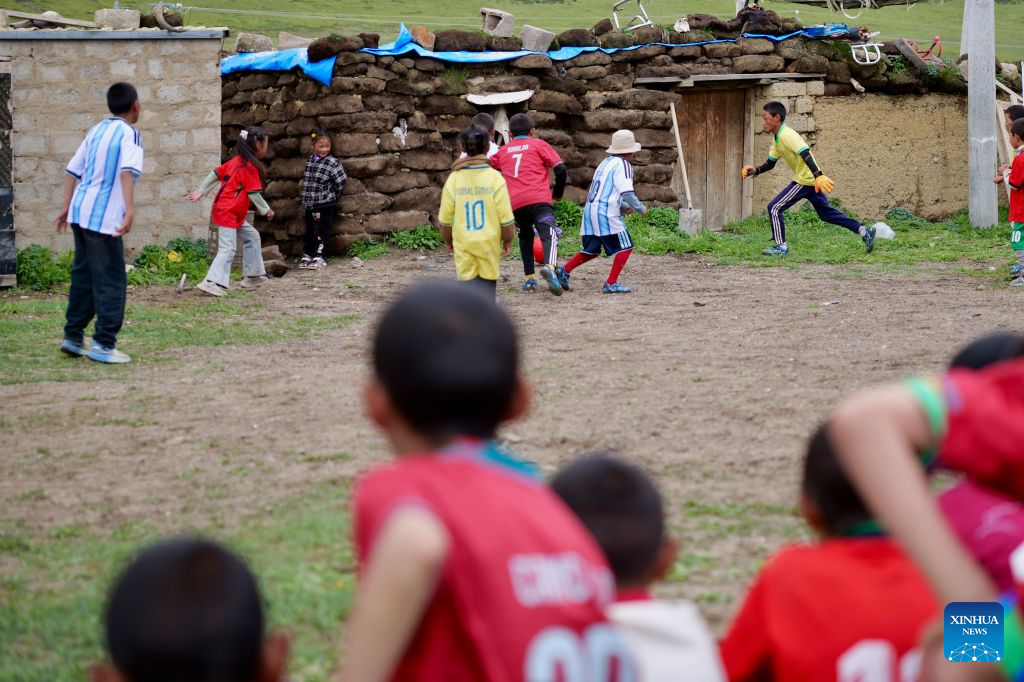
Players compete in a match in Zangbi Township of Lhari County, Nagqu, southwest China's Xizang Autonomous Region, July 18, 2026.(Xinhua/Zhou Yulong)
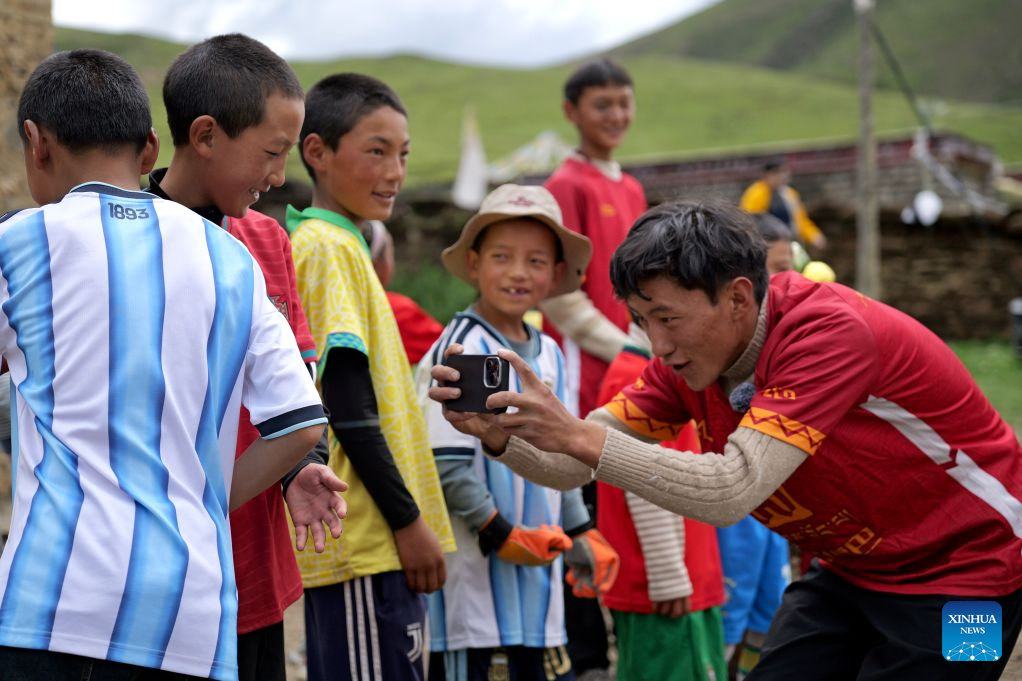
Sonam Jigme (1st R) takes videos for players in Zangbi Township of Lhari County, Nagqu, southwest China's Xizang Autonomous Region, July 18, 2026.(Xinhua/Zhou Yulong)
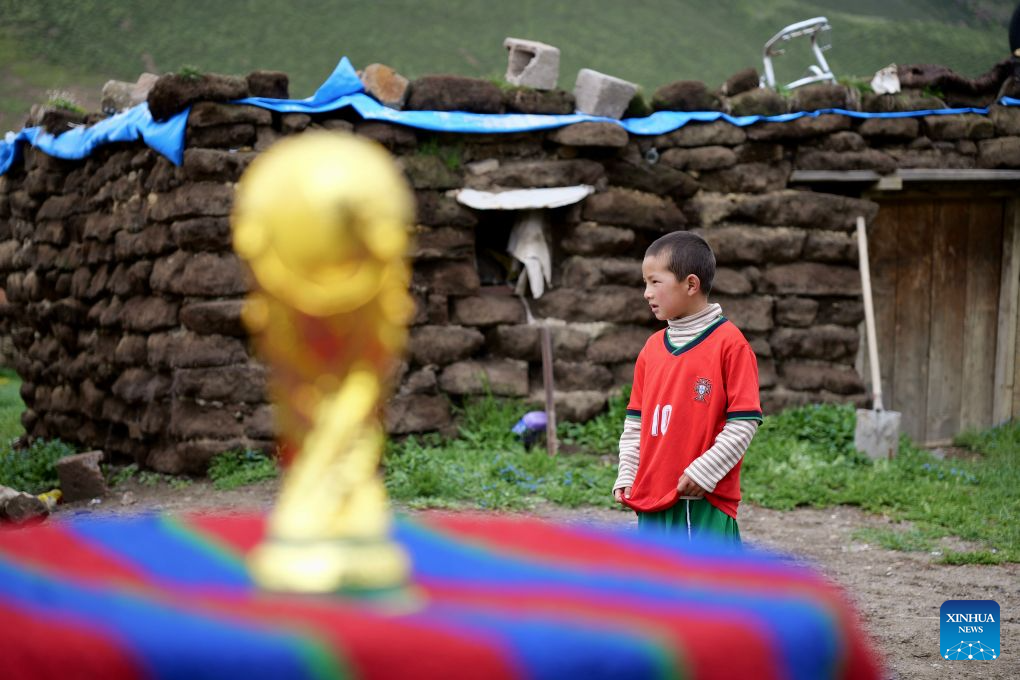
A player is pictured before a match with a model of the World Cup trophy prepared by Sonam Jigme placing in front in Zangbi Township of Lhari County, Nagqu, southwest China's Xizang Autonomous Region, July 18, 2026.(Xinhua/Zhou Yulong)


