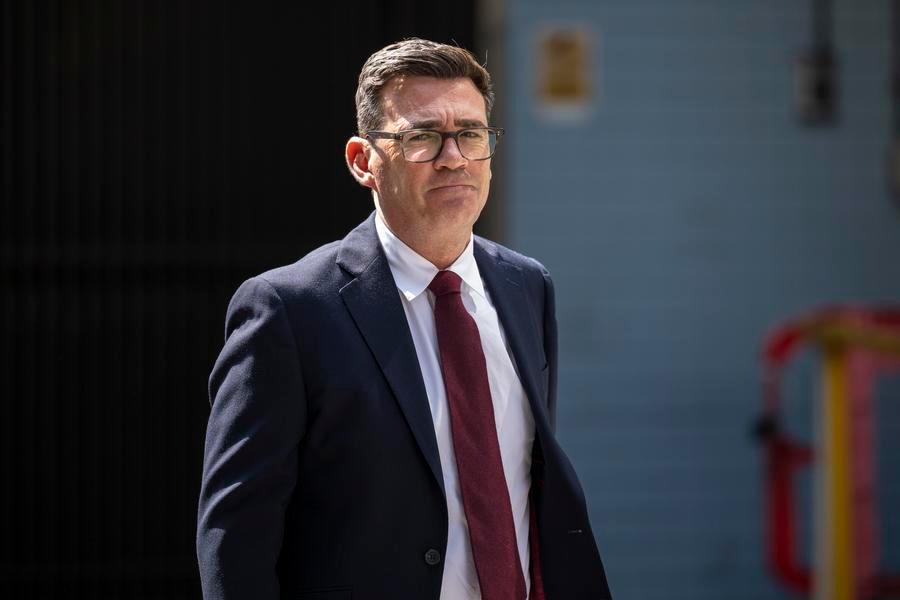
LONDON, July 17 (Xinhua) -- Andy Burnham was confirmed as leader of Britain's ruling Labour Party on Friday, stepping into the center of national power as Labour struggles to recover from internal divisions and weakened public confidence.
Outgoing Prime Minister Keir Starmer is expected to formally leave office on July 20, when Burnham will be asked by King Charles III to form a government, British media reported.
Burnham arrives at the head of his party with overwhelming support among Labour lawmakers and a political identity built far from Westminster. Having served as mayor of Greater Manchester for nearly a decade, he promises to apply his experience across Britain, which means stronger local government, closer coordination between public investment and private capital, and greater public control over essential services.
AN UNCONTESTED ASCENT
Burnham secured nominations from 379 Labour MPs, around 94 percent of the parliamentary party. These were endorsements from lawmakers rather than votes cast in a wider party election.
Under Labour's rules, a candidate needs the backing of at least 20 percent of its MPs, equivalent to 81 nominations, to enter the next stage. Since Burnham had collected enough support to deny a rival reaching the threshold, the planned ballot of party members became unnecessary.
Labour avoided a prolonged campaign at a moment when the government was seeking to recover from Starmer's resignation and months of internal division. Peter Kyle, a senior Labour politician, had earlier warned against turning the succession into a "coronation" in an interview with the BBC, arguing that a contested election would have allowed Labour to debate its response to Reform UK, a far-right political party, and the reasons many voters had lost confidence in the government.
Without televised debates with an opponent, questions remain over the program he will take into government, especially on taxation, welfare, immigration and foreign policy.
Burnham has spent much of his recent career outside Westminster. Experts believed that distance helped him build an image as a regional leader willing to challenge the political center while also allowing some of his national positions to remain loosely defined.
MANCHESTERISM GOES NATIONAL
Burnham set out his broad governing philosophy in a speech at Manchester's People's History Museum on June 29.
He promised to establish a "No. 10 North" in Manchester, describing it as the "nerve centre of a rewired Britain." The office would coordinate a wider transfer of power from Whitehall to cities and regions, with local leaders receiving greater influence over transport, housing, skills, energy and investment.
The proposal reflects what Burnham and his supporters call "Manchesterism," which covers a system of long-term regional planning, public-private cooperation and intervention in services that affect everyday living costs.
Outside the museum, local resident Emma told Xinhua that she believed Burnham "genuinely cared about ordinary people."
Greater Manchester's Bee Network is its most visible example. The city region brought buses under a publicly controlled franchising system, coordinating fares, routes and timetables while private companies continued to operate services.
Ian Scott, a professor at the University of Manchester, told Xinhua that the transport overhaul was Burnham's clearest policy achievement, showing what government direction could accomplish after years of fragmented services.
Scott said Burnham's politics combines traditional Labour support for public ownership with the public-private partnerships associated with the governments of Tony Blair, which helps explain his appeal across different wings of the party. The Labour left see a social democrat prepared to intervene, while centrists regard him as a pragmatic politician comfortable working with businesses.
Applying the model nationally would be difficult because local government structures vary across England, Scott said. He added that "No. 10 North" could prompt questions about why Manchester, rather than Birmingham, Leeds or Newcastle, should become the center of Burnham's devolution program.
THE FISCAL TEST
Burnham's immediate economic challenge will be to fund his national ambitions without weakening confidence in Britain's public finances. The Institute for Fiscal Studies, based in London, has warned that debt, borrowing and debt-interest costs remain high, while public services continue to face severe pressure.
David Bailey, a professor at the University of Birmingham, told Xinhua that Burnham would inherit some useful foundations from Chancellor of the Exchequer Rachel Reeves. He highlighted planning reform, which sought to tackle Britain's chronic difficulty in building homes, factories, electricity networks and infrastructure.
However, Burnham will face similar fiscal constraints as he seeks to fund housing, transport, social care and further devolution. Labour's earlier tax pledges had already narrowed the Treasury's room for manoeuvre, Bailey added.
Burnham's choice of chancellor will offer an early indication of his approach. The Financial Times reported Wednesday that Home Secretary Shabana Mahmood is expected to replace Reeves, citing people briefed on Burnham's plans, although his spokesperson has declined to confirm cabinet appointments before Monday.
The newspaper said the Chancellor of the Exchequer's first major task would probably be preparing the autumn budget while maintaining fiscal credibility and finding money for Burnham's regional program.
Scott said Burnham would need to overcome resistance in Whitehall and set out a credible regional investment plan. "Show the numbers, tell Parliament and people what you're going to do," he said. ■