
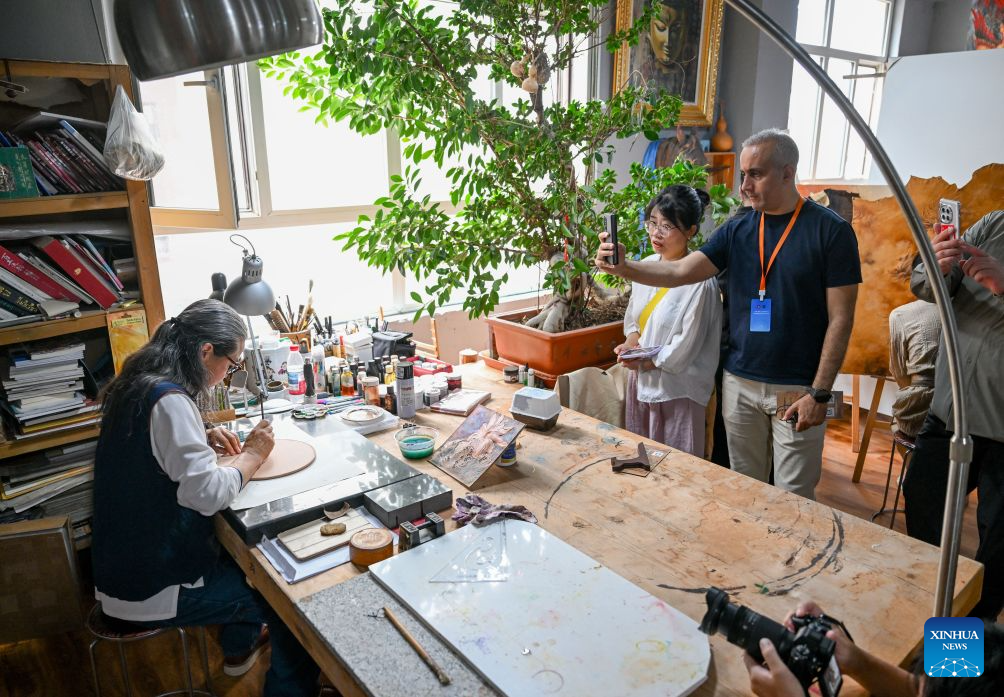
Journalists visit an art workshop in Tongliao City, north China's Inner Mongolia Autonomous Region, July 14, 2026. (Xinhua/Lian Zhen)
HOHHOT, July 16 (Xinhua) -- Journalists from the United States, Morocco, the Republic of Korea (ROK), Japan, Vietnam, as well as Chinese central media outlets, visited local ecological conservation frontlines, new energy equipment production workshops, and intangible cultural heritage inheritance sites in Tongliao, north China's Inner Mongolia Autonomous Region, from July 13 to 16.
Tongliao is home to 41.04 million mu (about 2.74 million hectares) of sandy land, accounting for 52.9 percent of the total area of the Horqin sandy land. For decades, generations of local residents have carried out continuous desertification control efforts, and the once degraded sandy land is now restoring its original grass landscape.
In Tongliao's Naiman Banner, the 1,000-square-kilometer Baogutu Desert has been preserved as a tourist resort, where the unique landscape of white sand interwoven with green oases amazed the visiting journalists.
"We have brought the sandy land in need of treatment under control, while retaining this stretch of desert as a unique attraction. Many tourists come here specially for the sand scenery," said Li Pengfei, head of the resort.
Lee Hye-mi, a Beijing-based reporter with Hankook Ilbo (Korea Daily), was deeply touched by the dusk view of the desert, where sand dunes blend with a rosy sunset glow as camels walk slowly across the landscape.
"This is the first time I have seen a real desert. The scenery is so magnificent, I hope I can bring my mother here to experience it in the future," she said.
As part of the ecological security barrier in north China, Tongliao has continuously advanced desertification control, grassland protection and wetland restoration. The city's grassland vegetation coverage has now stabilized at over 64 percent.
Omar Er-Rouch, editor-in-chief of the Moroccan News Agency, said the local ecological restoration and desertification control achievements are remarkable.
The once barren desert hinterland is now covered with vegetation, and local residents live stable and happy lives. Such changes are very impressive, he noted.
Leveraging its abundant wind and solar resources, Tongliao has been adhering to an ecology-first, green development path.
At Tongliao's new energy equipment manufacturing base, the reporters showed great interest in local wind energy development and equipment application scenarios.
According to the base's head, the area within 500 kilometers around Tongliao has nearly 300 million kilowatts of undeveloped wind and solar resources. The city is, notably, building an integrated industrial cluster covering wind and solar power development, equipment manufacturing, and energy storage supporting facilities to help achieve China's carbon neutrality goal.
As the core area of west Liao River culture, Tongliao boasts a cultural heritage of integrated farming and pastoral lifestyles, as well as coexistence of multiple ethnic groups, which has fostered folk arts combining traditional features and modern charm.
At the printmaking creation and training base in Naiman Banner, the three-dimensional woodcut works created by local artists attracted the reporters to stop and watch.
Wang Zhicheng, curator of the Naiman Banner Art Museum, said that local printmaking has a history of decades, and the base has been organizing training sessions, serving as an important platform for mass cultural creation.
During the experience session, La Thi Huyen Trang, a Vietnamese reporter, picked up a carving knife and printing plate to make her own print work.
"All walks of life here are thriving, and local people have genuinely benefited from development. I am deeply impressed by all this!" said Omar Er-Rouch, adding that he is keen to share the joy brought by such development with more people. ■
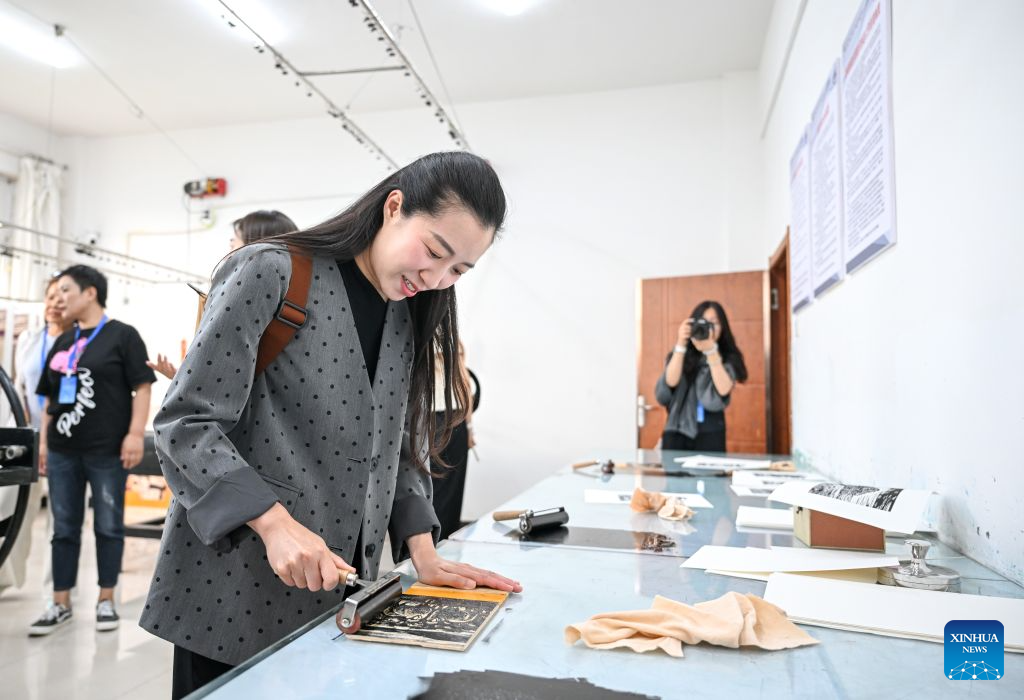
A journalist experiences woodblock painting at a printmaking creation and training base in Naiman Banner of Tongliao City, north China's Inner Mongolia Autonomous Region, July 14, 2026. (Xinhua/Lian Zhen)


