
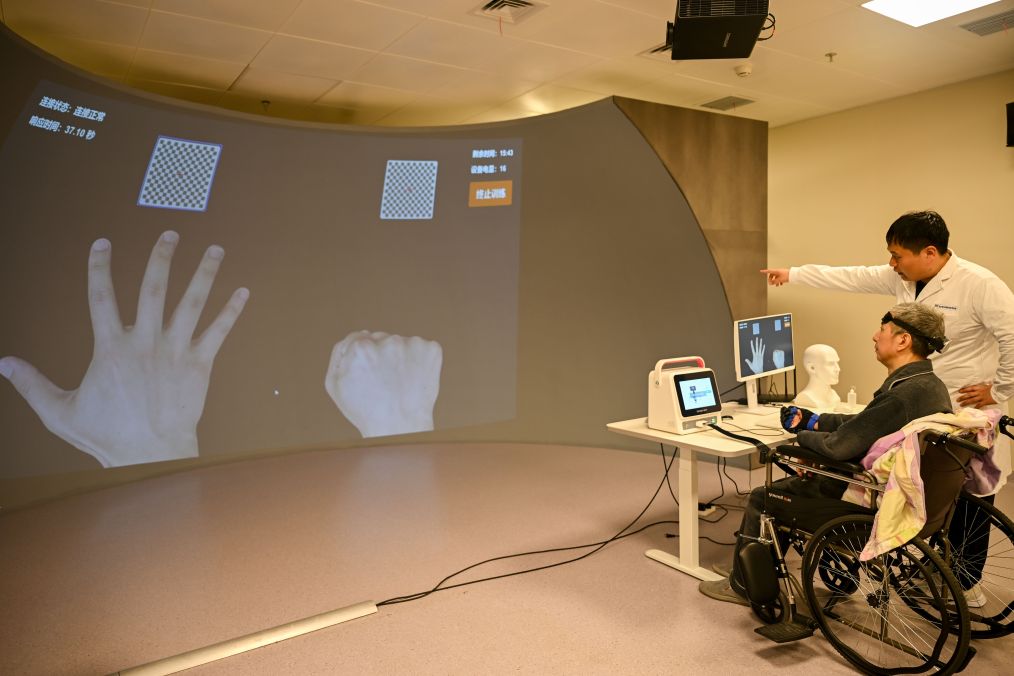
BEIJING, July 16 (Xinhua) -- China's brain-computer interface (BCI) sector is accelerating its transition from the laboratory to industrialization, making steady progress via the market launch of diverse related products and thanks to surging investment in the sector.
According to industry insiders, expanding clinical resources and improving reimbursement systems are expected to serve as breakthroughs enabling BCI to effectively enter real-world scenarios, thereby representing a critical leap for this high-tech sector.
China's BCI market is projected to be valued at 6.14 billion yuan (around 904.3 million U.S. dollars) by 2028, with a compound annual growth rate of 17.7 percent from 2024 to 2028, according to CCID consulting under China's Ministry of Industry and Information Technology.
In the first half of 2026, the BCI sector showed accelerating momentum across all segments -- from product registration and clinical trials to production capacity building.
Multiple companies are expected to complete patient enrollment for the clinical trial of invasive and semi-invasive BCI products within the year, alongside a rapidly expanding market for BCI application.
China's National Medical Products Administration (NMPA) has approved the innovative product registration application for an implantable BCI hand motor function compensation system developed by Neuracle Technology (Shanghai) Co., Ltd, marking the market launch of this BCI medical device. It is also the world's first invasive BCI medical device to enter the clinical application stage.
The product consists of a brain-computer interface implant, an implantable EEG electrode kit, an EEG signal transceiver, a pneumatic glove device, a disposable surgical tool kit, EEG decoding software, medical testing software and clinical management software. It is designed for patients with tetraplegia caused by cervical spinal cord injury, assisting them in compensating for hand grasping function via a pneumatic glove device.
The BCI sector was designated a future industry in this year's government work report. It was also included in the outline of the 15th Five-Year Plan (2026-2030) as the country aims to cultivate it into a new engine of growth.
More specifically, a guideline issued by seven authorities last August laid out short-term targets for the innovative development of this sector, including achieving key breakthroughs in BCI technologies with an advanced technology system, industrial system and standards system by 2027, and significantly enhancing the innovation capacity of the industry with its overall strength ranking among the world's leaders by 2030.
The NMPA has underlined the importance of the BCI sector by adding resources for product review and approval to accelerate the market launch of related products, among other efforts. These moves have effectively sped up BCI product commercialization and enhanced the international competitiveness of China's high-end medical devices, according to the administration.
Also developing its own invasive BCI system, Beijing-based medical technology company BCIFlex unveiled a 1,000-channel BCI system in March, featuring a key innovation: stretchable, flexible electrodes that address the problem of electrode threads being pulled out due to relative movement between brain tissue and the skull.
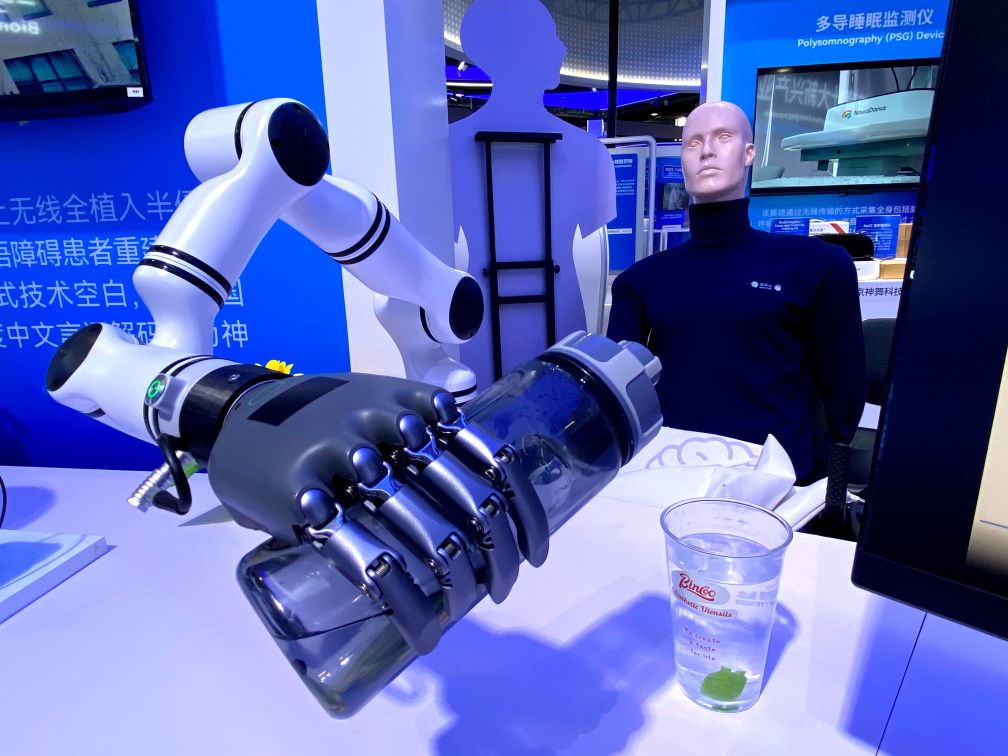
Meanwhile, development of semi-invasive brain-computer interface devices is also accelerating to catch up with the tide. The clinical trial of the semi-invasive Beinao-1 system was launched in March, and patient enrollment is underway.
Jointly developed by the Chinese Institute for Brain Research in Beijing and NeuCyber NeuroTech (Beijing), Co., Ltd, the Beinao-1 system features an implantable unit surgically placed inside the patient's head, with electrodes positioned on the outer surface of the dura mater without penetrating or damaging brain tissue.
In fact, multiple other companies are now also advancing plant construction, clinical trials and regulatory filings of related products, jointly boosting progress in the BCI sector toward mass production and industrialization in the Chinese market.
In June this year, the NMPA issued the guiding principles for classification of BCI medical devices and the guiding principles for generic naming of BCI medical devices, explicitly classifying the management of invasive and implantable BCI products. ■