
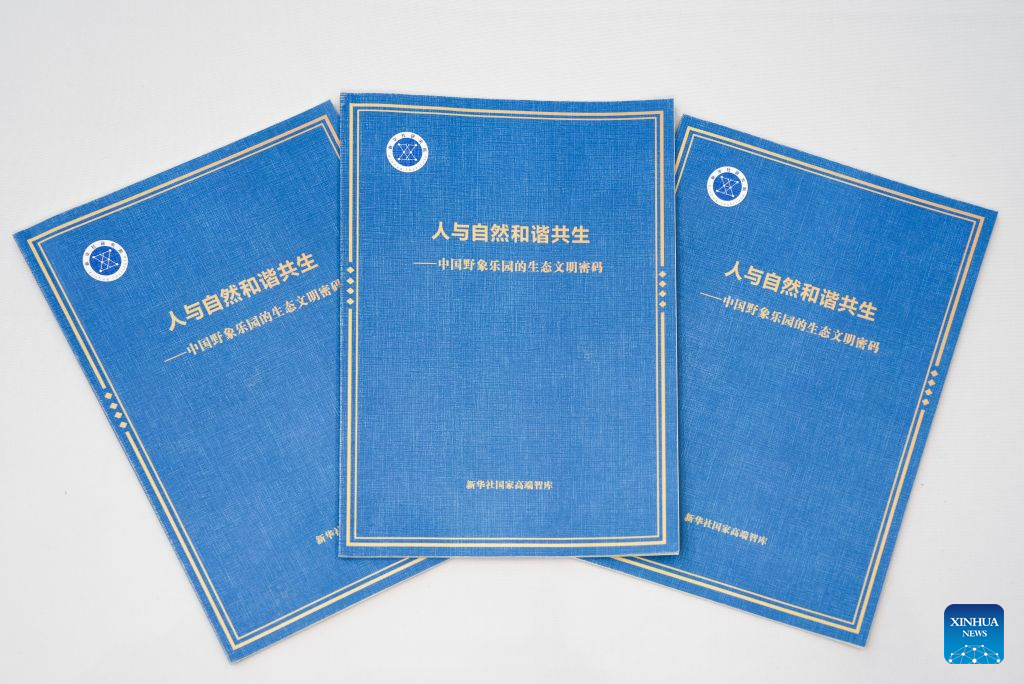
This photo shows copies of the think tank report titled "Living in Harmony with Nature: The Ecological Civilization Behind China's Wild Elephant Sanctuary." The report was released Thursday by the Xinhua Institute, a think tank affiliated with Xinhua News Agency at the 5th Yunnan International Communication Forum in Xishuangbanna Dai Autonomous Prefecture of southwest China's Yunnan Province. The report offers an in-depth analysis of the Chinese practice of wild elephant protection, and summarizes experiences and inspirations for pursuing modernization featuring harmonious coexistence between humanity and nature. (Xinhua/Chen Xinbo)
KUNMING, July 16 (Xinhua) -- At a time when Asian elephant numbers are declining globally, one herd in southwest China has added seven members in just five years.
The herd, known as the "short-nose family," captured worldwide attention in 2021 after roaming more than 1,400 kilometers across Yunnan Province. It returned to its traditional habitat with 14 members. With two calves born this year, the family has since grown to 21.
Its growth is part of a much larger story. China's wild Asian elephant population has risen from about 150 in the 1980s to nearly 400 today, according to a report released Thursday by the Xinhua Institute, a think tank affiliated with Xinhua News Agency.
The increase stands out because Asian elephants reproduce slowly and remain endangered globally. It also raises a question familiar to conservationists around the world: how can a large, wide-ranging, sometimes conflict-causing species recover while sharing the landscape with people?
The report, titled "Living in Harmony with Nature: The Ecological Civilization Behind China's Wild Elephant Sanctuary," presents Yunnan's approach as one of managing coexistence through habitat restoration, monitoring, compensation and community participation.
That approach can be seen in the story of A Bao.
The male elephant became an online sensation in 2018 after wandering alone into the city of Pu'er. After being rescued, A Bao underwent years of rehabilitation and rewilding training before being released into the wild in May 2024, becoming China's first rescued Asian elephant to successfully return to the wild.
"A Bao is adapting better and better to life in the wild. It even seems he may have found a mate," said Bao Mingwei, a senior veterinarian in Xishuangbanna who has continued to monitor the animal since its release.
A Bao's return reflects China's broader efforts to build a comprehensive system for elephant rescue and conservation.
China has established 11 nature reserves covering a total of 5,098 square kilometers across wild Asian elephant habitats. More than 12,000 mu, or 800 hectares, of dedicated feeding grounds have also been established in Yunnan and planted with vegetation favored by elephants. Dubbed "elephant canteens," they improve habitat quality and food availability while helping reduce the likelihood of human-elephant encounters.
Since its establishment in 2009, the Xishuangbanna Asian Elephant Breeding and Rescue Center has rescued and rehabilitated more than 30 wild Asian elephants.
Yet protecting elephants is only half the challenge. The other half is keeping people who share their habitat safe as the animals migrate.
China has developed an early-warning system to monitor elephant movements and reduce risks to both people and elephants. Since 2022, it has issued more than 210,000 alerts and helped prevent over 1,000 potential human-elephant conflicts, according to the report.
Yunnan has also introduced compensation for damage caused by elephants and strengthened emergency-response mechanisms. China and Laos, meanwhile, have established a cross-border conservation mechanism to monitor and protect Asian elephants migrating through their border areas.
The result is a model centered not only on protecting elephants, but also on managing coexistence between wildlife and nearby communities.
Now in Pu'er, visitors can relax amid lush green hills, sipping locally produced coffee while watching herds of wild elephants from a safe distance. In the nearby forest, adult elephants feed calmly while calves play.
Field observers have even recorded elephants lying down together to sleep rather than merely dozing on their feet -- behavior regarded as a sign that the animals feel secure.
The report places elephant conservation within Yunnan's broader effort to protect biodiversity while developing ecological tourism, green energy and locally distinctive agricultural industries.
For places facing habitat loss and rising human-wildlife conflict, Yunnan's experience suggests that species recovery requires more than protected areas. It also depends on connected habitats, scientific monitoring, compensation for elephant-related damage, community participation and cross-border cooperation.
The story of Asian elephant conservation in China is not only about saving an endangered species, but also about demonstrating how humans and nature can thrive together, Chen Fei, director of the Asian elephant research center under the National Forestry and Grassland Administration, was quoted as saying in the report. ■


