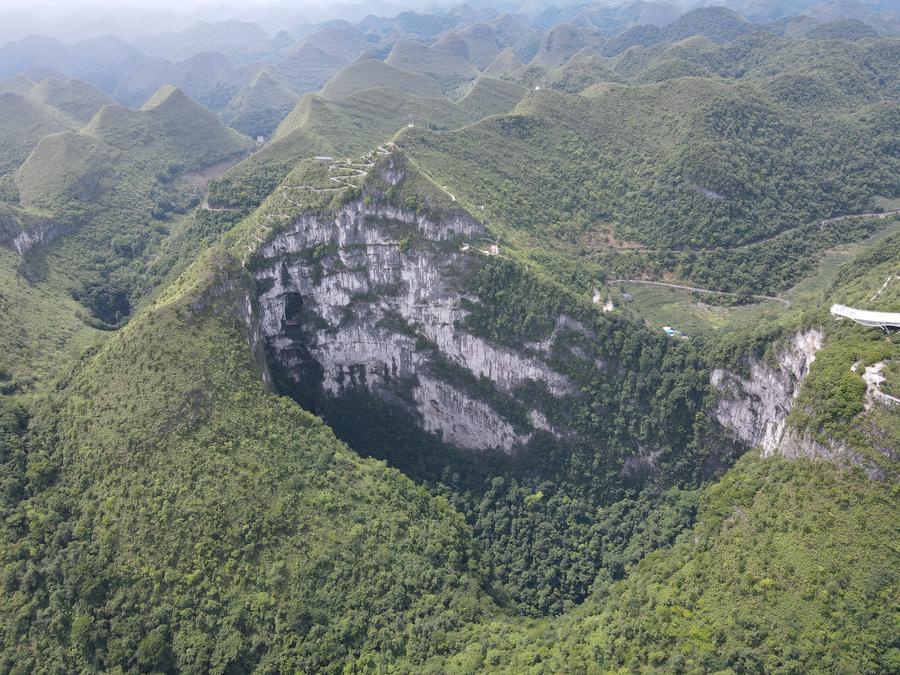
GUANGZHOU, July 16 (Xinhua) -- Are sinkholes safe havens or evolutionary traps? A new study by Chinese researchers suggests they might be both and that the dark side wins.
For years, ecologists have treated karst sinkholes as nature's panic rooms. They are deep, secluded fortresses where endangered plants can hide from heat and drought.
In a study published in Current Biology on Tuesday, researchers from the South China Botanical Garden (SCBG) under the Chinese Academy of Sciences (CAS) and the CAS Guangxi Institute of Botany found that colossal karst sinkholes can help preserve the endangered Magnolia aromatica tree, but also limit gene flow and diminish its long-term evolutionary potential.
Manglietia aromatica is a rare and endangered tree species endemic to karst regions in southwest China. It is mainly distributed across fragmented limestone habitats in south China's Guangxi, and Guizhou and Yunnan, both in the southwest. The tree grows both inside and outside these sinkholes.
The researchers assembled a high-quality reference genome for Magnolia aromatica and re-sequenced 112 individuals from 26 populations across southwest China, including populations from both inside and outside the sinkhole landscape found in karst regions.
The study showed that across the species' entire distribution range, populations near sinkholes generally maintained moderate levels of genomic diversity and mutation load, supporting the theoretical expectation that sinkholes served as refuges for species survival during adverse climatic periods.
However, at a finer spatial scale, populations inside sinkholes exhibited significantly lower genetic diversity and higher harmful mutation loads compared to those outside.
"Sinkholes are not simply safe havens," said Kang Ming, a SCBG researcher and corresponding author of the study.
"They provide a buffered microenvironment that helps endangered plants persist, but their enclosed geography can also isolate populations and gradually wear away the genetic variation needed for future adaptation," Kang added.
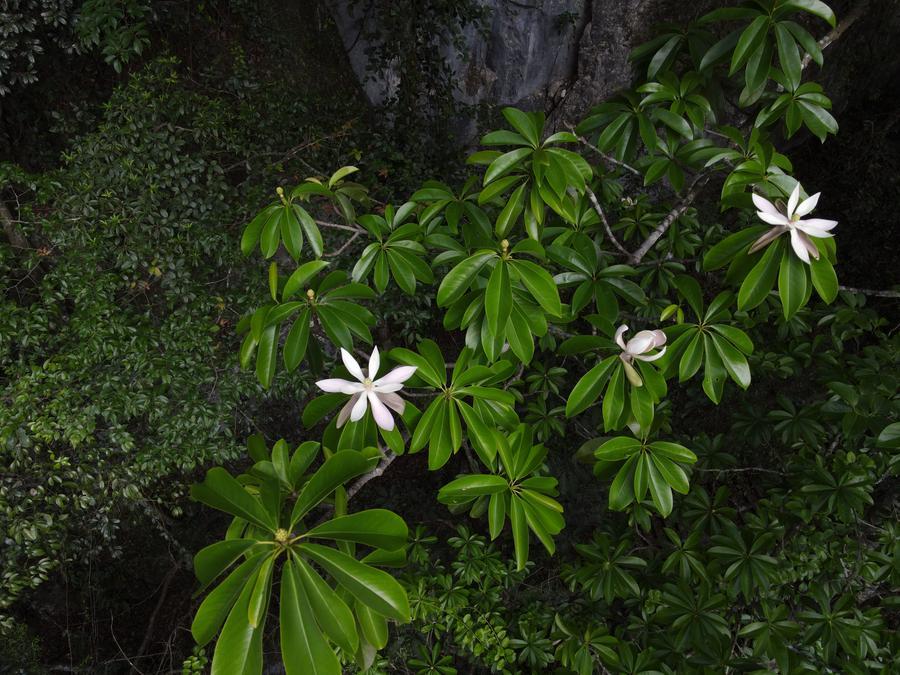
One of the most striking features inside sinkholes is extreme light deficiency. Through genomic scanning and controlled shading experiments, the team found that seedlings from sinkhole-origin sources died rapidly under full or strong light, but survived and grew well when light was reduced by half or more, performing best in near-darkness where less than 10 percent of full sunlight penetrated.
Genomic analysis further revealed that genes under selection in sinkhole-interior populations were enriched for functions related to photosynthesis and carbon fixation, revealing a special adaptive mechanism of the species to the low-light sinkhole environment.
"This helps explain why Magnolia aromatica can thrive in the dim, humid forests at the bottom of sinkholes," said Zhu Xianliang from the SCBG, first author of the study. "The species appears to be strongly dependent on shaded environments, especially during early seedling establishment."
But this adaptation comes at a cost. The team's climate models warn that by 2100, under a high-emission scenario, about one-third of the species' existing habitats will become climatically unsuitable. The worst-hit areas will be the sinkhole edges, precisely where gene flow has already broken down, making them high-risk hotspots for adaptive lag.
Meanwhile, harmful mutation loads in most populations are projected to continue rising.
The study provides a broader lesson for conserving species in isolated microrefugia: places that protect biodiversity today may not be sufficient to safeguard the evolutionary future of species under rapid environmental change, according to the research team.
"Our results suggest that conservation should protect both the shelter and the connections around it," said Kang.
"For endangered karst plants, maintaining gene flow among populations may be just as important as preserving the special habitats where they survive," he noted. ■