* Chinese EV manufacturers are entering the African markets, where countries are seeking to accelerate the transition to green mobility and reduce their cost on fossil fuel imports.
* Beyond passenger cars, African countries are pushing green transport across the board. Delivery companies are turning to electric bikes for fast and affordable services.
* Many Chinese automakers are also building manufacturing and research facilities on the continent, becoming long-term partners in Africa's industrialization and helping strengthen its industrial capacity.
by Xinhua writers Liu Fangqiang and Yan Ran
ADDIS ABABA, July 13 (Xinhua) -- When fuel queues in Addis Ababa stretched beyond a day during this year's Middle East conflict, university professor Balew Demissie decided he had had enough. He traded his gasoline car for a Chinese-made BYD Song Plus electric vehicle.
"Fuel-based cars are becoming increasingly risky, especially during global crises that drive energy prices higher," Demissie said. He now spends about 500 Ethiopian birr (about 3 U.S. dollars) a month on charging -- a fraction of his previous fuel bill.
His decision reflects a broader shift across Africa, where renewed tensions in the Middle East have revived concerns over fuel costs and energy security. Disruptions to shipping through the Strait of Hormuz, which carried around a quarter of global seaborne oil trade, have added urgency to the search for alternatives.
Electric mobility is increasingly seen as one solution. Africa's EV sales increased to about 25,000 units in 2025 from some 4,000 two years earlier, with Chinese automakers driving much of the growth and BYD accounting for 35 percent of regional sales, according to the International Energy Agency.
A CONTINENT RECHARGES
Across Africa, countries are exploring their own paths toward a green mobility transition.
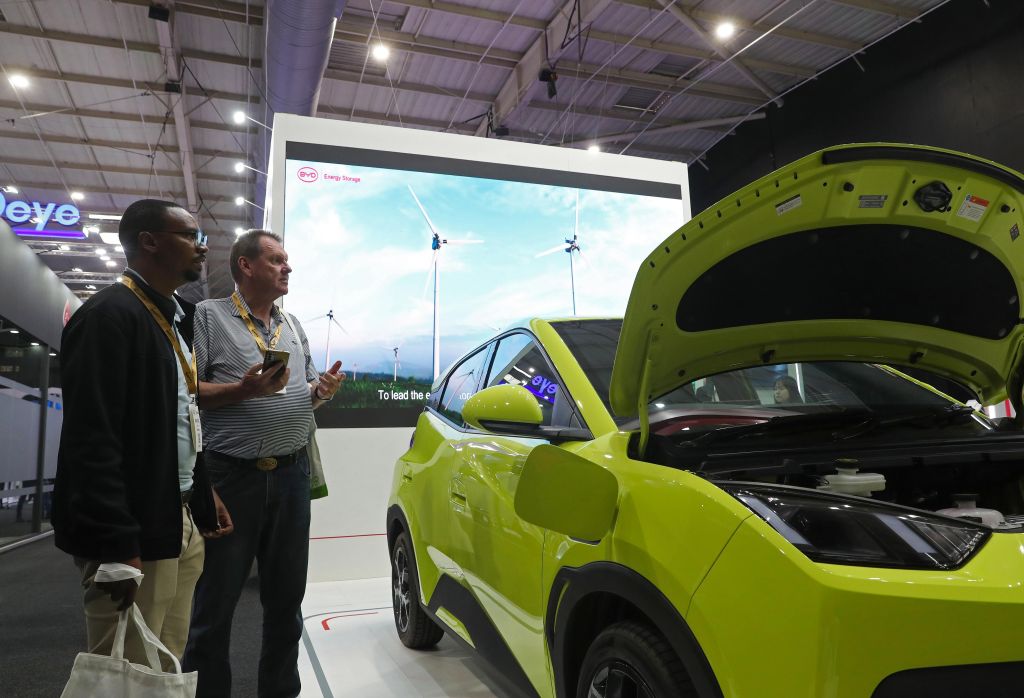
Ethiopia, which relies almost entirely on imported fuel and experienced some of the longest queues during the height of the crisis, began its transition well before the disruption. In 2024, the government banned imports of gasoline- and diesel-powered vehicles to fast-track the shift to electric mobility and reduce hard currency spent on fuel. Since then, Chinese EV brands have entered the East African country of 130 million people.
Among them is Guangzhou Automobile Group (GAC), which debuted four new EV models in the Ethiopian market in March 2026. Zhou Li, GAC's country manager for Ethiopia, said the government's push for green mobility and growing demand for environmentally friendly vehicles prompted the launch.
Alemu Sime, Ethiopia's minister of transport and logistics, commended the company for providing spare parts and after-sales services through trained local technicians.
More than 140,000 EVs -- private cars, minibuses and public buses -- are now on Ethiopian roads, according to the Ministry of Transport and Logistics. Having met its initial import target ahead of schedule, the government aims to put up to 500,000 EVs on the road under its 10-year development plan through 2030.
Kenya has taken an incentive-based approach. After sharp fuel price hikes disrupted public transport nationwide, President William Ruto announced in May that the government is in the process of procuring 3,000 EVs through the Ministry of Interior for use by security and administration officials.
"I am also making a declaration that the first 100,000 electric vehicles to be imported into Kenya, whether for public service or private use, will be duty-free," he said. The market was already gaining momentum: registered EVs in Kenya jumped from fewer than 1,400 in 2022 to more than 39,000 in 2025, according to Kenyan officials.
In South Africa, consumers are driving the transition. Data from the National Association of Automobile Manufacturers of South Africa showed 1,293 EVs were sold between March and May this year, surpassing the previous full-year record of 1,257 units set in 2024.
Challenges remain. Charging networks are sparse outside major cities, and high upfront costs limit affordability. Nevertheless, industry observers said Chinese automakers, with their advantages in battery technology and an expanding range of affordable models, are well-positioned to help lower those barriers over time.
WIDER ELECTRIC WAVE
Beyond passenger cars, Ethiopia, a country abundant in hydropower, is pushing green transport across the board. Delivery companies are turning to electric bikes for fast and affordable services, while electric heavy-duty trucks have been deployed at construction sites for the first time.
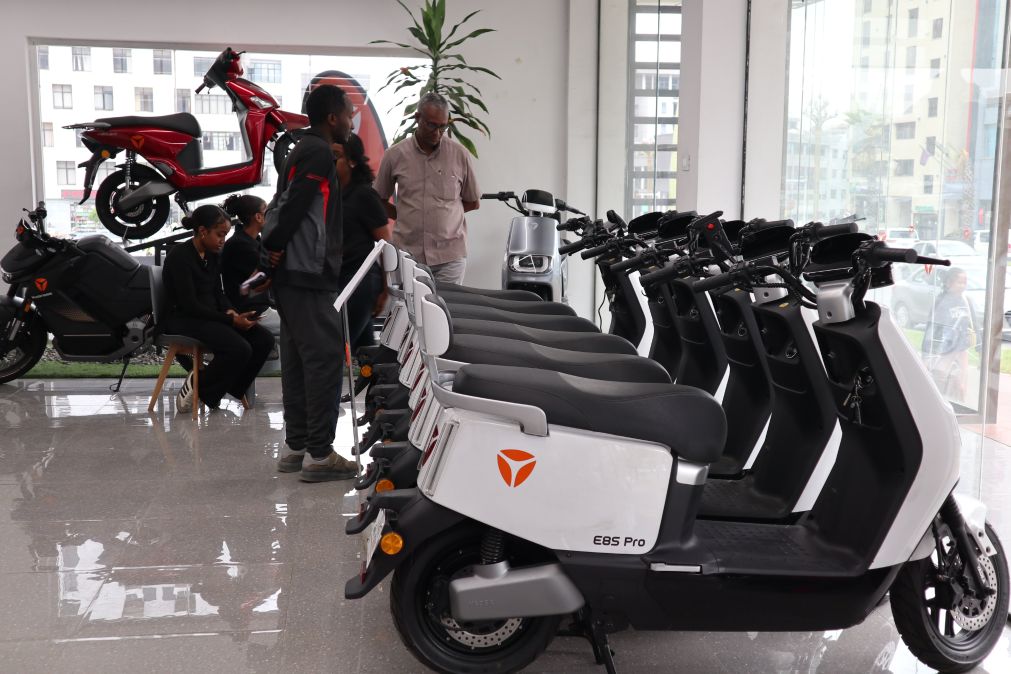
Lodric Trading PLC, one of the fast-growing e-bike businesses in Ethiopia, has been assembling and distributing China-made Yadea-brand e-bikes over the past year. After opening its first Yadea shop in Addis Ababa in March 2025, the company added five more outlets in major cities, including Mekelle and Hawassa, offering models with a range of 60 to 150 km.
"We are glad to see a 30 percent increase in the sales of our e-bikes during the second half-year compared to the first half-year of operation," said Biruk Abiot, chief executive officer of Yadea Ethiopia, adding that public awareness of e-bikes and their advantages over motorbikes continues to grow.
About 50 km southeast of the Yadea shop, electric heavy-duty dump trucks imported from China are operating around the clock at the construction site of the Bishoftu International Airport, which is set to become Africa's largest upon completion. Each truck can travel 220 km on a full charge, supported by 19 charging poles installed at the site, said Yan Shaofa, chief engineer of the airport project from China Communications Construction Company, the first to deploy electric heavy-duty trucks in Ethiopia.
"By comparison, the electric dump truck's work efficiency is 1.45 times that of the diesel dump truck, while the operational cost is only one eighth of that of the diesel dump truck," Yan said.
MADE IN AFRICA
In the first half of 2026, China exported 5.096 million vehicles, up 65.3 percent year-on-year, with new energy vehicles contributing over 46 percent of the total. Rather than simply shipping cars, many Chinese automakers are building manufacturing and research facilities on the continent.
The latest example is Chery, which inaugurated its manufacturing plant in Rosslyn, north of South Africa's administrative capital Pretoria, on July 3. The facility will begin production in mid-2027 following an upgrade, with an initial output of 15,000 vehicles planned for the second half of that year. Its production line will be able to accommodate gasoline, hybrid and pure electric models.
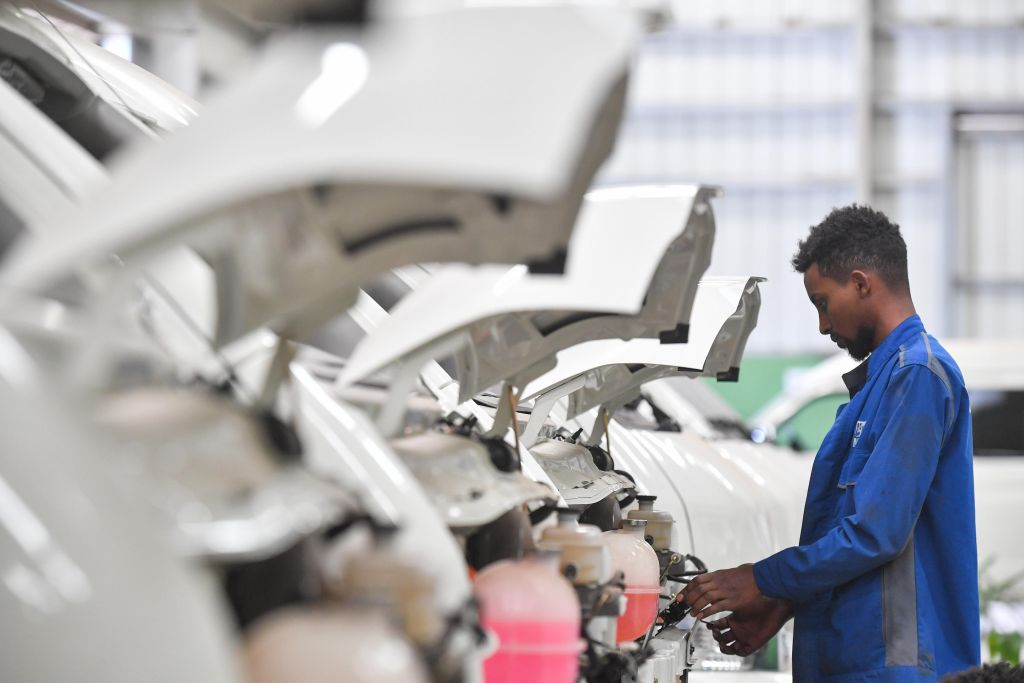
The Rosslyn plant was a historic factory that embodies the legacy of South Africa's automotive industry. Chery has pledged to retain all 692 existing employees at the plant and expects the investment to create nearly 3,000 jobs across the supply chain. Once production starts, the products will not only supply the local market in South Africa, but also be exported to countries in East and West Africa.
"We have moved from being an importer to a manufacturer, and from a market participant to a long-term partner in South Africa's industrial story," Chery Chairperson Yin Tongyue said at the ceremony.
South African Deputy President Paul Mashatile said "Chery's investment will pave the way for technology transfer, automation, digitalization and advanced manufacturing systems," noting that these developments will strengthen South Africa's industrial capacity.
Some 4,000 km to the northeast, Ethiopia is pursuing a similar ambition, positioning itself as a hub for automotive manufacturing and assembly in Africa, supported by its abundant energy resources, young and trainable workforce, and strategic access to the African Continental Free Trade Area. GAC said it plans to partner with local firms to sell EVs, build charging infrastructure and launch local assembly operations in the country.
Back in Addis Ababa, Demissie no longer checks daily fuel prices or waits in queues. "My decision to switch to electric mobility was the right one, and I believe the future of transportation in Ethiopia will be dominated by EVs."
(Video reporters: Yan Ran, Liu Fangqiang, Fan Haoyu, Jin Bowen and Guo Chen; video editors: Wang Houyuan, Roger Lott and Wei Yin)