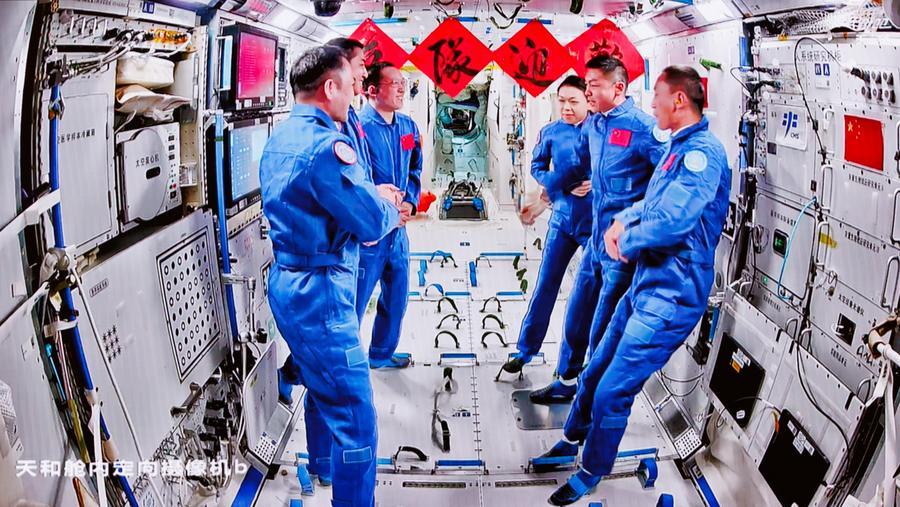
BEIJING, July 13 (Xinhua) -- Shenzhou-23 spaceflight mission's three-person crew has successfully tested an upgraded in-orbit mass measurement device at China's space station, as the three astronauts approach their 50th day in orbit with a steadily expanding roster of scientific experiments.
Besides testing the new device, astronauts Zhu Yangzhu, Zhang Zhiyuan and Li Jiaying carried out a series of experiments in space life sciences and human research over the past week, the China Manned Space Agency (CMSA) said in a video released on Sunday.
For the musculoskeletal loading study, they conducted plantar pressure measurement, lower-limb biomechanical testing, and muscle-tendon characterization during running and resistance exercises under different load conditions, collecting data on plantar pressure, joint kinematics and motion images, and muscle parameters to map the characteristics of changes in muscle-tendon interactions, according to the CMSA.
The crew also used near-infrared brain functional imaging equipment to perform neuroergonomic experiments with multi-task paradigms. Ground researchers will use the collected data to study how the space environment affects astronauts' cognitive control.
The trio continued their daily in-orbit exercise to counteract the physiological effects of weightlessness.
China launched the Shenzhou-23 crewed spaceship on May 24. The mission is notable for including a one-year in-orbit stay experiment, which will provide crucial data for future long-duration space exploration. ■