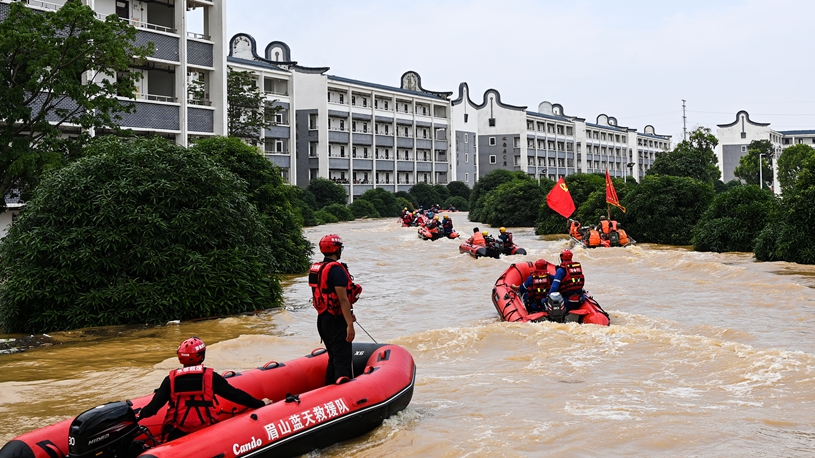
BEIJING, July 12 (Xinhua) -- China has stepped up flood control and disaster relief efforts as Typhoon Bavi continued to affect large parts of the country on Sunday.
Typhoon Bavi, the ninth typhoon of the year, made landfall twice along the coast of east China's Zhejiang Province at 11:20 p.m. Saturday and again around midnight, then moved inland. It is expected to move northwest while gradually weakening.
Over the past 24 hours, heavy rain exceeding 50 mm has hit much of the central and southern parts of Zhejiang, covering about 42 percent of the province's total area.
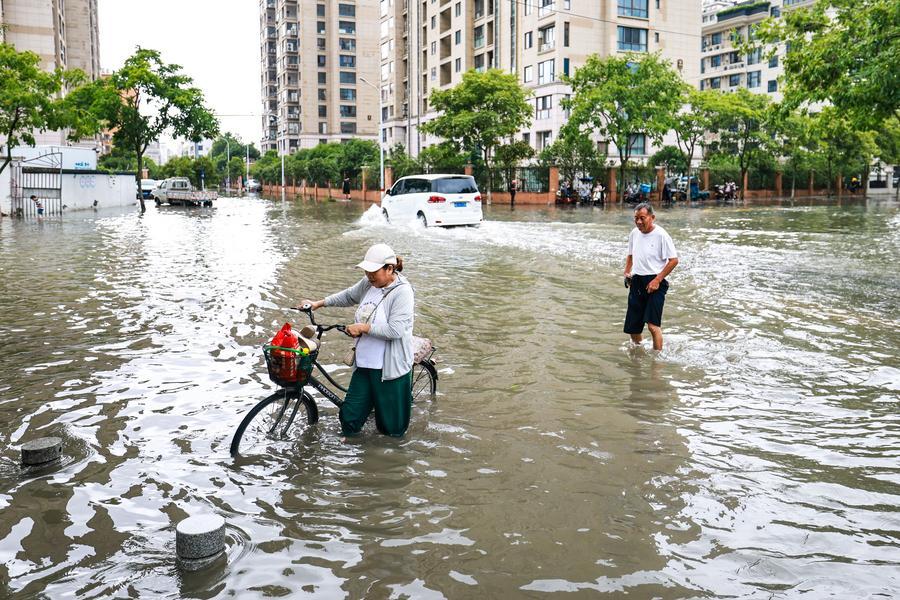
Bavi is the strongest July typhoon to strike Zhejiang since 1949. Due to its massive size and strength, it not only churned up huge waves along the coast but also pushed deep inland, posing a high risk of flash floods, geological disasters, and urban waterlogging, said Hu Yaowen, chief engineer of the provincial department of emergency management.
The province had rolled out a series of proactive responses to battle the typhoon before its landfall. As of 7 p.m. Saturday, local authorities relocated 2.68 million people and opened more than 19,000 emergency shelters across the province. Classes were suspended at schools and training institutions, 830 construction sites were shut down, and more than 400 scenic areas, along with over 200 amusement facilities with high risks, were closed to ensure public safety.
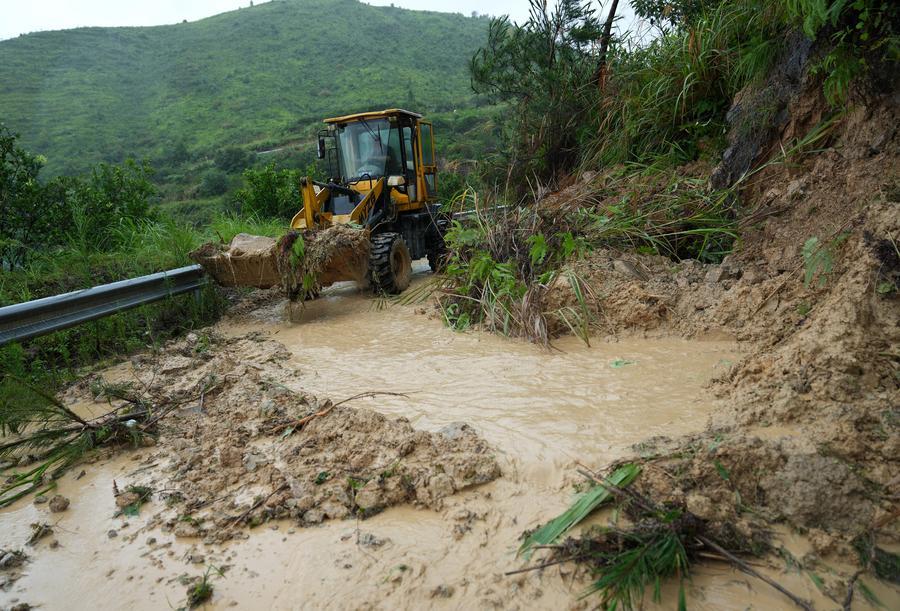
Near the temporary shelter at the public activity center in the city of Yueqing, many trees were toppled or snapped by strong winds.
Zhang Shanshan, a subdistrict-level worker in charge of the shelter, said the site houses more than 500 people, mostly from nearby construction sites that have been shut down. She added that thorough arrangements had been made in terms of staffing and supplies.
"Windows and doors had been reinforced, with wooden boards placed outside the glass doors and sandbags stacked on both sides for extra protection," said Zhang.
China's National Development and Reform Commission has allocated emergency central budget funds to support post-typhoon recovery in regions hit by recent storms.
A total of 100 million yuan (about 14.71 million U.S. dollars) was granted to Zhejiang, which will be used for the emergency restoration of damaged roads, water conservancy facilities, schools, hospitals and other public services, aiming to help restore normalcy as soon as possible.
Another 100 million yuan was additionally allocated to Guangxi Zhuang Autonomous Region in the south, following an earlier 100-million-yuan fund on July 6, as Typhoon Maysak brought heavy floods and wreaked havoc in the area.
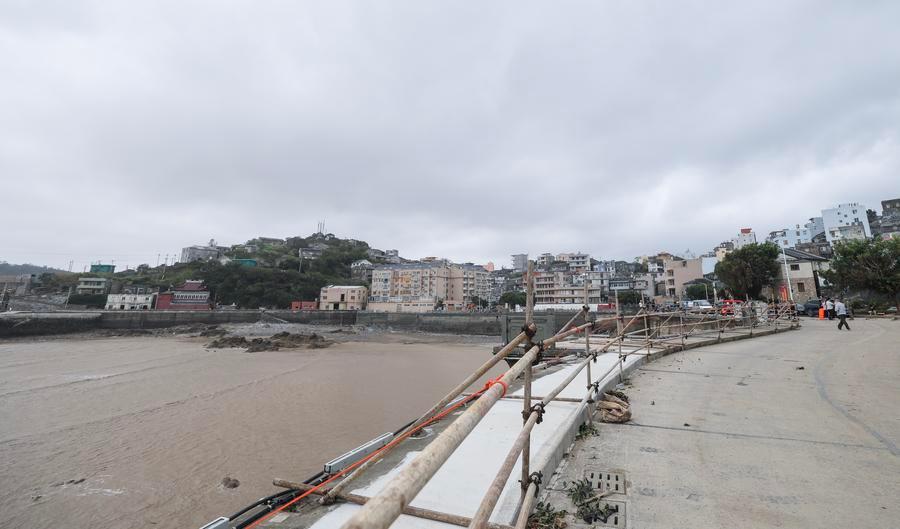
From Sunday to Tuesday, heavy to torrential rain is expected to lash a swath of China, including Anhui, Jiangxi and Zhejiang provinces, as well as parts of Liaoning and Jilin provinces.
In Zhejiang's neighboring Anhui, a reservoir in the city of Huangshan already discharged water, freeing up storage capacity to respond to the approaching rainstorms.
Torrential rains started battering the city late Saturday, and as of 6 p.m. Sunday, nearly 14,000 residents had been evacuated.
In Shenyang, capital of Liaoning Province in northeast China, all primary and high schools, kindergartens and training institutions will be suspended, outdoor gathering activities will be canceled, and construction sites will halt production on Monday. The scenic spots near mountains and waters, and morning and night markets will also be closed.
In response to potential geological disaster risks, the Beijing-Tianjin-Hebei region in north China has established a coordinated prevention and control mechanism, enabling real-time data sharing within the region to enhance disaster response capabilities.
A national Level-IV emergency response remains in effect for the affected regions, according to the National Commission for Disaster Reduction.
The Ministry of Water Resources on Sunday upgraded its flood alert to yellow, the third-highest level in China's four-tier weather warning system, saying that heavy rainfall could trigger flooding in some rivers, mountain torrents and urban waterlogging.
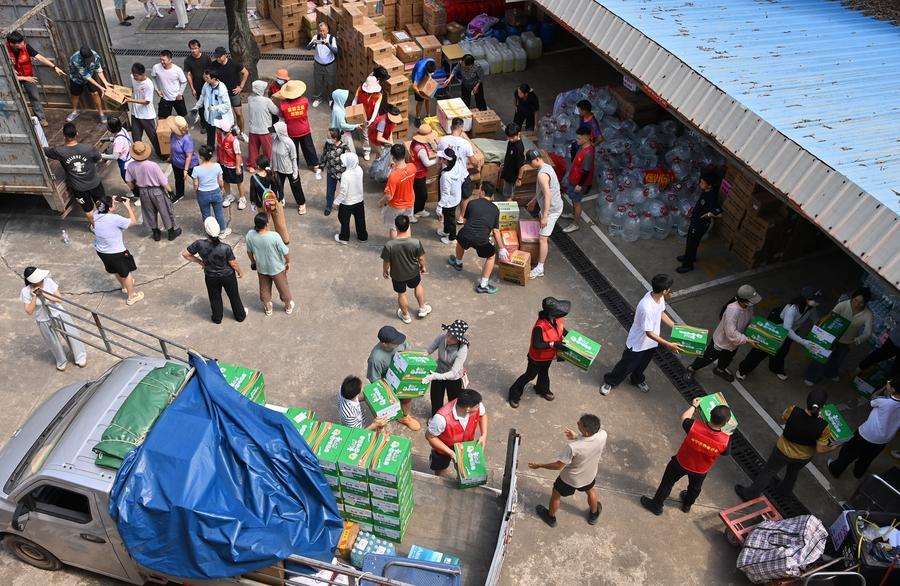
Central authorities have dispatched 70,000 items of disaster relief supplies to Zhejiang, Tianjin and Anhui to support the relocation and resettlement of affected residents, according to the Ministry of Emergency Management (MEM).
The items, including folding beds, blankets, summer quilts and family emergency kits, were jointly allocated by the office of the national commission for disaster prevention, reduction and relief, the MEM, and the National Food and Strategic Reserves Administration. ■