by Guo Xiaobing
On the eve of the 2026 North Atlantic Treaty Organization (NATO) summit in Ankara, NATO Secretary General Mark Rutte claimed NATO could not afford to be "naive" about China and hyped up the so-called threat stemming from "China's massive nuclear build-up." Ironically, NATO turns a blind eye to its own nuclear expansion and nuclear proliferation activities.
About three weeks ago, the Nuclear Planning Group, NATO's senior body in charge of nuclear sharing affairs, released its first ministerial statement on nuclear deterrence since 2007. It announced that NATO would continue to boost its nuclear sharing capacity by investing in necessary resources, capabilities and forces.
Such double-standard rhetoric distorts the objectives and principles of the Treaty on the Non-Proliferation of Nuclear Weapons (NPT), and will further undermine the fragile global non-proliferation architecture.
NATO has been upgrading its nuclear sharing mechanisms in multiple dimensions and expanding such arrangements to Eastern and Northern Europe. First, in terms of nuclear warhead upgrades, NATO is replacing outdated B61-3 and B61-4 warheads with the more precise B61-12 variant. Second, in terms of aircraft upgrades, NATO is phasing out aging dual-capable aircraft such as the F-16 and replacing them with F-35A fighters featuring stronger penetration capabilities. Britain, Germany, the Netherlands, Belgium and Italy are currently carrying out this plan. Third, in terms of infrastructure upgrades, NATO is renovating cables, command systems and communication facilities at nuclear weapon bases across European countries. Fourth, NATO holds an annual "Steadfast Noon" nuclear deterrence exercise, in which U.S. strategic bombers and dual-capable conventional and nuclear aircraft from European allies take part to demonstrate military resolve and cross-national interoperability.
The most transformative shift in NATO's nuclear sharing framework lies in its geographical expansion. The United States used to deploy tactical nuclear warheads on the territories of five NATO allies: Belgium, Germany, Italy, the Netherlands and Türkiye. However, reports emerged last summer that the United States redeployed nuclear warheads in Britain for the first time in 17 years. Britain also announced plans to purchase F-35A jets and join NATO's nuclear sharing mechanism.
Currently, the United States is considering deploying nuclear weapons to more European nations. In Eastern Europe, Poland has repeatedly voiced its willingness to host nuclear warheads and launched relevant consultations with the United States. In Northern Europe, Sweden and Finland, after joining NATO, have both become members of the NATO Nuclear Planning Group (NPG). Finland's Defense Ministry stated its intention to allow nuclear weapons to be stationed on its territory in March, and the Finnish Parliament passed legislation in June to lift the domestic legal ban on nuclear arms so as to align the country with NATO's nuclear frameworks. Baltic states, especially Lithuania, are also potential sites for NATO nuclear deployments.

The authority to control these overseas-deployed nuclear weapons has long remained a controversial core issue since the establishment of NATO's nuclear sharing mechanism. In peacetime, all these overseas nuclear weapons are said to be controlled, supervised and maintained by the United States. In wartime, once the NPG approves and the U.S. President and British Prime Minister authorize the operation, the jurisdiction over these nuclear weapons will be transferred from the United States to certain non-nuclear-weapon NATO member states. Air force pilots of those countries will then gain control of the nuclear weapons and take full responsibility for delivering them to designated targets.
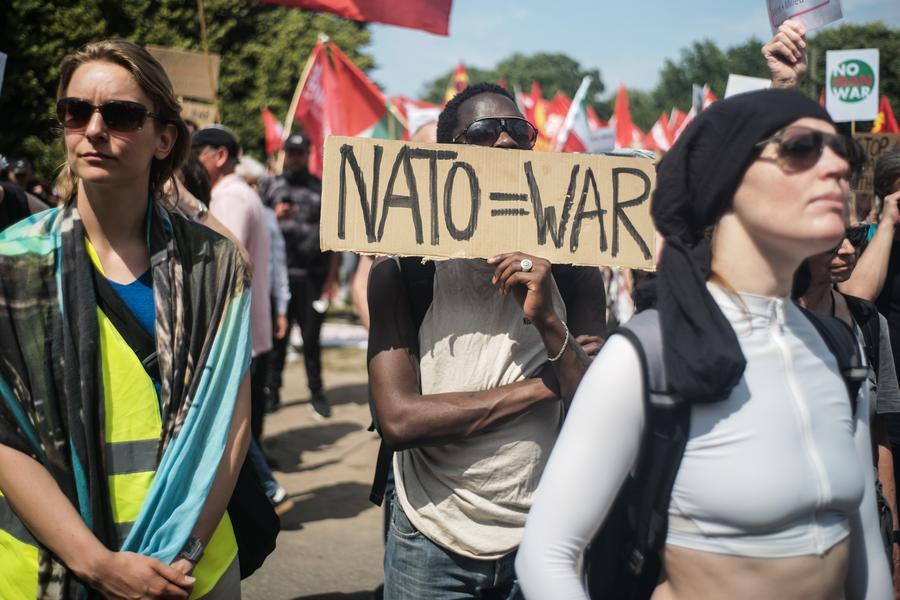
More than 120 countries, including members of the Non-Aligned Movement and the New Agenda Coalition, accounting for 60 percent of all NPT state parties, have repeatedly submitted documents to NPT Review Conferences to condemn NATO nuclear sharing and extended deterrence, and strongly urged NATO to adjust its nuclear policies. Their core arguments are as follows.
First, U.S. actions under NATO nuclear sharing violate Article I of the NPT. The Article explicitly prohibits nuclear-weapon states from transferring nuclear weapons or their control rights to non-nuclear-weapon states. The U.S. practices, including assisting allies to upgrade fighter jets, organizing long-term joint nuclear delivery training, and prearranging the transfer of nuclear weapon usage authority in wartime, constitute typical indirect nuclear proliferation.
Second, non-nuclear-weapon NATO members' participation in the nuclear sharing scheme breaches Article II of the NPT. This Article bans non-nuclear-weapon states from accepting control over nuclear weapons. Non-nuclear NATO allies have voluntarily undertaken nuclear strike missions, upgraded supporting facilities and prepared to control nuclear weapons on their dual-use fighters in wartime substantially violating their treaty obligations.
Third, NATO's moves run counter to Article VI of the NPT by creating more obstacles to nuclear disarmament. Article VI mandates nuclear-weapon states to pursue nuclear disarmament in good faith. Nevertheless, NATO is modernizing its nuclear delivery platforms, expanding overseas nuclear deployments and continuously elevating the strategic weight of nuclear weapons in its security doctrines, which deviates from the objective of nuclear disarmament.
Faced with international scrutiny, NATO has offered three self-serving justifications: Nuclear sharing predates the NPT; the United States retains exclusive peacetime control over nuclear weapons; and the treaty loses binding force during wartime. These claims lack solid legal grounds and have won little recognition from most NPT state parties. The last argument is particularly absurd and hazardous. The NPT was drafted to avert the risk of nuclear war, yet NATO's stance implies it is ready to disregard the treaty when nuclear conflict looms.
In stark contrast to NATO, China's nuclear doctrine, ever since it acquired nuclear weapons, advocates the complete elimination and thorough destruction of all nuclear weapons, and maintains an extremely restrained stance on nuclear development and use. If a world free of nuclear weapons is a mountain summit where various nuclear powers camp at different altitudes, China's position is the closest to the peak.
On the employment of nuclear forces, China has consistently upheld its solemn commitments: no first use of nuclear weapons under any circumstances, and unconditional non-use or threat of use of nuclear weapons against non-nuclear-weapon states and nuclear-weapon-free zones. This position has remained stable and consistent for over six decades. China has promoted joint statements among the five nuclear-weapon states to prevent nuclear war, and called for the negotiation of a treaty on no-first-use of nuclear weapons to eliminate nuclear conflict risks at the source. In contrast, NATO regularly stages nuclear strike drills and reserves the option of preemptive nuclear strikes -- a sharp contrast that reflects the vast difference in self-restraint between the two sides.
On the development of nuclear forces, China has always kept its nuclear capabilities at the minimum level required for national security. It adheres to the principle of building a lean and effective nuclear arsenal, refuses to participate in any nuclear arms race, and its nuclear stockpile is far smaller than that of the United States and Russia. China's nuclear modernization merely aims to guarantee the safety, reliability and serviceability of its nuclear weapons, so as to deter others from launching nuclear threats or nuclear attacks against China. Meanwhile, NATO is expanding its nuclear arsenal and pouring massive funds into modernizing nuclear warheads, combat aircraft and land-based intermediate-range missiles. NATO's criticism of China's limited, self-defensive nuclear modernization lays bare its blatant double standards.
In global arms control and non-proliferation governance, China advocates diplomatic solutions and takes tangible actions to uphold the international nuclear order. It has enacted comprehensive nuclear export control laws, insisted on resolving regional nuclear crises through diplomatic channels, and opposed unilateral sanctions and military coercion. Furthermore, China continuously enhances the transparency of its nuclear policies and proactively notifies relevant countries before conducting strategic missile launches.
By contrast, NATO unilaterally claims the NPT is only a peacetime treaty, attempting to undermine the cornerstone of the international nuclear non-proliferation regime. In addition, U.S. strategic communities are pushing for closer coordination between European and Asian extended deterrence mechanisms, raising the risk that NATO-style nuclear sharing will be replicated in East Asia.
The security of a handful of countries cannot be built upon the insecurity of all others. Amid widespread calls from the bulk of the international community, NATO ought to refrain from expanding nuclear deployments to more European nations, downgrade the role of nuclear weapons in its security strategy, stop smearing China's nuclear policies, and work with all parties to forge a balanced, effective and sustainable global security architecture.
Editor's note: Guo Xiaobing is a research professor and director of the Center for Arms Control and Export Control Studies, China Institutes of Contemporary International Relations.
The views expressed in this article are those of the author and do not necessarily reflect the positions of Xinhua. ■