
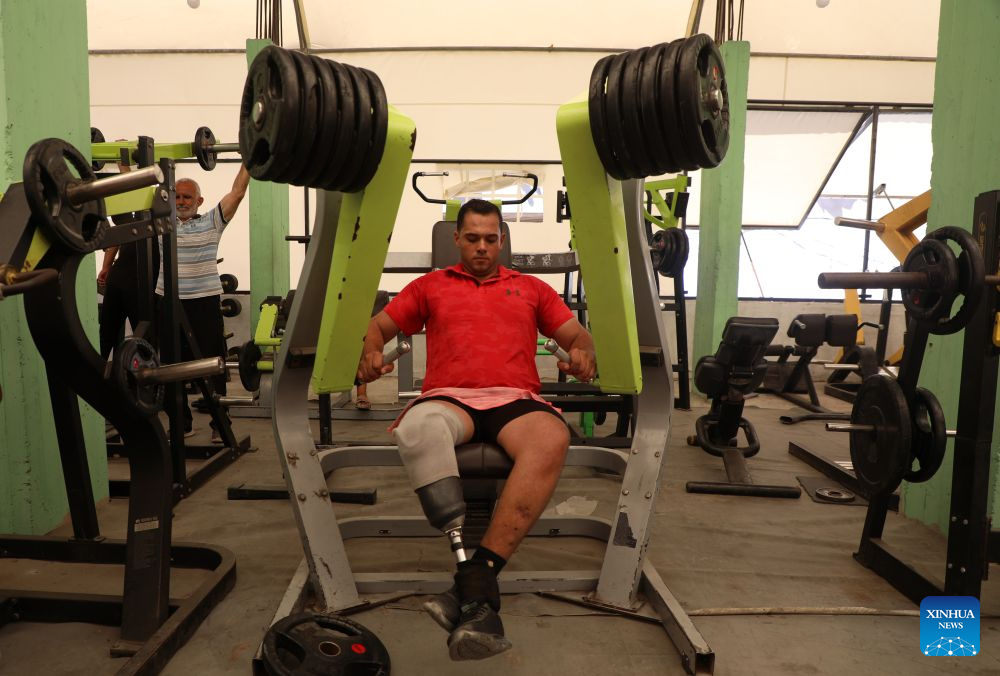
Palestinian bodybuilding coach Mahmoud Abu Madkour on a prosthetic leg exercises at the modest Al-Sakhra gym in al-Nuseirat refugee camp in the central Gaza Strip, on July 8, 2026. (Photo by Rizek Abdeljawad/Xinhua)
GAZA, July 11 (Xinhua) -- While millions of football fans around the world are following the 2026 FIFA World Cup, Mahmoud Abu Madkour from the Gaza Strip is engaged in a different kind of competition.
Every morning before sunrise, the 33-year-old bodybuilding coach makes his way through the narrow streets of al-Nuseirat refugee camp in the central Gaza Strip on a prosthetic leg, heading to the modest Al-Sakhra gym, where he trains aspiring athletes while rebuilding his own life after losing a limb during the conflict.
"For an athlete, losing a leg felt like the end of everything," Abu Madkour told Xinhua. "I thought I would never walk again or return to bodybuilding. But I refused to let the injury define the rest of my life."
Inside the gym, Abu Madkour removes his prosthetic leg, changes into his training clothes, carefully refits the artificial limb and moves between the exercise equipment.
He coaches trainees, demonstrates proper techniques and completes his own workout, determined to continue the sport that has shaped much of his life.
Before the war, Abu Madkour hoped to represent Palestine in bodybuilding championships.
That dream was interrupted on June 8, 2024, when he was seriously injured during an Israeli military operation in al-Nuseirat.
Abu Madkour recalled sheltering at his sister's home when heavy bombardment began.
"We went out to rescue the injured, but moments later I became one of them," he said. "My right leg was amputated, and my left leg was badly injured. I still suffer from its effects."
The injury initially shattered his hopes. "My whole life revolved around sports," he added. "After the amputation, I thought that chapter had ended forever."
Encouraged by his family and friends, Abu Madkour underwent months of rehabilitation before returning to the gym after receiving a prosthetic leg. Although grateful for the device, he said it is not designed for intensive athletic training.
His daily routine now begins at 5:30 a.m., when he opens the gym before coaching young athletes and completing his own exercises.
"Bodybuilding is part of who I am," he said. "I can't stay away from the gym. Sports are my therapy."
Abu Madkour hopes to travel abroad one day to obtain a more advanced sports prosthesis that would enable him to train more effectively and possibly compete again.
"They amputated my leg," he added. "But they didn't amputate my dream."
Abu Madkour is among thousands of Palestinians living with war-related disabilities who are striving to rebuild their lives through sport despite mounting physical and psychological challenges.
Another is 19-year-old Saif Bilal from Gaza City, who has found renewed purpose in amputee football after losing his left leg during the conflict.
On a small football pitch in Gaza City, Bilal trains with the Gaza of Will amputee football team, balancing on crutches as he chases the ball.
A former player for Palestine Club, Bilal said he was injured on March 5, 2024, in an Israeli airstrike that struck a group of young men on Salah al-Din Street in Gaza City.
"I regained consciousness in the hospital," he told Xinhua. "I spent three days in the emergency department because there were so many injured people. Doctors tried to save my leg, but the lack of medical resources meant it eventually had to be amputated."
The operation left him believing his football career had come to an end.
"When I woke up and saw that my leg had been amputated, I thought my dream of playing football was over forever," he added.
Months later, Bilal met Mohammed Aliwa, coach of the Gaza Will amputee football team, whose encouragement inspired him to return to the sport.
"At first, I couldn't imagine playing football with one leg and two crutches," Bilal said. "But gradually I adapted. The way I play has changed, but my passion for football has not."
Bilal added that the team trains under difficult conditions. Many players have been displaced and struggle to reach training sessions, while worn-out crutches are difficult to replace.
"Football has become more than a game," he explained. "It shows that disability does not stop a person from pursuing a dream. I may never play at the World Cup, but every training session is a victory over my injury."
The growing number of war-related amputees has placed increasing pressure on rehabilitation services across Gaza.
Hosni Muhanna, spokesperson for the Gaza Municipality's Prosthetics and Paralysis Center, said demand for rehabilitation services has risen sharply since the conflict began.
The center has registered around 1,000 amputees who are receiving ongoing medical and technical follow-up, Muhanna told Xinhua.
During the same period, the center has provided prosthetic limbs to about 100 patients and distributed dozens of wheelchairs, mobility aids and other assistive devices through its facilities and mobile clinics, according to Muhanna.
However, Muhanna said the center faces severe shortages of raw materials needed to manufacture prosthetic limbs, as well as medical equipment, spare parts and maintenance supplies, limiting its ability to meet growing demand.
"The number of amputees continues to increase, while our resources continue to decline," he said. "We urgently need more materials and equipment to provide prosthetic limbs and rehabilitation services."
Gaza-based psychologist Dirdah al-Shaer told Xinhua that returning to sports can play an important role in the psychological recovery of amputees.
"Many amputees experience denial, sadness and isolation after their injuries... Sports help them regain confidence, rebuild their sense of identity and reintegrate into society," he said.
For athletes in particular, returning to training represents more than physical rehabilitation, according to al-Shaer.
"Sports are not only physical activity," he said. "They are also a form of psychological therapy that helps people regain confidence and feel capable of achieving their goals again."
According to the Palestinian Central Bureau of Statistics, about 42,000 people in the Gaza Strip have sustained severe injuries requiring long-term rehabilitation, including nearly 6,000 amputees, around 75 percent of whom have lost lower limbs.
In a report issued in December 2025, the bureau said more than 10,000 children had sustained disabling injuries.
It added that rehabilitation services had declined by 62 percent due to damage to health facilities, the deaths of more than 1,700 healthcare workers, and severe shortages of prosthetic limbs and assistive devices. ■
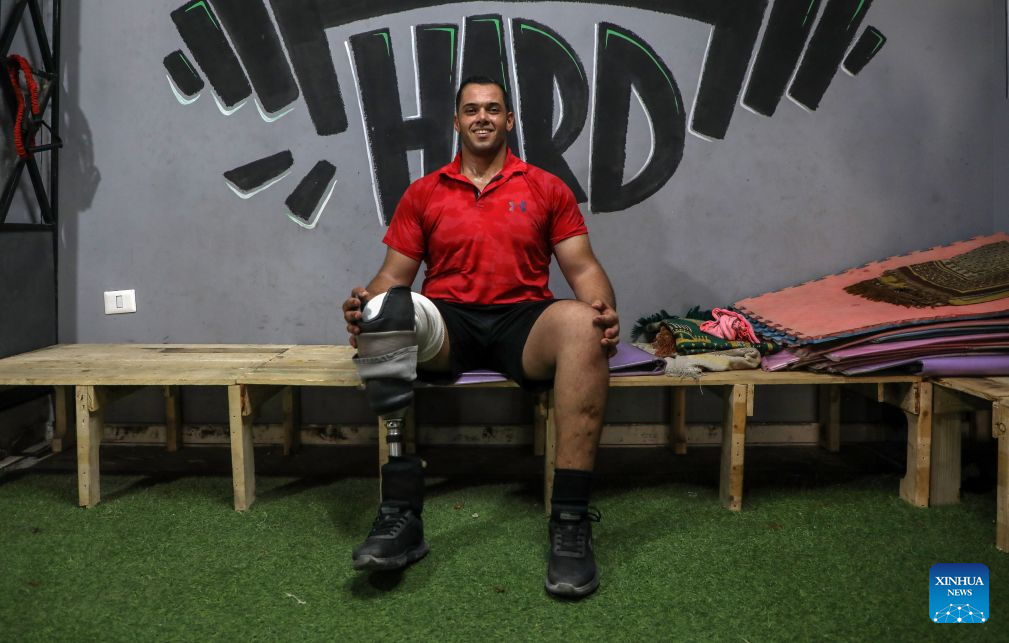
Palestinian bodybuilding coach Mahmoud Abu Madkour poses for a photo at the modest Al-Sakhra gym, in al-Nuseirat refugee camp in the central Gaza Strip, on July 8, 2026. (Photo by Rizek Abdeljawad/Xinhua)
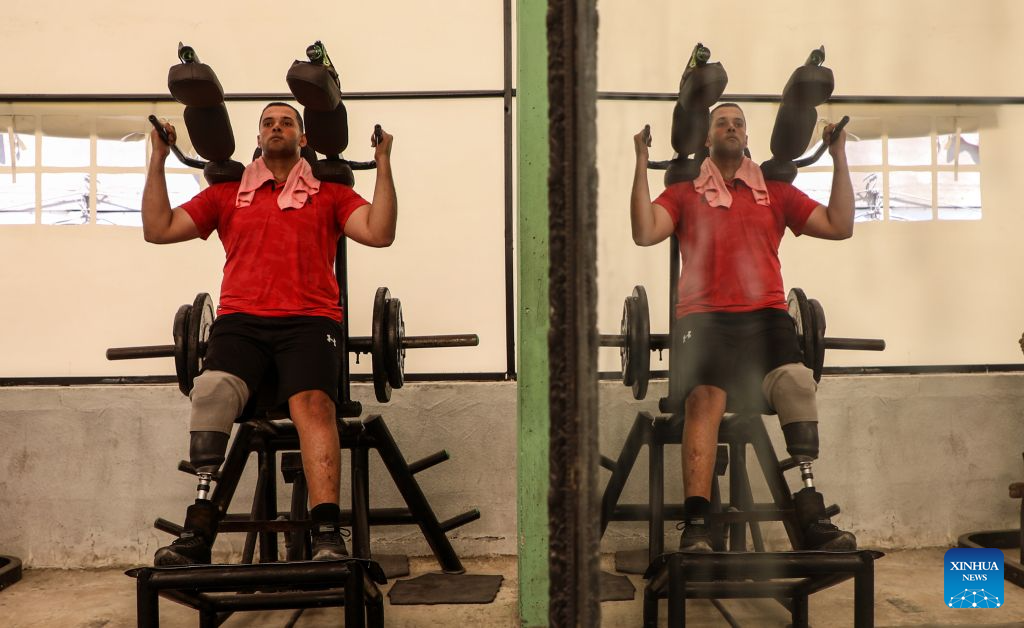
Palestinian bodybuilding coach Mahmoud Abu Madkour on a prosthetic leg exercises at the modest Al-Sakhra gym in al-Nuseirat refugee camp in the central Gaza Strip, on July 8, 2026. (Photo by Rizek Abdeljawad/Xinhua)


