* U.S. President Donald Trump pressed NATO members to raise defense- and security-related spending to 5 percent of GDP, placing growing pressure on European budgets.
* Trump also renewed his claim that the United States should control Greenland, an autonomous territory of the Kingdom of Denmark, drawing criticism from several NATO members.
* Trump further brought the Iran crisis into the summit by saying he was "very disappointed" with fellow NATO members over what he viewed as insufficient support for Washington's operations against Iran.
ANKARA, July 9 (Xinhua) -- NATO leaders concluded a two-day summit on Wednesday with carefully worded pledges of unity and new arms procurement announcements. However, U.S. President Donald Trump's pressure over defense spending, Greenland and Iran laid bare the alliance's deepening internal rifts.
In its final declaration, NATO reaffirmed its "ironclad commitment" to collective defense under Article 5 of the Washington Treaty, saying that "an attack on one is an attack on all." It also announced more than 50 billion U.S. dollars in new arms procurements, pledged to expand collective manufacturing capacity and vowed to accelerate defense innovation.
The declaration said European allies and Canada are assuming greater responsibility for the alliance's defense and now finance the "vast majority" of security assistance to Ukraine. It pledged 70 billion euros (about 80 billion dollars) in military equipment, assistance, and training for Ukraine in 2026, and affirmed its commitment to maintain at least equivalent levels in 2027.
However, the summit fell short of providing a concrete roadmap for how allies would implement Washington's demand for sharply higher military-related spending.
Baris Doster, an international relations scholar at Istanbul's Marmara University, said the procurement announcements were "vague statements lacking a solid foundation," adding that Trump's blunt criticism of European allies had weakened the summit's diplomatic atmosphere.
DEFENSE SPENDING PUSH FUELS FRICTION
Trump has pressed NATO members to raise defense- and security-related spending to 5 percent of GDP, arguing that Europe has relied too heavily on the United States for its security.

At the NATO Summit Defense Industry Forum held on Tuesday, allies announced new procurement plans covering air defense, long-range strike, surveillance, unmanned systems and other military capabilities. The projects included Triton uncrewed aircraft, GlobalEye aircraft, new AWACS (Airborne Warning and Control System)-related capabilities, drone initiatives, and other procurement arrangements involving U.S. and European defense companies.
Trump made clear that U.S. arms manufacturers would be among the beneficiaries of Europe's accelerated military buildup.
"The defense companies are going to be making most of that equipment," Trump told reporters. "They want the American equipment because it works better. We make the best equipment in the world."
He also claimed at a press conference after the summit that military spending by other NATO countries had increased by nearly 150 billion dollars in 2025, and that much of the money would be used to buy U.S.-made equipment.
Giuseppe Gagliano, president of the Italy-based Carlo De Cristoforis Strategic Studies Center, said defense spending has become NATO's new economic doctrine.
"The target of 3.5 percent of GDP for core defense, plus 1.5 percent for broader security-related areas, means a massive redirection of public resources toward the military industry," Gagliano wrote in a post on social media.
He warned that the shift would place growing pressure on European budgets, as defense spending competes with spending on public welfare, infrastructure and education.
The spending issue also triggered fresh tensions between Washington and Madrid. Trump criticized Spain for resisting higher military spending targets and threatened to cut off trade with the country, prompting concern in Europe over the use of economic pressure within the alliance.
GREENLAND REMARKS ADD STRAIN
The summit was further complicated by Trump's renewed remarks on Greenland, an autonomous territory of the Kingdom of Denmark.
Trump again raised the issue at the summit, saying that the United States should control the Arctic island. He argued that Greenland is strategically important to the United States and criticized Denmark's handling of the territory.
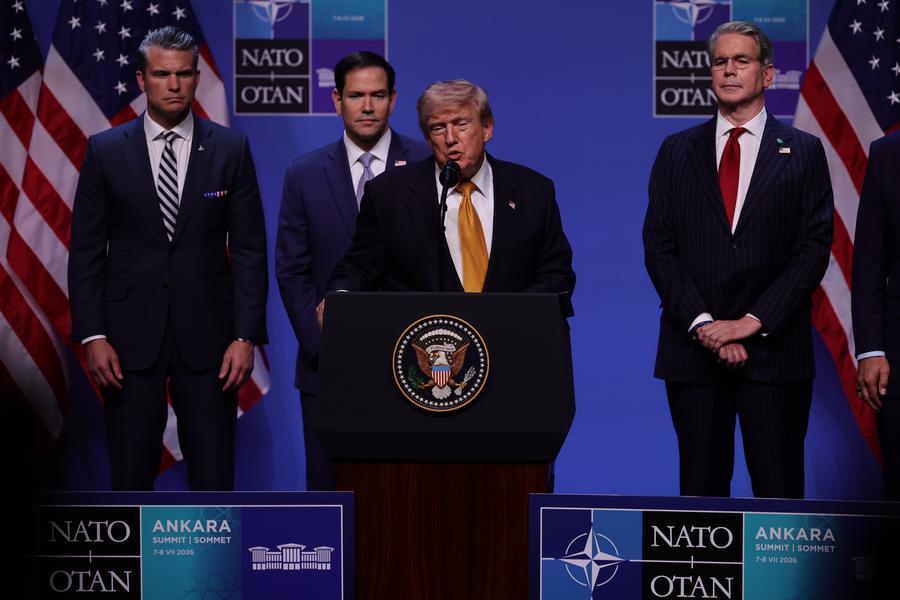
Danish Prime Minister Mette Frederiksen swiftly rejected the claim, stressing that Greenland is "not for sale" and urging allies to respect Denmark's sovereignty and Greenland's right to self-determination.
Trump's remarks drew criticism from several NATO members. Finnish President Alexander Stubb, whose country is among NATO's newest members and is closely engaged in Arctic affairs, rejected the claim, saying that matters concerning Greenland should be decided by Denmark and Greenland itself.
Icelandic Prime Minister Kristrun Frostadottir also made clear that Greenland's future should be decided by its own people. "The lines in the sand are clear: Greenland belongs to the people of Greenland," she said.
Jacob Kaarsbo, a foreign and security policy commentator and former chief analyst at the Danish Defense Intelligence Service, said Trump's intention to take Greenland would not simply go away.
He said Trump does not believe in NATO in the traditional sense, nor does he see European countries as equal allies. Instead, Kaarsbo said, Trump treats them as pawns on a geopolitical chessboard.
IRAN CRISIS COMPLICATES SUMMIT
Iran also added to the summit's tensions. Although the issue was not at the center of NATO's formal agenda, Trump brought the crisis into the summit by saying he was "very disappointed" with fellow NATO members over what he viewed as insufficient support for Washington's operations against Iran.
European countries, already under pressure over defense spending, faced renewed criticism from Trump over their reluctance to fully align with the United States on Iran and the Strait of Hormuz.
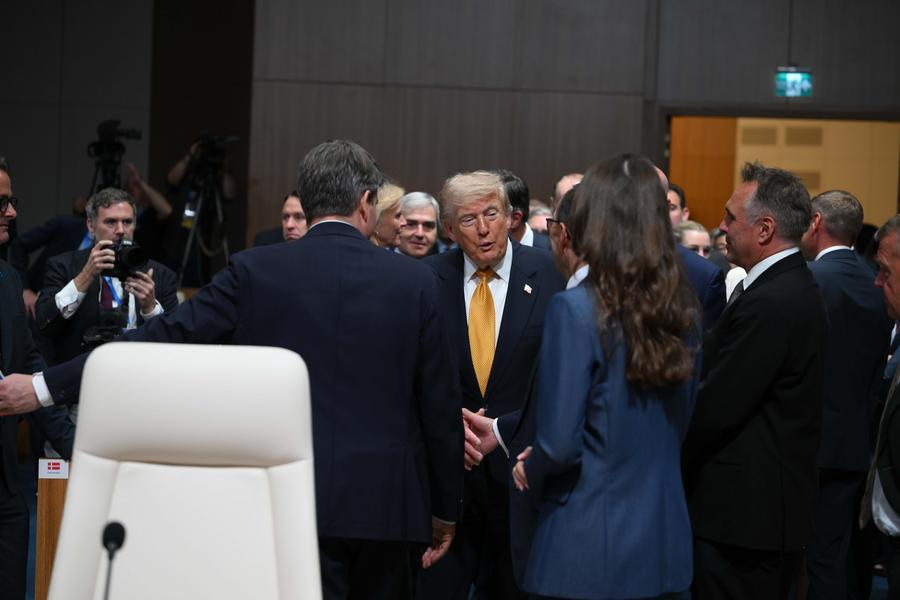
Tensions escalated as Trump warned of resuming a naval blockade in the Strait of Hormuz and potentially taking over Iran's Kharg Island. He added that the U.S. military might strike Iran again as soon as Wednesday night.
"From the unprecedented trade threats against Spain to the absurd claims over Greenland and the sudden escalation with Iran, Trump completely hijacked the summit to serve his domestic political needs and the American arms industry," Doster said.
Doster said Trump had effectively transformed the alliance into a chaotic and transactional protection scheme, "leaving allies to question whether the greatest threat to NATO's future comes from external adversaries or from Washington itself."
(Video reporters: Wu Yao and Umut Ozlu; Video editors: Hong Liang, Zhu Cong, Zhang Mocheng and Zhang Yichi) ■