
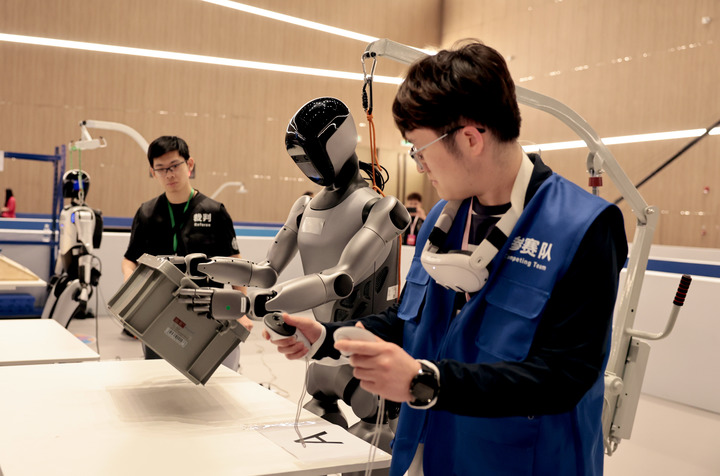
SHANGHAI, July 9 (Xinhua) -- To a rhythmic beat, a humanoid robot flawlessly executes backflips and splits. Moments later, it shifts to a security patrol, accurately identifying unauthorized personnel.
This demonstration at Shanghai-based AgiBot, a pioneering humanoid robot startup, offers a glimpse into a rapidly maturing industry, proving that its latest robots have evolved beyond mere prototypes into commercial successes.
The company has achieved various milestones, ranging from setting a Guinness World Record for a bipedal robot's cross-province trek to breaking technical bottlenecks in high-speed dynamic motion to achieve autonomous table tennis rallies and securing hundreds of millions of yuan in orders right at launch.
"We have multiple robot models covering industrial handling, logistics sorting and security patrols," said Yao Maoqing, head of AgiBot's embodied business department.
While the embodied robot sector is booming, mass production remains a hurdle. AgiBot, however, is shattering this bottleneck at a staggering pace.
"Last month, our 15,000th general-purpose embodied robot rolled off the production line," noted Zhan Kun, senior vice president of AgiBot's supply chain. The company grew from just six prototype units in 2023 to reaching 10,000 units in March 2026, hitting the 15,000 mark less than three months later. "Immediate delivery and deployment upon leaving the factory" has become a reality for AgiBot.
The company's growth mirrors Shanghai's push to cultivate cutting-edge industries. The city's 15th Five-Year Plan (2026-2030) explicitly calls for expanding robot applications, equipment interconnection, and the digitalization and intelligent upgrading of production processes. Backed by dedicated funding and the AI Plus Initiative, Shanghai is actively advancing embodied AI robots into real-world scenarios.
Zhan points to the Yangtze River Delta's comprehensive supply chain as a critical driver. "The region hosts a leading, fully equipped embodied AI industrial cluster," he explained. Nearly 90 percent of components for these robots are sourced locally, with some core parts available within hours, providing a robust foundation for stable mass production.
Driven by this collaborative ecosystem, Shanghai's robotics sector is surging with momentum. Pudong, a major innovation hub in the city, has clustered over 100 robotics companies, with more than 90 percent located in Zhangjiang Science City. Meanwhile, a specialized robotics industrial park in Shanghai's Baoshan District hosts around 300 key enterprises covering the entire value chain, helping Shanghai account for one-third of China's total robotics industry scale.
This robust domestic foundation has translated into global market success. According to Shanghai Customs, in the first five months of 2026, exports of various categorized robots from Shanghai ports reached 8.36 billion yuan (about 1.2 billion U.S. dollars). Shipped to 113 countries and regions, these exports accounted for over 40 percent of China's total robot exports, ranking first nationwide.
Shanghai's trajectory reflects a broader national strategy. Under China's 15th Five-Year Plan (2026-2030), embodied AI has been designated as a new engine for economic growth.
By 2025, China was home to more than 140 humanoid robot manufacturers, with shipments reaching 14,400 units and accounting for 84.7 percent of the global market.
"China's accelerated sprint in the field of humanoid robots will not only address its own demands for industrial upgrading, but will also deliver an entirely new power system and set of solutions to the world, much like the mobile internet and new energy vehicles did in their time," said Yan Weixin, chief scientist at the Shanghai Artificial Intelligence Research Institute and an associate professor at Shanghai Jiao Tong University.
He noted that China is reshaping the global innovation collaboration mechanism in this sector, paving the way for embodied AI to truly become a universal productivity tool as ubiquitous as electricity. ■