* As a swift and effective solution, responsive Chinese appliance manufacturers are offering a helping hand to relieve Europeans from this hotter summer.
* "The quality and development speed of these Chinese products are groundbreaking," Schaefer said, adding that customers continued to ask about the products and recommend them to others after purchase, further pushing up demand.
* Despite the policy discrepancies between the European Union and China, the broader European market still exhibits significant complementarity with Chinese manufacturing, particularly in sectors closely tied to people's livelihood requirements and industrial upgrading.
FRANKFURT, July 7 (Xinhua) -- In heatwaves grilling Europe, German resident Lucas Nickel has long longed to install an air conditioner in his rented apartment in Frankfurt, as bans on drilling in walls and building modifications leave him in hot days and nights.
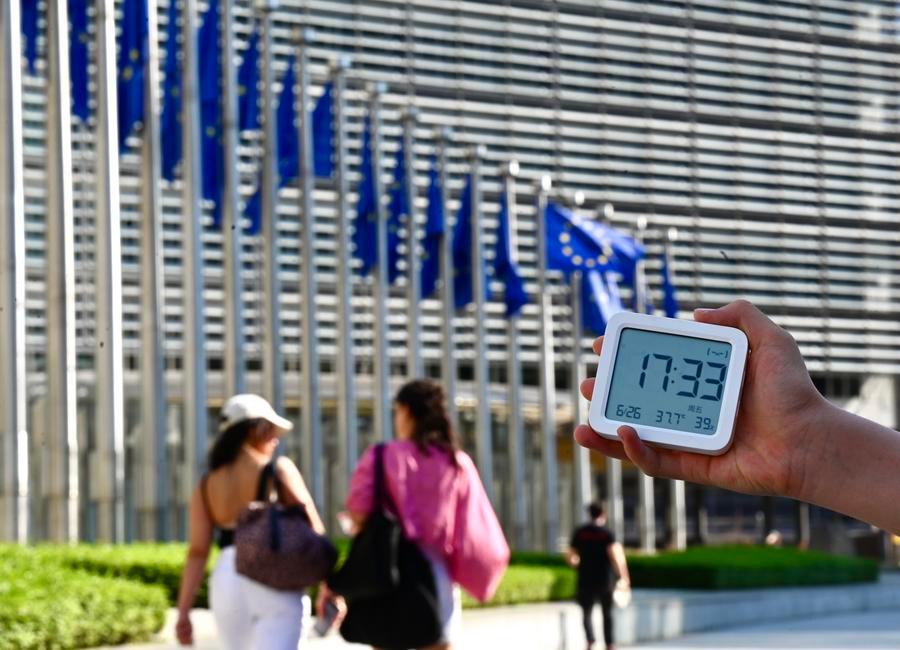
As soaring temperatures exacerbate Europe's long-standing shortage of household cooling solutions, demand for air conditioners, fans and other cooling devices is surging across the continent. Retailers have been crying sellouts, while consumers are searching every supermarket for available household cooling appliances.
As a swift and effective solution, responsive Chinese appliance manufacturers are offering a helping hand to relieve Europeans from this hotter summer. It highlights the strong resilience and high complementarity of China-Europe economic and trade ties.
"NEED IT NOW"
In Germany, Austria, Italy and many other European countries, residents had long viewed hot weather as a brief summer episode. Air conditioners were not standard equipment in most homes, and many people got through summer by opening windows, pulling shades or waiting for temperatures to drop at night. But as heatwaves become more frequent, intense and prolonged, that perception is shifting.
"Now more and more people are realizing that excessive summer heat is a major risk," said a staff member called Laurenz at Chinese company Xiaomi's Frankfurt store.
At retail shops, demand for cooling devices is skyrocketing. Laurenz said fan sales at Xiaomi's German stores rose by about 600 percent last week. "We restocked 50 units, and they were probably all sold out in about 20 minutes."
Compared with traditional air conditioners, he said, fans are often the first choice for many consumers to resist heatwaves. "Air conditioners are still not that popular in Germany. First, they are a bit expensive. More importantly, installation costs are high, permits may be needed, and the waiting time can be long," he said. "Fans are cheaper, require no installation, and can be used immediately after purchase."
Roger Schaefer, managing director of Hausgeraete Center Schaefer, a home appliance retailer in the German state of Hesse, has also felt the shift in demand. He told Xinhua that relevant products had been sold out for weeks. His company had been trying to place additional orders, but it is still hard to meet all needs.
"German summers are getting hotter year after year, and the weather is becoming increasingly unpredictable," Schaefer said. "Cooling demand comes very quickly and must be met in time."
Interviewees pointed out that the robust sales of cooling products in Europe are not merely a seasonal consumption pattern. Instead, they represent the concentrated manifestation of long-accumulated potential demand that has been unleashed due to extreme weather conditions.
Marco Leporati, an Italian economic commentator, said the situation is particularly evident in Italy, where many buildings lack central air-conditioning infrastructure and historic or century-old buildings are difficult to retrofit.
In his view, China's robust manufacturing capacity, backed by complete industrial clusters and comprehensive supply chains, is well positioned to respond promptly to such urgent demand.
CONSUMER TRUST
As demand surges, European consumers and local distributors are changing their perception of Chinese cooling products.
Schaefer said that not long ago, Chinese brands were not the first choice for local consumers, many of whom preferred established brands in the European market. But in recent years, the quality and service of Chinese products have impressed him.
"The quality and development speed of these Chinese products are groundbreaking," he said, adding that customers continued to ask about the products and recommend them to others after purchase, further pushing up demand.
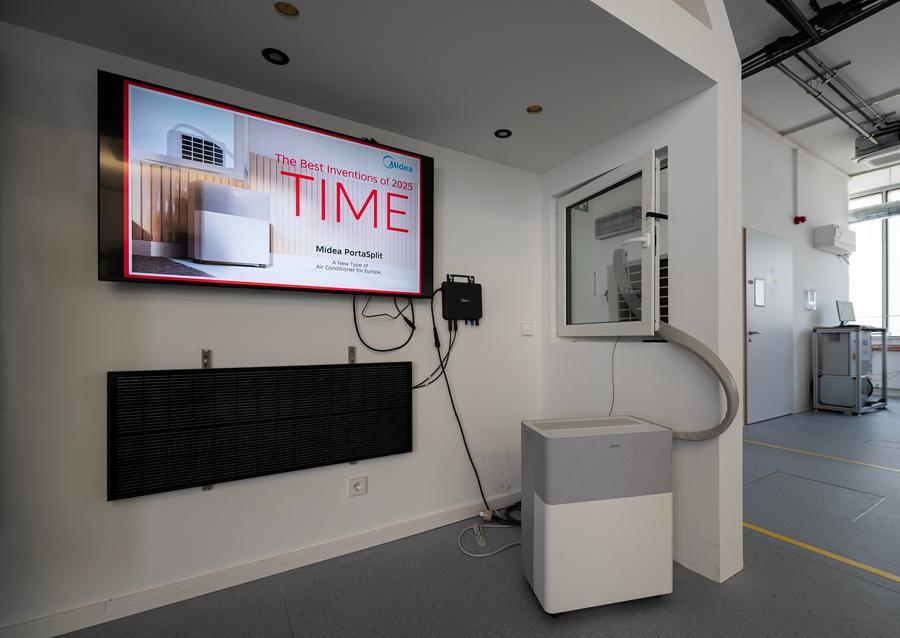
Schaefer said his company has long worked with Chinese brands, including Changhong, Haier and Midea. "This is already the third consecutive peak season that we have worked with Midea, and PortaSplit is an absolute bestseller," he said.
The product follows the trend in the German market, where cooling demand arrives faster and consumers need products they can obtain and use immediately, he said.
Denis Yurchak, a Vienna-based engineer and founder of telecom solution websites Yadaphone and eSIMPal, has recently gone viral on social media after chronicling his entire quest to buy a Midea PortaSplit.
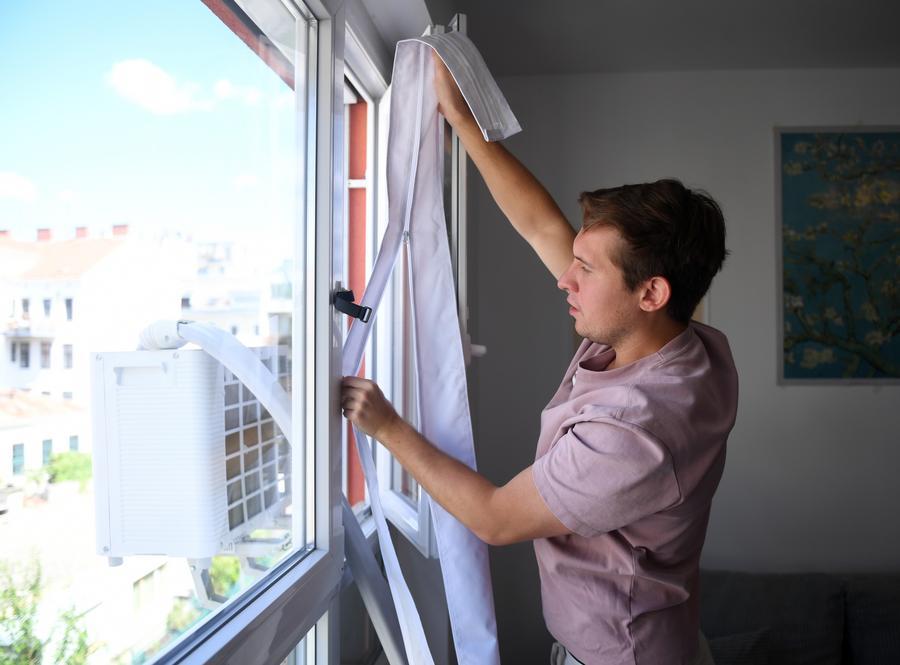
Putting his tech background to use, he built an AI agent to track the product's scarce inventory. After finally locating a unit, he drove about 200 miles to Linz, Austria, to pick it up, sharing the "adventure" with his online followers.
Yurchak told Xinhua that what attracted him was the product's fit with European housing conditions: no drilling, relatively low noise, lower running costs, and cooling performance closer to what he considered a "proper AC" than a traditional portable unit.
He noted that the European cooling market still has strong potential, as heatwaves increase while restrictions on installing traditional air conditioners persist.
Laurenz said German consumers tend to look beyond the purchase price and consider the full cost over a product's life cycle, including installation, electricity use, product quality and future repair costs.
As a result, consumers are increasingly seeking integrated solutions that combine reliable products with dependable after-sales service. In Germany, Xiaomi works with local service partners to provide after-sales support, with products repaired or replaced based on inspection results, Laurenz said.
SUPPLY MEETS DEMAND
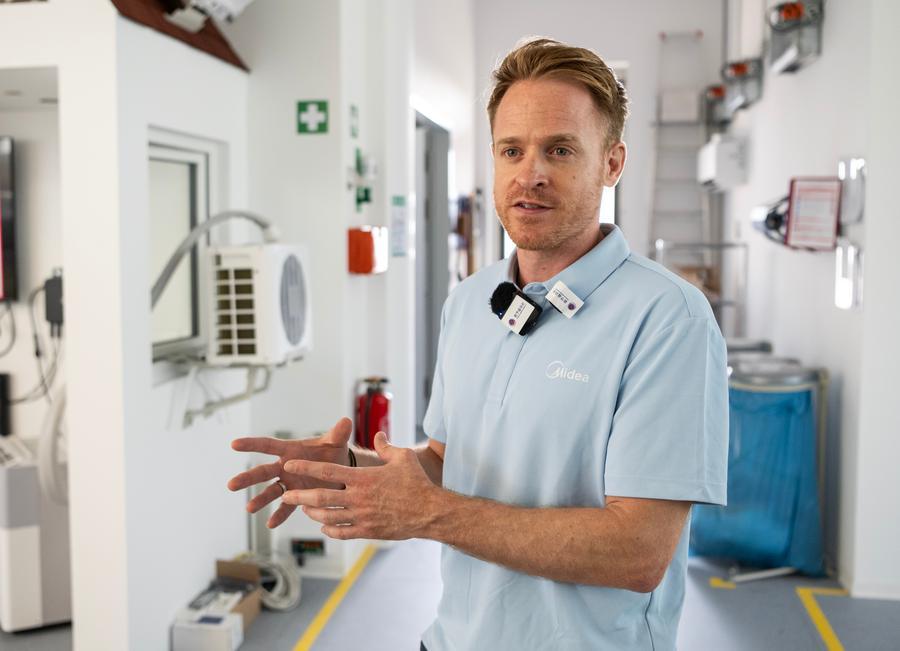
At Midea's R&D center in Germany, researchers test brackets against various European window types. Tobias Strobel, technical innovation head for residential air conditioners at the center, said his team follows user comments on platforms such as Reddit and YouTube, especially feedback on noise, and improves products accordingly.
Tobias said that when local engineers put a concept into a PowerPoint presentation, the team in China can quickly turn it into an engineering solution and produce a prototype. Such a "China speed," he said, is vital for localized R&D.
Xinhua learned from Midea that more than 100 containers of PortaSplit units are expected to enter the European market in July.
Retailers are also bridging the supply gap. Laurenz said Xiaomi's Frankfurt store usually restocks twice a week but increases frequency under special circumstances, leveraging nearby warehouses to speed up availability.
Joybuy, JD.com's European online retail brand, is coordinating supply with upstream brands to accelerate replenishment. The platform said it can provide delivery, installation, removal of old machines and customer service support, helping respond to sudden spikes in heat-driven demand.
From localized R&D and large-scale manufacturing to flexible restocking, local warehousing and after-sales services, Chinese companies are turning supply chain capabilities into "cooling supply" that European consumers can tangibly experience.
Despite the policy discrepancies between the European Union and China, the broader European market still exhibits significant complementarity with Chinese manufacturing, particularly in sectors closely tied to people's livelihood requirements and industrial upgrading.
Marko Cadez, president of the Chamber of Commerce and Industry of Serbia, said the rapid rollout of Chinese cooling products reflects a broader pattern of industrial synergy.
Since the China-Serbia free trade agreement took effect, he said, Serbian companies have found it easier to access Chinese technologies, machinery, raw materials and automation equipment, allowing many to modernize production at lower costs.
Chinese equipment is technologically advanced and reliable in quality, Cadez said, adding that more and more Serbian companies are purchasing and using it.
From his perspective, China's mature supply chains, along with its advantages in quality and cost-effectiveness, have empowered China-made air conditioners, fans, and other cooling products to swiftly satisfy the demands of the European market amid persistent heatwaves.
Beyond imminent heatwaves, Cadez said the world needs certainty and stability, and open cooperation rather than protectionism serves the common interests of all parties.
From an air conditioner that overcomes installation hurdles to a service network that delivers, installs and supports products in time, this matching of supply and demand underscores that, despite geopolitical headwinds, China-Europe economic and trade ties remain highly complementary.
(Video reporters: Ma Yueran and Yuan Hengrui; video editors: Wu You, Roger Lott, Zheng Qingbin, Yu Jiaming and Liu Ruoshi)■