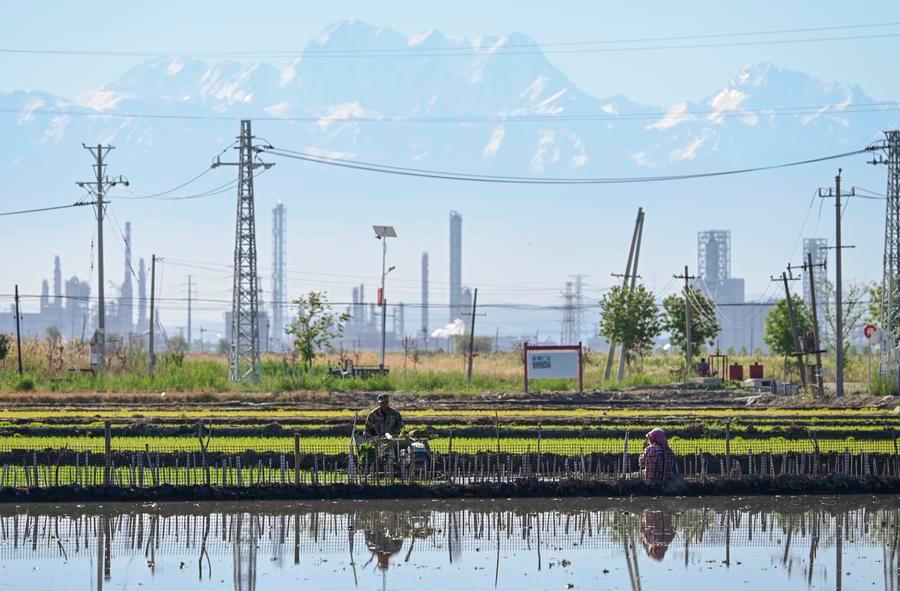
LANZHOU, July 7 (Xinhua) -- Chinese scientists have proposed a new framework and provided data support for accurately assessing glacier mass changes and meltwater evolution patterns in the Tianshan Mountains in northwest China's Xinjiang Uygur Autonomous Region, according to the Northwest Institute of Eco-Environment and Resources (NIEER) under the Chinese Academy of Sciences.
The study, conducted by NIEER researchers, is expected to offer a stronger scientific basis for assessing future trends in regional water resource, optimizing water resources allocation, and advancing sustainable water management in arid regions, the institute said.
Glaciers in the Tianshan Mountains act as a critical "solid reservoir" for Central Asia's arid areas, and changes in their mass balance are directly linked to regional water supply, ecological security, and socio-economic sustainable development, according to Wang Puyu, a researcher at the NIEER.
"Better understanding regional glacier mass changes is essential for tackling local water resource challenges. However, estimates of regional glacier mass changes have been constrained by limited glacier mass balance monitoring," Wang said.
Previously, due to insufficient continuous observational data on glacier mass balance, detailed assessment of glacier mass changes in the Tianshan Mountains and their hydrological effects at the regional scale remained challenging.
To address this problem, a research team at the NIEER systematically reconstructed the glacier mass balance processes over the past two decades for six river basins in the Tianshan Mountains, based on multi-source data fusion and multiple model simulations.
The researchers projected glacier mass balance and meltwater runoff processes under different future climate scenarios, and quantitatively analyzed the evolution of glacier meltwater runoff and its contribution to total river runoff.
The study showed that from 2000 to 2021, glaciers in the Tianshan Mountains maintained an overall negative mass balance. The annual mean glacier meltwater runoff accounted for about 31.45 percent of the total basin runoff.
It is projected that under low- and high-emission scenarios, the region could face potential glacier mass losses of 53 percent to 77 percent by 2100. Glacier meltwater runoff is projected to continue increasing until around 2050 and then gradually declining, indicating a weakening role of glaciers in regulating regional water resources, according to the study.
The findings have been published in the journal Global and Planetary Change. ■