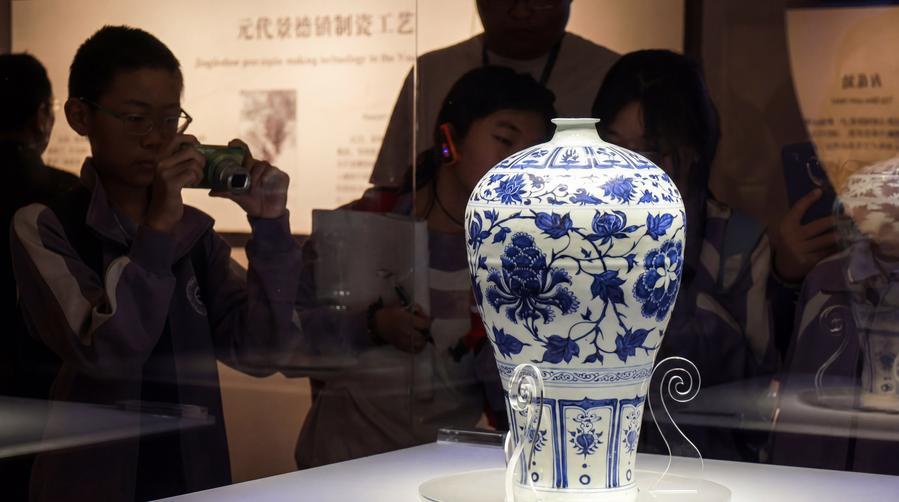
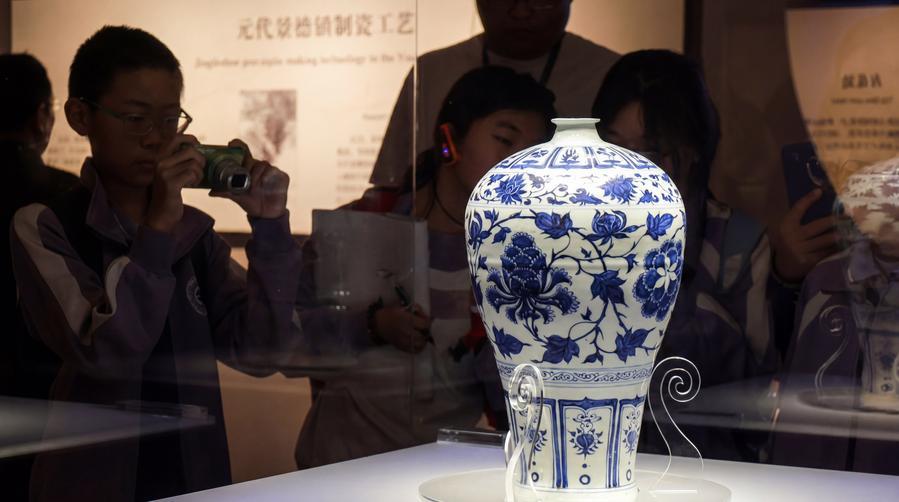
IZNIK, Türkiye, June 30 (Xinhua) -- Standing beside the blazing kilns of Jingdezhen, China's thousand-year-old porcelain capital, in 2023, Turkish ceramic artist Adil Can Guven watched flawless porcelain emerge from fires raging at 1,300 degrees Celsius.
For a craftsman who had spent decades preserving the Turkish tradition of Iznik ceramics, a craft shaped by lower firing temperatures and greater fragility, that moment was a quiet revelation. It was not merely a lesson in temperature, but a new way of understanding clay, fire, and the resilience of craft itself.
"In both systems, quartz is present, but everything else changes," Guven recalled. "In porcelain, feldspar acts as a flux, allowing the body to mature at very high temperatures. Iznik ware relies on quartz and glass frit, using local white clay. It makes the process more fragile, but gives our ceramics their distinctive texture."
That fragility leads to a high cost. Fired at just 900 degrees Celsius, nearly 40 percent of his pieces may crack or warp during the process. "No factory could endure this," he said, noting that the craft is sustained by artistry rather than commercial efficiency.
The exchange of ceramic traditions between China and Türkiye dates back hundreds of years. As early as the 15th century, blue-and-white porcelain from China's Ming Dynasty reached Anatolia, leaving a lasting imprint on Iznik's ceramic craftsmanship.
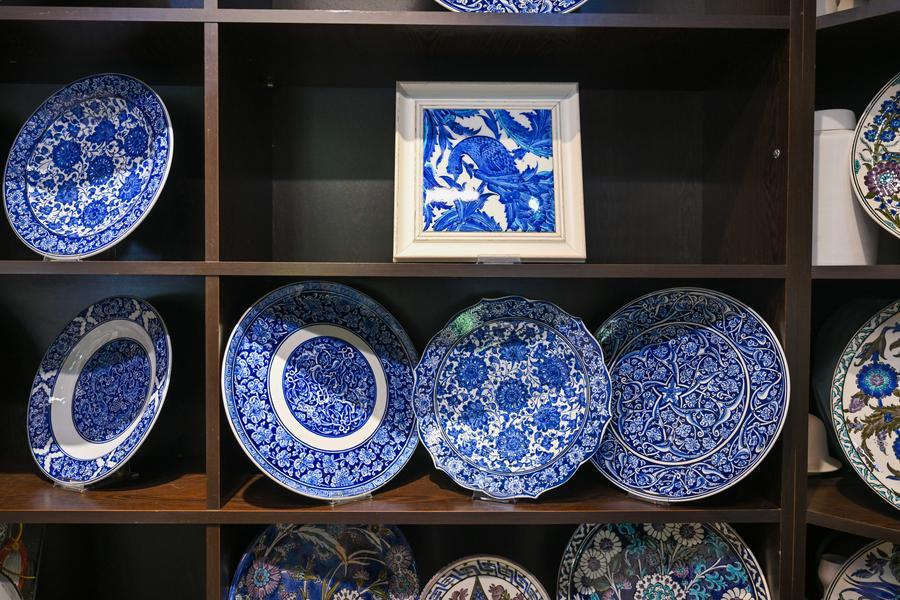
Today, these two traditional crafts are finding new vitality through collaboration.
By the end of this year, a joint ceramic production facility planned in Iznik and developed in partnership with Jingdezhen will bring the two traditions together for collaborative production and research.
Following an April visit to Jingdezhen to examine production technologies and equipment, Iznik officials have entered the final phase of the project. The facility will function not only as a production site, but also as a space for workshops, artist exchanges, and cultural activities between the two cities.
Ke Xinguo, general manager of the Jingdezhen porcelain official flagship store in Istanbul and a participant in the project, said it represents a continuation of long-standing China-Türkiye exchanges.
"It transforms historical ceramic ties between Jingdezhen and Iznik into a lasting platform for cooperation," Ke told Xinhua.
For ceramic artist Ozlem Camkoz, the project represents a bridge between generations, creating new hands to carry the ceramic traditions of both countries forward, while deepening the friendship forged through centuries of artistic exchange.
"By offering workshops and access to masters from both countries, we are creating a unique ecosystem," Camkoz said. "We are providing young artisans with the skills, networks, and job opportunities needed to keep these traditions alive today."
Back in Iznik, Guven returns to his wheel, where another piece of clay slowly takes shape beneath his hands.
He said his visit to Jingdezhen broadened his understanding of the craft, revealing that while the techniques may differ, both traditions are rooted in the same elements: clay, fire and patience.■