
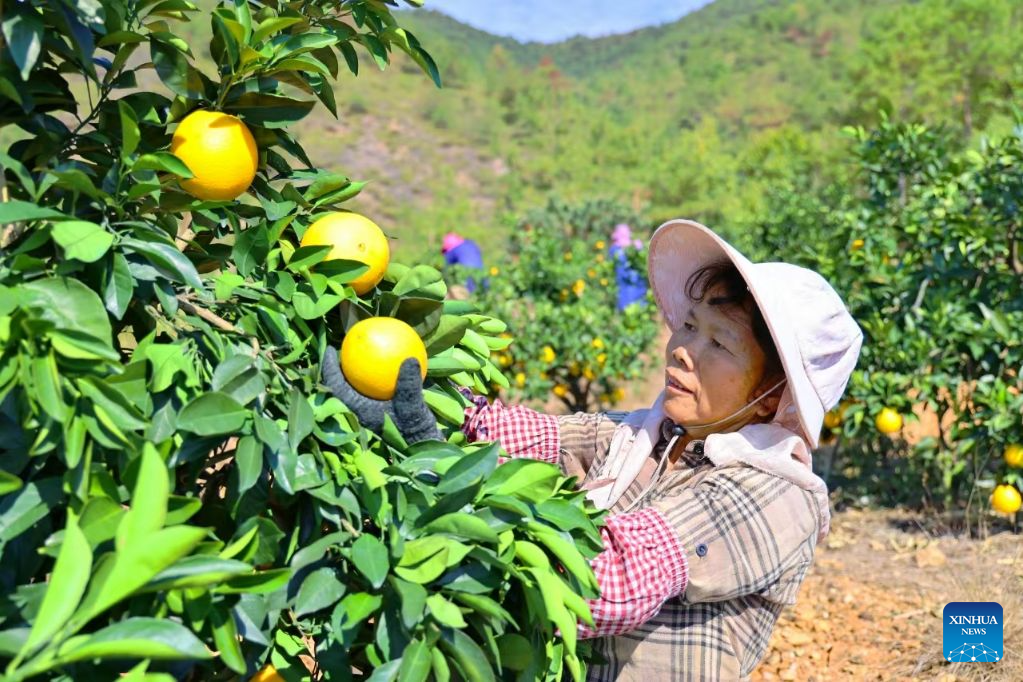
This file photo shows a farmer picking Gannan (meaning southern Jiangxi) navel orange, a signature agricultural product of the region, in Ruijin City, east China's Jiangxi Province, Nov. 3, 2024. (Photo by Li Huacheng/Xinhua)
NANCHANG, July 1 (Xinhua) -- The straw sandals were rough, light and surprisingly difficult to make.
In Yudu County of Ganzhou City, east China's Jiangxi Province, Zhavier Harris twisted hemp, tied knots and pulled strips of straw into shape. He was following the lead of local craftsmen who were showing visitors how Red Army soldiers once prepared for the Long March.
For Harris, a marketing and communications manager at the Springfield Urban League in the United States, making straw sandals was not simply a craft lesson. A decade earlier, he had taken part in a Long March-themed visit, an experience that helped make him an advocate for international exchange.
"Experiencing a whole Long March this year will be tremendous for me to see the true history and experience the entire journey," Harris said. "It's a story of resilience and perseverance -- the indomitable human spirit and the will to carry on. I think that truly represents the people here."
For many foreign visitors, places like Yudu and nearby Ruijin offer a starting point for understanding a question often raised about modern China: how the Communist Party of China (CPC) built public support in its early rural base areas, and how that revolutionary memory continues to shape local narratives of governance today.
In November 1931, the CPC declared the establishment of the Provisional Central Government of the Chinese Soviet Republic in Ruijin, where the CPC turned revolutionary ideals into experiments in governance, public mobilization and the rule of law.
Yet in the former revolutionary base, the past is not confined to memorial sites. It appears in textbooks, village wells, community renovation plans, and even local regulation aimed at protecting the orange industry.
In Ruijin, Huang Lufen, a guide, explained to visitors that in the Ruijin dialect, the word "Soviet" sounds like "shi wei wo," or "it is for me."
The phonetic coincidence aptly captures a theme that runs through the local revolutionary memory: governance was expected to address the needs of the people.
A short drive away in Shazhouba, visitors gather around a well that Mao Zedong led soldiers and villagers to dig. Beside it stands a stone tablet reading: "Never forget the well-diggers when drinking water from the well." The story, which appears in Chinese primary-school textbooks, has become part of the shared memory of generations of Chinese people.
The idea was tested in hard conditions. During the revolutionary years, the CPC carried out land reform, built irrigation works, reclaimed wasteland, planted forests, repaired bridges and roads, and expanded education in places such as Xingguo.
In "Red Star Over China," American journalist Edgar Snow wrote: "In our model hsien (county), Hsing Ko (Xingguo), we had over three hundred primary schools and about eight hundred schoolteachers... When we withdrew from Hsing Ko, illiteracy had been reduced to less than 20 percent of the population."
The support was concrete and measurable. During the years of the Chinese Soviet base areas, more than 930,000 people from southern Jiangxi joined the army and participated in the revolutionary war, accounting for about one-third of the local population.
In Yudu today, the same idea is taking more everyday forms -- renovated old neighborhoods, public canteens, and consultation mechanisms through which residents can raise their concerns.
In the Changzheng (Long March) Park area of Yudu, elderly residents sit in a pavilion playing chess and chatting. Nearby, a Party and public service center has become a shared community space, with the quiet of reading rooms and the smell of meals from its canteen.
Liu Changfu, 76, remembers the neighborhood before the renovation. "In the past, when it rained, you stepped into water and mud as soon as you went out," he recalled. "Overhead wires were tangled like spider webs. Cars had trouble passing, and pedestrians had to watch their step."
A residents' consultation mechanism has helped channel local feedback into urban renovation projects. This year, Yudu has invested 248 million yuan (about 36.4 million U.S. dollars) to upgrade old residential areas, including the Changzheng Park neighborhood. The renovation covers seven areas and 14,100 households, with improvements including paved roads, separate rainwater and sewage systems, and the streamlining of utility lines.
"These days, I usually have lunch at the canteen, then stroll around the square and sit in the sun," Liu said. "Life is getting more comfortable."
In Ruijin, officials describe their approach to development as carrying forward the "good conduct of Soviet area cadres." Today, that idea is applied in practical ways: clearing obstacles for investors, finding workers for new projects, and trying to bring industrial opportunities to a county-level city.
To secure a major investment project from a leading coastal enterprise, Ruijin officials helped resolve land and labor constraints, making 13.33 hectares of land available and recruiting 500 welders when construction began. The company, initially reluctant to invest in a county-level city, later expanded its footprint with additional projects. Once fully operational, the projects are expected to generate more than 100 million yuan in tax revenue and create thousands of jobs.
The region's governance story is also told through the rule of law.
Before the Long March began, a constitutional outline was promulgated in the Soviet area, with more than 100 laws, decrees, regulations and instructions issued, creating an early legal framework for revolutionary governance.
That tradition remains relevant today, and it is being applied to a new frontier: protecting the local economy, notably through specific regulation issued to protect the Gannan (meaning southern Jiangxi) navel orange, a signature agricultural product of the region.
Gannan navel oranges carry the hopes of about a million growers in southern Jiangxi for higher incomes. But the prevalence of counterfeit oranges sold under the Gannan name once left farmers such as Huang Linsheng, who has grown the fruit for more than 20 years in Ningdu County, feeling helpless.
In 2023, the city of Ganzhou adopted the Gannan Navel Orange Protection Regulation, its first local regulation dedicated to a distinctive industry, covering industrial development, brand protection and legal liabilities.
Huang said the regulation matters because it targets one of growers' biggest concerns: oranges from elsewhere being sold under the Gannan name. By cracking down more precisely on counterfeits, he said, the law would help protect both the brand and the livelihoods built around it.
Since gaining local legislative power in 2015, Ganzhou has enacted more than 10 local regulations to address residents' pressing concerns and the city's development needs.
For visitors like Harris, the Long March may begin with the awkward work of making a pair of straw sandals. In southern Jiangxi, it is not treated simply as history. It remains a test of governance: whether old revolutionary ideals can be made visible in the daily lives of ordinary people. ■
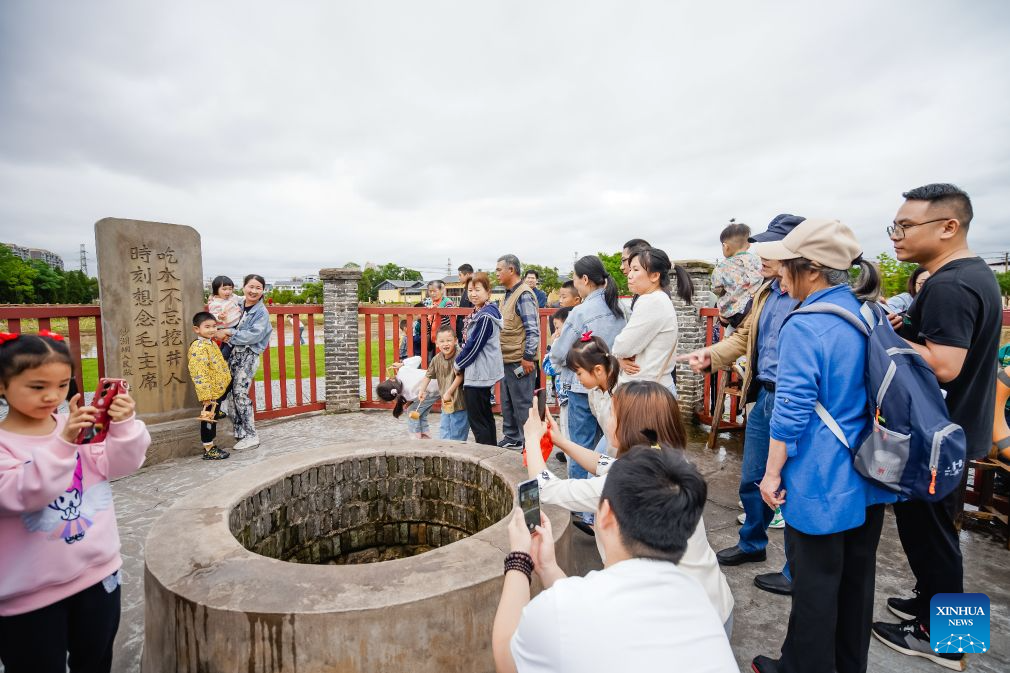
This file photo shows visitors taking photos at a well that Mao Zedong led soldiers and villagers to dig in Ruijin City, east China's Jiangxi Province, May 1, 2024. (Photo by Li Huacheng/Xinhua)
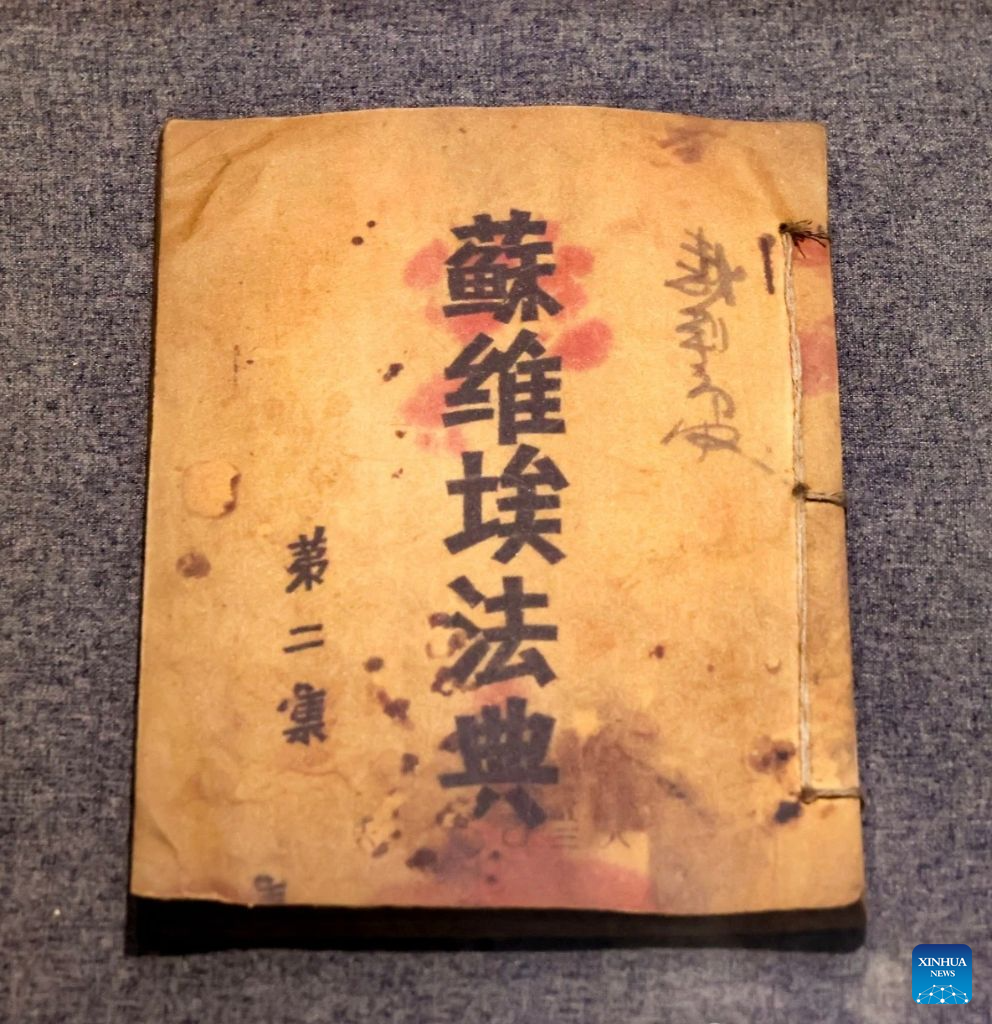
This undated file photo shows a copy of The Soviet Code (Volume Two) from the collection of the Central Revolutionary Base Area History Museum in Ruijin City, east China's Jiangxi Province. (Xinhua)


