
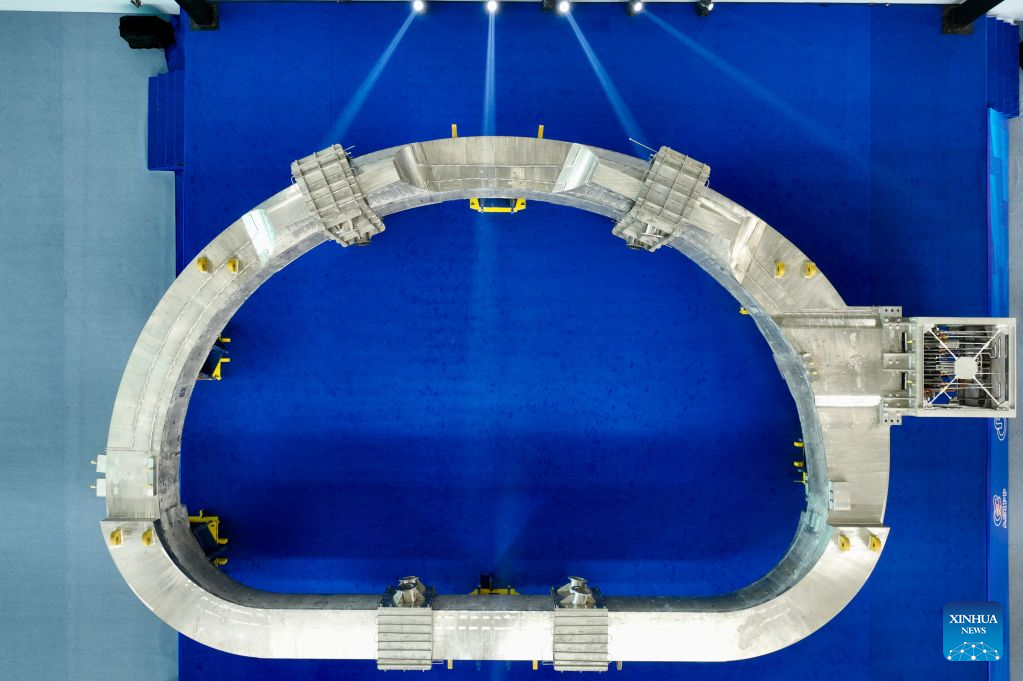
A drone photo taken on June 27, 2026 shows the toroidal-field superconducting magnet for the fusion reactor in Hefei, east China's Anhui Province. China's "artificial sun" project, also known as the EAST (Experimental Advanced Superconducting Tokamak), on Saturday achieved a major engineering milestone in the development of superconducting magnet systems for the fusion reactors.
The Institute of Plasma Physics at the Hefei Institutes of Physical Science under the Chinese Academy of Sciences completed the development, acceptance, and full-performance testing of two key superconducting magnet systems for future fusion reactors, namely a toroidal-field superconducting magnet and a high-temperature superconducting central solenoid coil. All critical technologies were developed domestically, with the systems ranking among the world's most advanced in overall performance. (Xinhua/Zhou Mu)
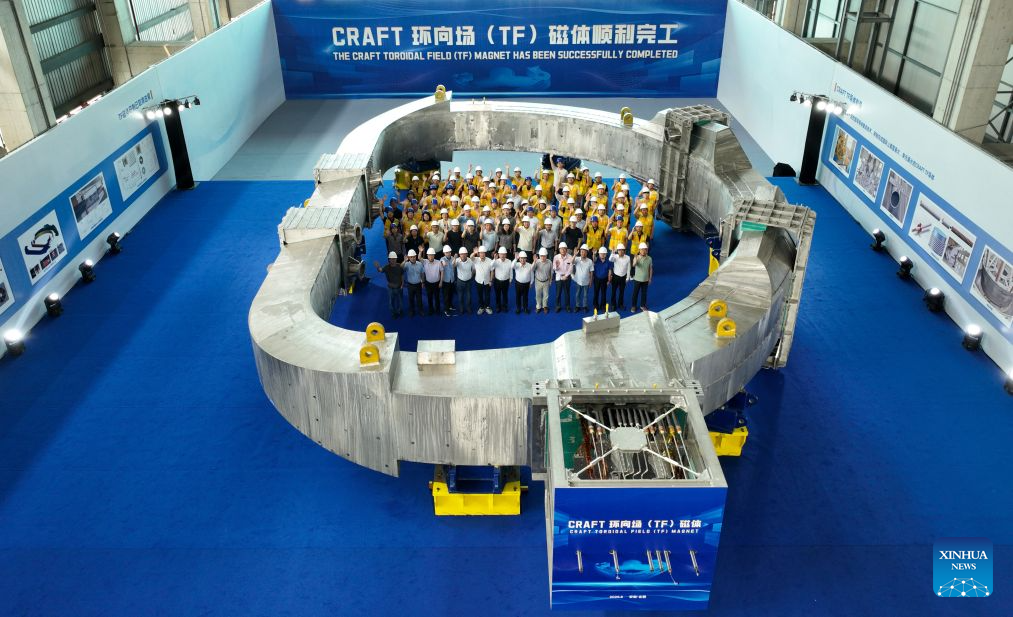
A drone photo taken on June 27, 2026 shows technicians and experts posing for group photos with the toroidal-field superconducting magnet for the fusion reactor in Hefei, east China's Anhui Province. China's "artificial sun" project, also known as the EAST (Experimental Advanced Superconducting Tokamak), on Saturday achieved a major engineering milestone in the development of superconducting magnet systems for the fusion reactors.
The Institute of Plasma Physics at the Hefei Institutes of Physical Science under the Chinese Academy of Sciences completed the development, acceptance, and full-performance testing of two key superconducting magnet systems for future fusion reactors, namely a toroidal-field superconducting magnet and a high-temperature superconducting central solenoid coil. All critical technologies were developed domestically, with the systems ranking among the world's most advanced in overall performance. (Xinhua/Zhou Mu)
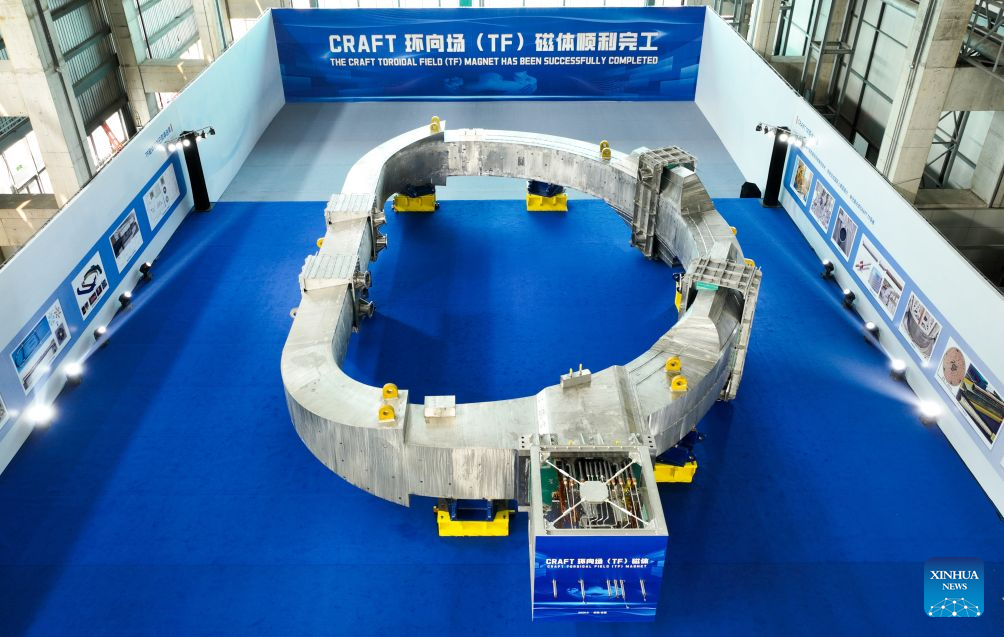
A drone photo taken on June 27, 2026 shows the toroidal-field superconducting magnet for the fusion reactor in Hefei, east China's Anhui Province. China's "artificial sun" project, also known as the EAST (Experimental Advanced Superconducting Tokamak), on Saturday achieved a major engineering milestone in the development of superconducting magnet systems for the fusion reactors.
The Institute of Plasma Physics at the Hefei Institutes of Physical Science under the Chinese Academy of Sciences completed the development, acceptance, and full-performance testing of two key superconducting magnet systems for future fusion reactors, namely a toroidal-field superconducting magnet and a high-temperature superconducting central solenoid coil. All critical technologies were developed domestically, with the systems ranking among the world's most advanced in overall performance. (Xinhua/Zhou Mu)
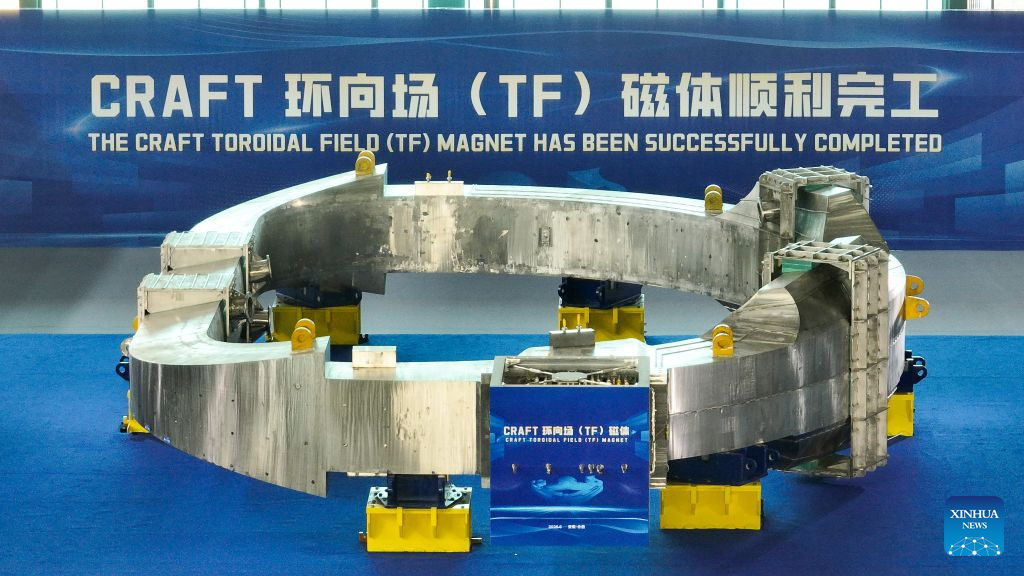
A drone photo taken on June 27, 2026 shows the toroidal-field superconducting magnet for the fusion reactor in Hefei, east China's Anhui Province. China's "artificial sun" project, also known as the EAST (Experimental Advanced Superconducting Tokamak), on Saturday achieved a major engineering milestone in the development of superconducting magnet systems for the fusion reactors.
The Institute of Plasma Physics at the Hefei Institutes of Physical Science under the Chinese Academy of Sciences completed the development, acceptance, and full-performance testing of two key superconducting magnet systems for future fusion reactors, namely a toroidal-field superconducting magnet and a high-temperature superconducting central solenoid coil. All critical technologies were developed domestically, with the systems ranking among the world's most advanced in overall performance. (Xinhua/Zhou Mu)
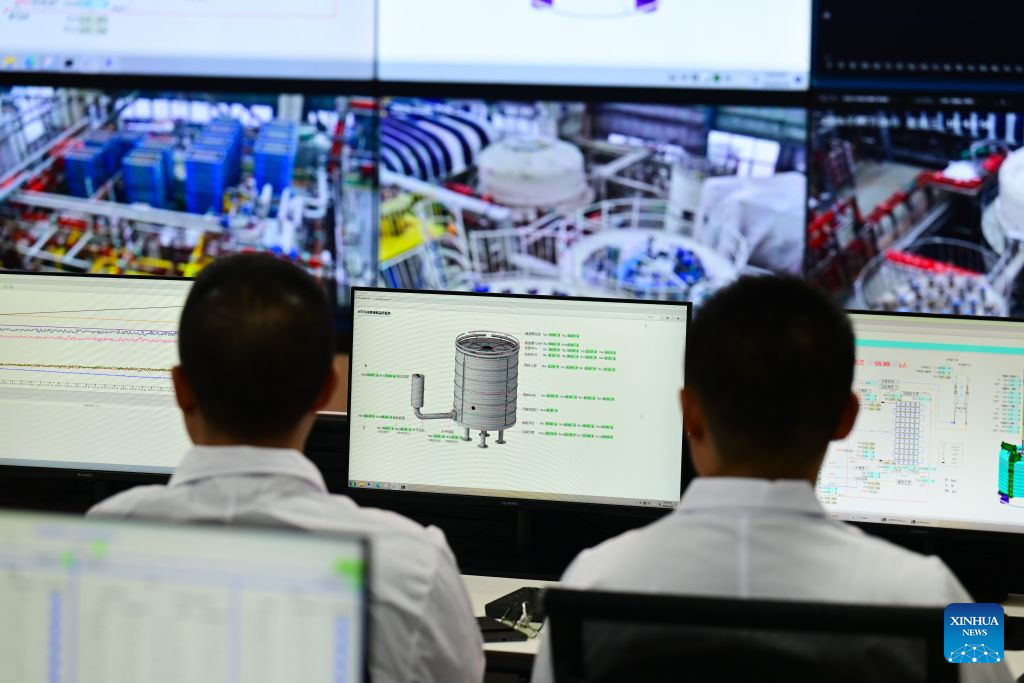
Researchers watch the testing of a high-temperature superconducting central solenoid coil in Hefei, east China's Anhui Province, June 26, 2026. China's "artificial sun" project, also known as the EAST (Experimental Advanced Superconducting Tokamak), on Saturday achieved a major engineering milestone in the development of superconducting magnet systems for the fusion reactors.
The Institute of Plasma Physics at the Hefei Institutes of Physical Science under the Chinese Academy of Sciences completed the development, acceptance, and full-performance testing of two key superconducting magnet systems for future fusion reactors, namely a toroidal-field superconducting magnet and a high-temperature superconducting central solenoid coil. All critical technologies were developed domestically, with the systems ranking among the world's most advanced in overall performance. (Xinhua/Zhou Mu)
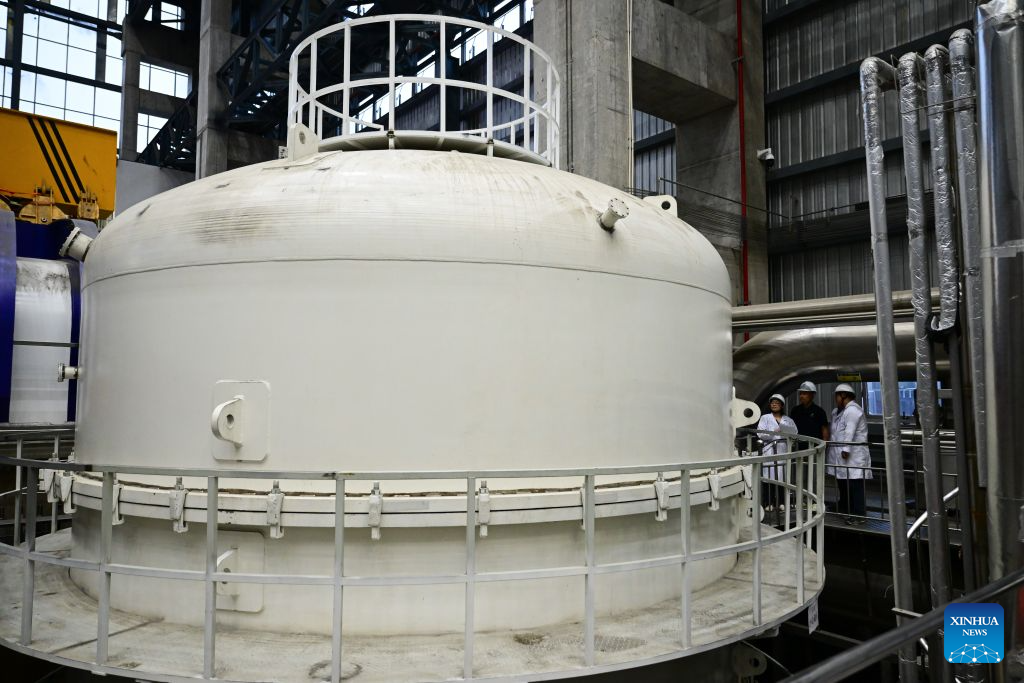
Researchers check the platform for testing a high-temperature superconducting central solenoid coil in Hefei, east China's Anhui Province, June 26, 2026. China's "artificial sun" project, also known as the EAST (Experimental Advanced Superconducting Tokamak), on Saturday achieved a major engineering milestone in the development of superconducting magnet systems for the fusion reactors.
The Institute of Plasma Physics at the Hefei Institutes of Physical Science under the Chinese Academy of Sciences completed the development, acceptance, and full-performance testing of two key superconducting magnet systems for future fusion reactors, namely a toroidal-field superconducting magnet and a high-temperature superconducting central solenoid coil. All critical technologies were developed domestically, with the systems ranking among the world's most advanced in overall performance. (Xinhua/Zhou Mu)
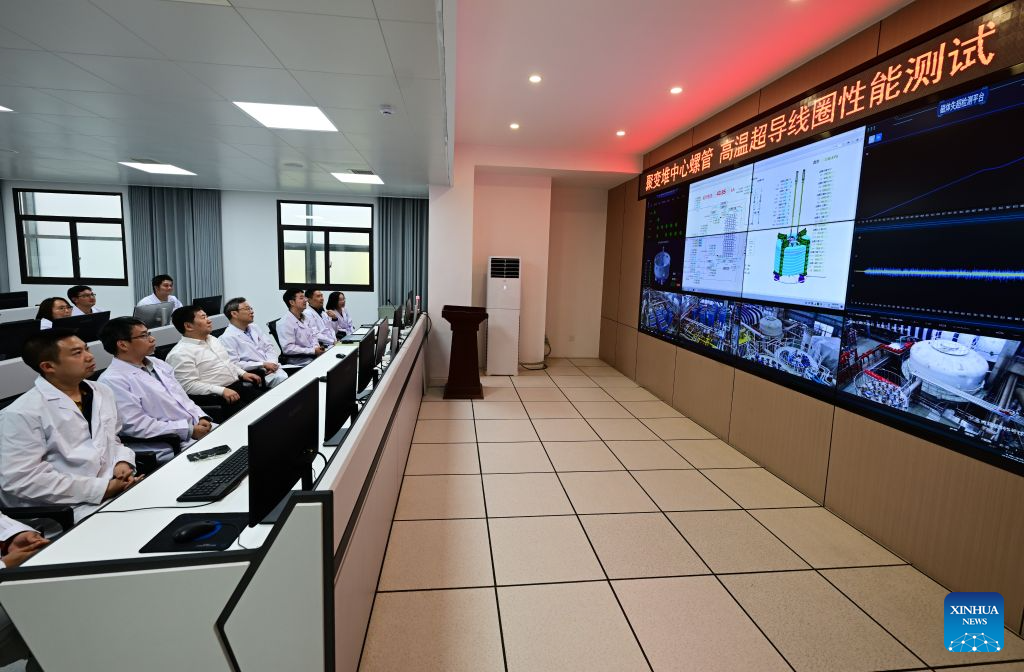
Researchers watch the testing of a high-temperature superconducting central solenoid coil in Hefei, east China's Anhui Province, June 26, 2026. China's "artificial sun" project, also known as the EAST (Experimental Advanced Superconducting Tokamak), on Saturday achieved a major engineering milestone in the development of superconducting magnet systems for the fusion reactors.
The Institute of Plasma Physics at the Hefei Institutes of Physical Science under the Chinese Academy of Sciences completed the development, acceptance, and full-performance testing of two key superconducting magnet systems for future fusion reactors, namely a toroidal-field superconducting magnet and a high-temperature superconducting central solenoid coil. All critical technologies were developed domestically, with the systems ranking among the world's most advanced in overall performance. (Xinhua/Zhou Mu)
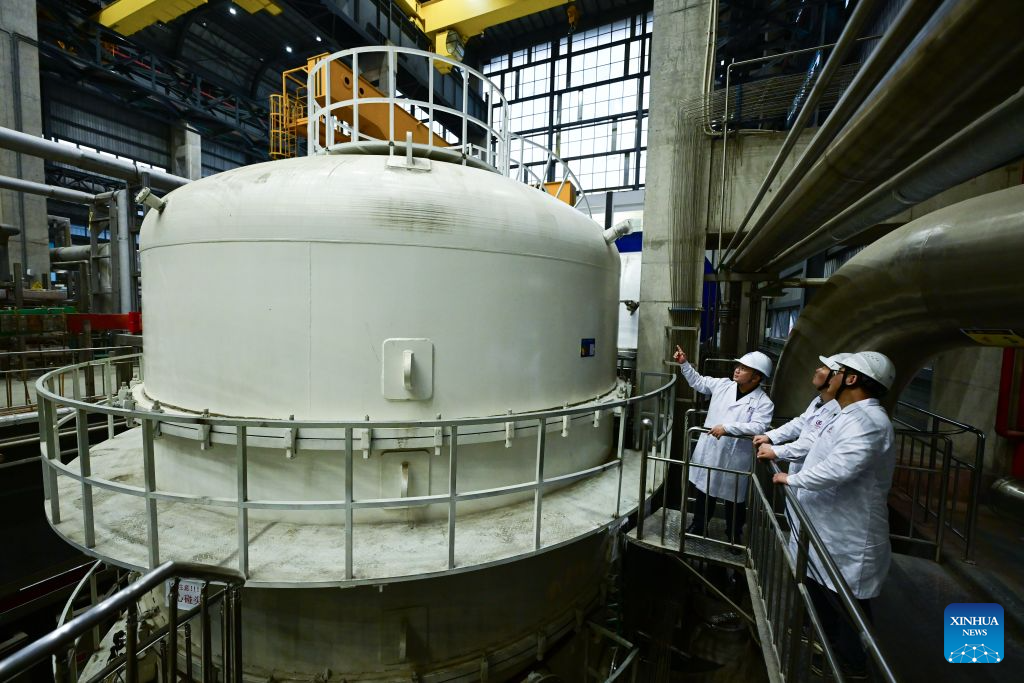
Researchers check the platform for testing a high-temperature superconducting central solenoid coil in Hefei, east China's Anhui Province, June 26, 2026. China's "artificial sun" project, also known as the EAST (Experimental Advanced Superconducting Tokamak), on Saturday achieved a major engineering milestone in the development of superconducting magnet systems for the fusion reactors.
The Institute of Plasma Physics at the Hefei Institutes of Physical Science under the Chinese Academy of Sciences completed the development, acceptance, and full-performance testing of two key superconducting magnet systems for future fusion reactors, namely a toroidal-field superconducting magnet and a high-temperature superconducting central solenoid coil. All critical technologies were developed domestically, with the systems ranking among the world's most advanced in overall performance. (Xinhua/Zhou Mu)


