
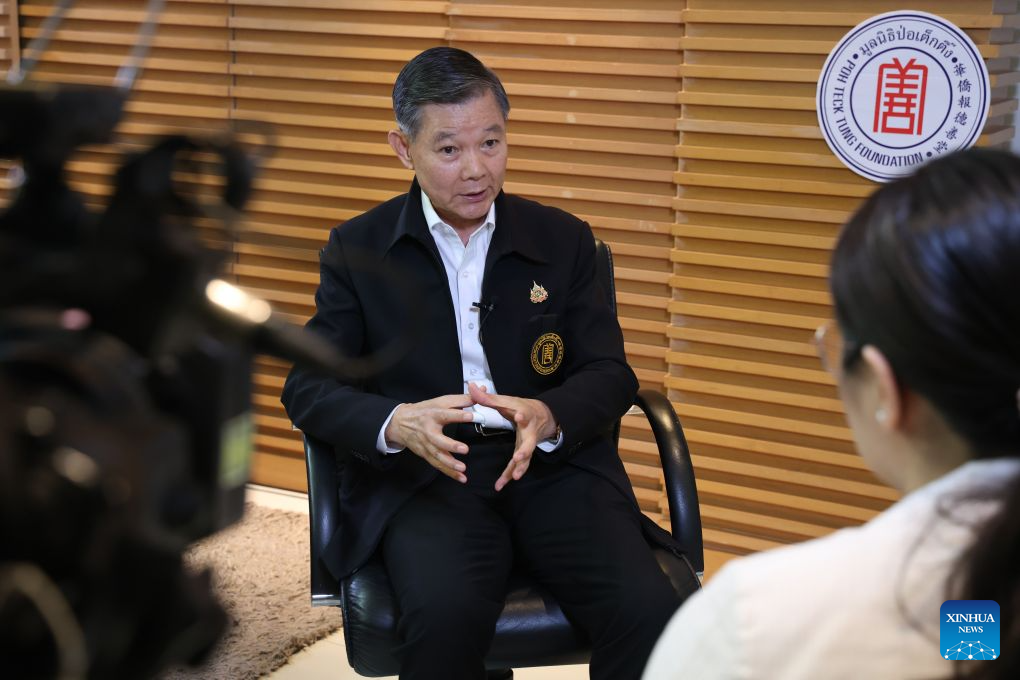
Xu Guanghui, vice chairman of the Poh Teck Tung Foundation, gives an interview to Xinhua in Bangkok, Thailand, June 9, 2026. (Xinhua/Sun Weitong)
BANGKOK, June 27 (Xinhua) -- China's heartfelt hit film Dear You is currently screening across multiple overseas countries and regions worldwide. Beyond its touching portrayal of family bonds and community commitment, the resonant feature encapsulates the enduring spiritual heritage of global overseas Chinese communities and sheds light on how these diaspora groups uphold ancestral traditions, contribute to both their motherland and local societies, and promote bilateral exchanges.
Such legacy is fully reflected in Thailand -- a historic primary destination of the century-old Nanyang (Southeast Asia) migration and a vivid microcosm of overseas Chinese diligence, gratitude and dedication.
TIMELESS "QIAOPI" MEMORIES
More than a century ago, numerous Chinese from the coastal provinces of Guangdong and Fujian crossed the ocean to seek livelihoods in Thailand amid hardship. Like the character Zheng Musheng in the film, most diligent overseas Chinese sent "qiaopi" to their families once they earned money.
In the 1950s, young Chen Zhenzhi left his hometown in Guangdong to join his elder brother in Thailand. Starting as an apprentice at a gold shop, he grew into Thailand's renowned "Gold King," and sending "qiaopi" became a habit he formed in his teens. "Whenever we thought of our hometown and families, we would send back every penny we had just saved," said Chen, now president of the Thai Gold Traders Association.
"Qiaopi" also anchors childhood memories for Lin Chuqin, president of the Thai-Chinese Chamber of Commerce. His parents migrated to Thailand for work in their younger years and persisted in sending back "qiaopi" even on modest incomes.
"During Chinese New Year, we children waited eagerly for red envelopes, yet my parents prioritized sending 'qiaopi' first before doling out pocket money," Lin noted. He still keeps photocopies of two "qiaopi," whose originals are now collected by museums in China.
For Li Jiachun, president of the Thai Chinese New Generation Business Association, "qiaopi" mirrors his own family's development trajectory. In the late 1970s, Li, as a young boy, witnessed his elder uncle returning home carrying sacks of scarce goods, including pork, biscuits and soap. "Ever since I was old enough to understand things, I've known I grew up relying on 'qiaopi'," he recalled.
DEDICATION TO HOMELAND TIES
Behind these "qiaopi" lies a deep longing for the motherland. Though advanced in years, Chen has never lost ties with his ancestral home. In recent years, he has invested in development projects in Jieyang, Guangdong, and frequently brought his children and grandchildren back for visits. "Our roots are in China, and I hope future generations will always remember where we come from," he stressed.
Times have changed, yet the new-generation overseas Chinese inherit the tradition of giving back to their ancestral homeland and innovate upon it.
Born in the 1970s, Li works tirelessly to secure study tours and government-enterprise matchmaking opportunities in China for young Thai Chinese, seeking to boost bilateral cooperation between China and Thailand.
During the COVID-19 pandemic, he donated 23.5 tons of Thai jasmine rice to Hong Kong. "The monetary value of donations matters less than conveying the sentiment of standing together with my homeland through thick and thin," he said.
Justin Lin, a man in his early thirties, has never sent any "qiaopi" in his life, but still resonates with Zheng Musheng's experience in the film.
"We enjoy far better startup conditions than our forebears, yet newcomers to Thailand still grapple with cultural barriers and integration difficulties. We are essentially Zheng Musheng with more advantages," said Lin, who has founded a consulting firm with partners to assist Chinese firms investing in Thailand with labor administration, regulatory compliance and external communication.
GIVING BACK TO LOCAL SOCIETY
Beyond nurturing enduring motherland affection, generations of Thai Chinese have upheld fine traditional virtues, integrating into and giving back to local Thai society through sustained philanthropic efforts.
Talking about the long-standing philanthropic tradition of the Chinese contributing to Thai society, Lin shared his personal observation: "Once I witnessed an accident on the road and saw staff from the Poh Teck Tung Foundation, instead of an ambulance, rushed to the scene first."
Poh Teck Tung Foundation is a prestigious, time-honored charitable institution founded by overseas Chinese in Thailand. Xu Guanghui, vice chairman of the Poh Teck Tung Foundation, said there are dual connotations behind the phrase "Poh Teck," which spells as "Bao De," meaning repaying kindness in Chinese.
"'Poh Teck' first embodies gratitude to Thailand, our host homeland, that enables overseas Chinese to thrive. Secondly, it is a tribute to our ancestral homeland, where our culture and heritage originate. The foundation's name retains its original Chinese pronunciation, so descendants will never forget their roots," Xu said.
Today, the spirit of "Poh Teck" has become an iconic symbol of Chinese communities in Thailand.
The Poh Teck Tung Foundation runs public welfare services spanning from birth to death. Its maternity hospital, established decades ago, ranks among Thailand's earliest maternity facilities and remains operational to this day. The foundation also provides working tools or vocational training for impoverished residents, dispatches volunteers to respond first to natural disasters and emergencies, and arranges proper burials for unclaimed deceased. Over the years, Thais have formed a consensus to dial the foundation for immediate help in car crashes, fires and other incidents.
"This philanthropic spirit rooted in Chinese culture will be passed down from generation to generation in both China and Thailand, continuously infusing momentum into friendship between the two countries," Xu said. ■


