by Xinhua writer Yang Shilong
NEW YORK, June 24 (Xinhua) -- At the age of 21, Jack Goodrich flew the Hump into China, a lifeline through which the Allies supplied China over the Himalayas between 1942 and 1945 in World War II.
Goodrich sat down with Xinhua recently in Malvern, Pennsylvania, home for 67 years. He remembers everything: the altitudes he flew at, the year he left China, and the taste of eggs in the southwestern Chinese city of Kunming, where he helped found a school, and he is convinced of one thing: The friendship between America and China matters more than ever.
"I CAME BACK. THEY DID NOT"
Goodrich's love of aviation began at roughly age 10, when he carved fragile airplane models from balsa wood with a tight-knit group of friends. There were six boys in that childhood squadron. Three became pilots in World War II. Only Goodrich came home.
"I was very fortunate," he said. "I came back. They did not. That was a very sad time."
The United States declared war against Japan when he was in high school. He trained as a pilot during a freezing St. Louis winter, then was assigned as copilot on the C-46, twin-engine military transport aircraft. On the flight line, ready to depart, he was redirected to a C-47 -- smaller, famously resilient. He told the pilot he had never flown one. The pilot told him not to worry.
He was.
After Japanese forces cut the Burma Road in 1942, the only way to keep China supplied was by air. Transport pilots flew from bases in India and Burma (now Myanmar) across the eastern Himalayas on a route they called simply the Hump -- through poor weather, thin air, primitive navigation and terrain that had already claimed hundreds of aircraft and their crews.
Goodrich was 21 when he was promoted from copilot to pilot, given his own aircraft and crew.
"To have my own ship at 21," he said, "that was quite a change in responsibility. I had to make sure we got back safe."
His base was in Myitkyina, northern Burma, on the Irrawaddy River. For eight months of the year, the flights were perilous but manageable -- clear skies, only enemy fighters to watch for. The monsoon season was different. Warm winds slammed into the Himalayan slopes and produced violent turbulence and walls of cloud that no small aircraft could safely enter.
"We flew through them anyway," Goodrich said, "night and day, because on the other side was China and the Flying Tigers, and they still needed supplies."
They flew on instruments from takeoff, on oxygen at 16,000 feet (4,877 meters) and higher, skimming a thousand feet above peaks that rose to 15,000. One monsoon night, midway to Kunming, his radio operator picked up another aircraft making nearly identical position and altitude calls. Seconds later, they broke through the clouds, and a C-46 screamed past so close overhead that it sheared off their radio aerial and damaged the rudder.
"If he had gone left, right, or under," Goodrich said, "both planes would have been down."
Instinctively, the other pilot had pulled up. When they landed in Kunming, that pilot sat in a corner shaking over a cup of coffee. Goodrich counted it as the closest he came to not coming home.
"KUNMING WAS THE REWARD"
On the ground at Myitkyina, life was rugged -- tents near the jungle, no electricity, no fresh milk, hunting to supplement their rations. One night, shaving by flashlight at two in the morning, Goodrich spun around to find two enormous glowing eyes just yards away. At first sight, he was almost certain it was a tiger. It turned out to be a water buffalo, lost and curious. Annoyed at his own fear, he hurled his razor at it until it retreated, then told the men who came running from their tents: "Oh, go back to sleep -- it was only a tiger."
Kunming was the reward.
While their planes were unloaded, crews rushed to the mess tent staffed by Chinese cooks.
"Eggs any time of night or day," Goodrich recalled, smiling at the memory. "Toast with jam and butter, coffee with cream and sugar. Every time I loved it."
"APPRECIATIVE OF OUR FRIENDSHIP"
Goodrich left China in December 1945. He returned to the United States and did what millions of veterans did: went to college, studied engineering and joined a firm that became one of the largest construction companies in the country. He built power plants, steel mills, dams and nuclear facilities. After 35 years, he became vice president of the construction company.
"I was very proud of that," he said.
The bond with China did not fade.
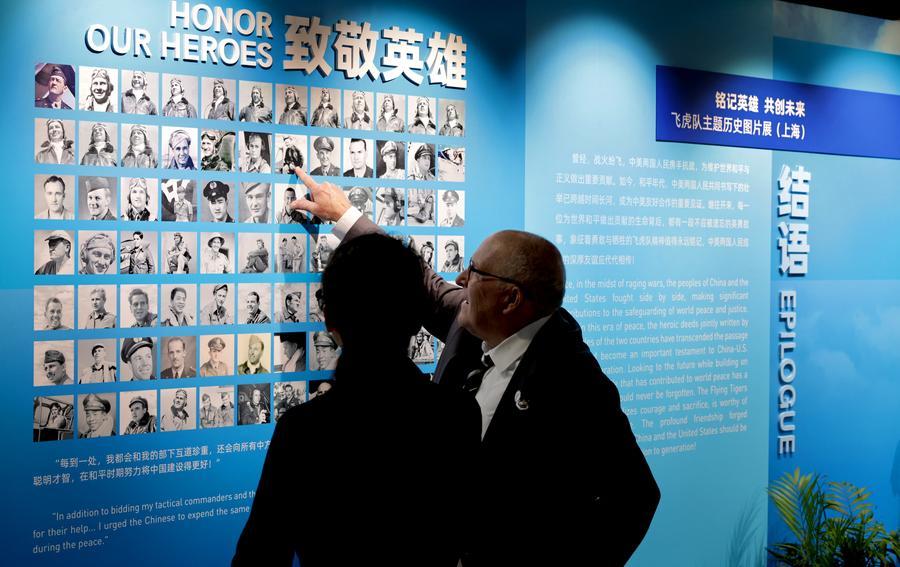
Over the following decades, as the Sino-American Aviation Heritage Foundation worked to keep the Flying Tigers' history alive, Goodrich spoke to students and civic groups, traveled back to China, and watched as a school established in Kunming -- begun with a single house purchased through his efforts and those of his Chinese friends -- grew into a full campus.
"I've always been very appreciative of our friendship," Goodrich said.
The world Goodrich looks out at now is not the one he hoped the postwar decades would build. China-U.S. relations are currently facing difficulties and strains. The conflict in the Middle East has unsettled energy markets, foreign policy and the ordinary economics of daily life across America. Alliances that once seemed durable are being tested.
He does not pretend that the tensions are not real. Nations will have disagreements, he acknowledges -- loud and long ones. But he draws a sharp line at violence.
"There's only one thing that's going to happen in a war," he said. "Equipment is going to be destroyed, and young men are not going to come home. Death."
He thinks of the five boys who carved balsa wood models with him as a child, the ones who went to war alongside him, the ones who did not return. He thinks of the Chinese pilots and generals and cooks and friends who made something real out of a wartime alliance -- a friendship, a school, a jade ring passed to a son.
Years ago, speaking in China, he said, "It is a pleasure to come back and find that the friends we made so many years ago in the stress of war are still our friends. May we remain such forever."
At 102, tending his garden, Goodrich still means it.
"Believe in tomorrow," he said. "It's going to come. Make it worthwhile." ■