
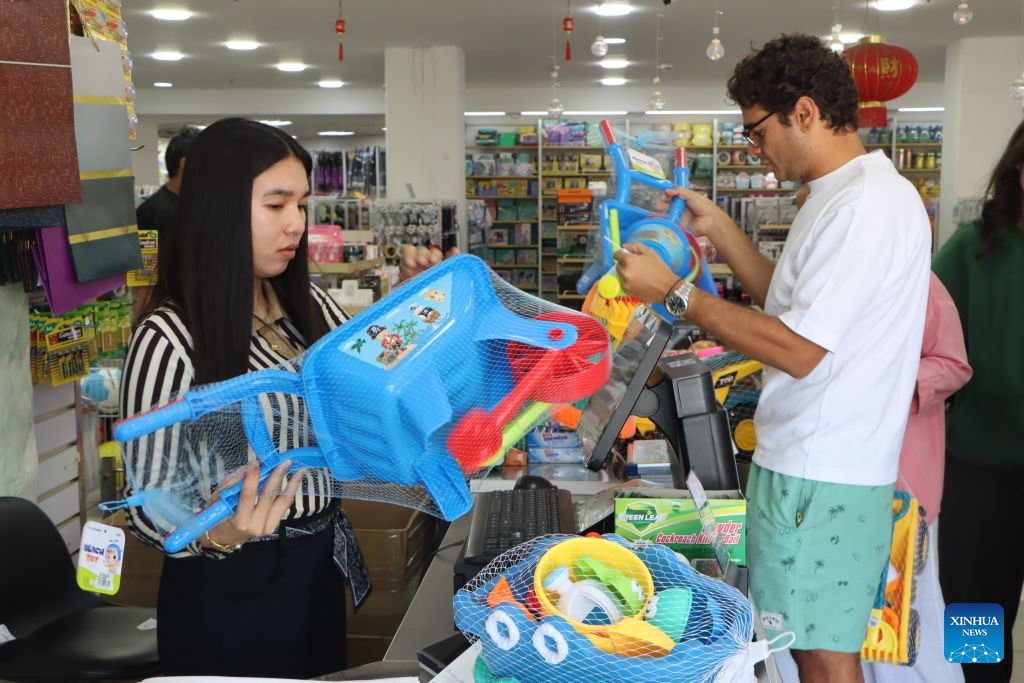
People select toys at a shop of China Town in Aqaba, Jordan, June 12, 2026. (Xinhua/He Yiping)
AMMAN, June 22 (Xinhua) -- On a hot summer afternoon in Aqaba's "China Town," a bustling marketplace, shoppers wandered through aisles lined with colorful goods while Chinese merchants haggled with customers in fluent Arabic.
For many visitors, such scenes have become a familiar part of Jordan's only coastal city. Since its establishment in 2006, China Town has grown into a popular destination for both residents and tourists visiting Aqaba.
"Every time I come to Aqaba, I never miss a visit to China Town," Khaled Abu Rakab, a resident from Jordan's northern Jerash Governorate, told Xinhua while touring the market.
"The variety of goods and prices encourages visitors to shop here regularly," Abu Rakab said. "The market also allows Jordanians to interact directly with Chinese merchants and learn more about the products they offer."
China Town hosts dozens of shops selling a wide range of Chinese-made products, including clothing, toys, household goods, accessories, perfumes and souvenirs. Its popularity reflects a broader shift in Jordanian consumer attitudes toward Chinese goods.
Rose Hassan, a resident of the capital Amman, said Chinese products have won growing acceptance in Jordan, with many Jordanians now seeing them as reliable and good value, rather than merely cheap alternatives.
"Many Chinese brands now compete strongly across different sectors, from electronics to automobiles," she said. "When I visit Aqaba, I often come here to buy household items and clothing, because the market offers a wide selection of products that meet family needs at affordable prices."
Behind the bustling storefronts are years of cooperation and friendship between Chinese and Jordanian traders.
Xu Bo, a Chinese merchant who has been selling shoes and toys in Aqaba for more than 15 years, now speaks Arabic fluently. He said the market has built a loyal following across Jordan.
"Over the years, I have established business relationships with many Jordanian traders," Xu said. "Together we have expanded the distribution of Chinese products throughout the country."
For Jordanian trader Ahmad Zahran, who is married to a Chinese woman and works in the clothing and accessories business, the significance of China Town extends beyond commerce.
"The market has helped Jordanians better understand Chinese products and appreciate their quality," he said. "More importantly, it has created opportunities for direct interaction between Jordanians and Chinese, strengthening mutual trust and understanding."
Business leaders say the market's success reflects the broader development of China-Jordan economic relations.
Mohammad Abu Omar, commissioner for economic affairs and investment at the Aqaba Special Economic Zone Authority, said Chinese investors are active across trade, textiles, light manufacturing and import-export services.
As cooperation between the two sides continues to deepen, interest is also expanding into renewable energy, logistics and export-oriented industries, Omar said.
Nayel Kabariti, president of the Aqaba Chamber of Commerce, noted the presence of Chinese investors has helped establish extensive economic and social ties with the local community, fostering mutual understanding and a model of economic coexistence.
"The direct connections between Jordanian and Chinese traders have made trade more efficient and opened wider opportunities for bilateral trade," he added. ■
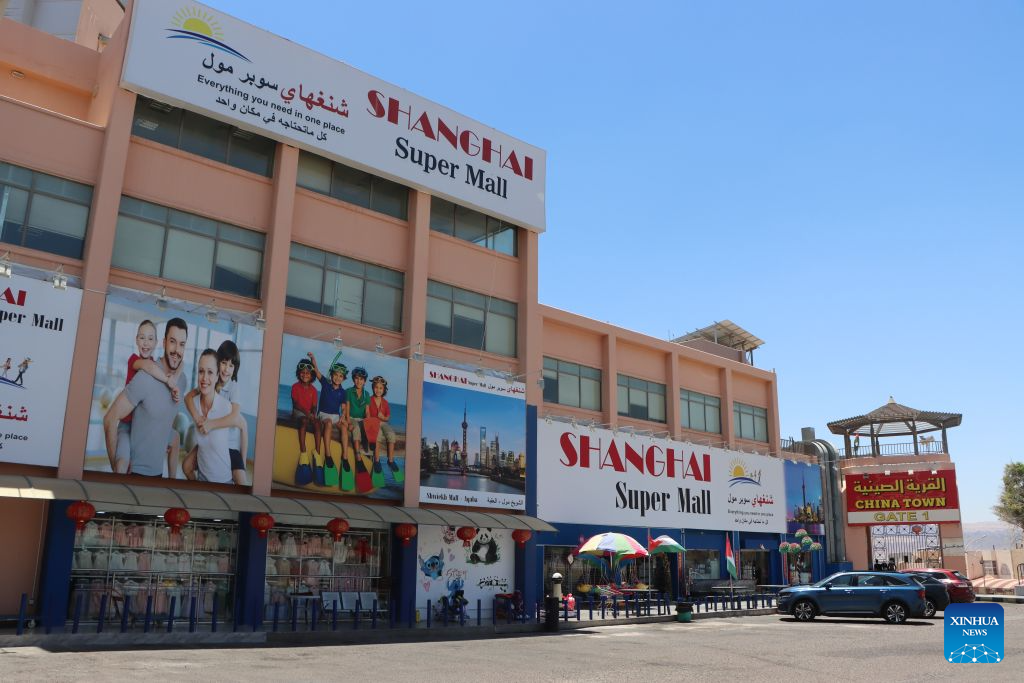
This photo taken on June 14, 2026 shows a building at China Town in Aqaba, Jordan. (Xinhua/He Yiping)


