
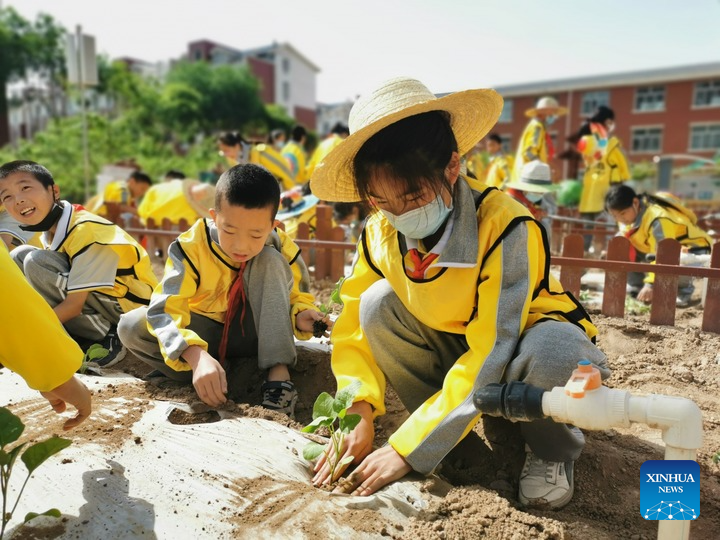
Students plant vegetables at a farming plot of No.23 Primary School in Xingqing District of Yinchuan, northwest China's Ningxia Hui Autonomous Region, in May 2022. (Xinhua/Ai Fumei)
YINCHUAN, June 22 (Xinhua) -- The assignment was to make cold dishes. The temptation to eat them first was too great!
As fifth-grader Nan Haoyi tried to arrange a plate of salad, a pair of chopsticks kept reaching in from the side. "Stop eating," she protested, batting a classmate's chopsticks away. "There won't be any left."
The scene, lively and a little unruly, did not unfold in a cafeteria. It was a labor education class at No.23 Primary School in Xingqing District of Yinchuan, capital city of northwest China's Ningxia Hui Autonomous Region, where children were learning how to wash vegetables, handle knives, mix seasonings and clean up -- and, more broadly, how much work lies behind an ordinary meal.
On a recent day, students arrived with ingredients from home, pulled on aprons and chef hats, and quickly divided the work among themselves. Soon, the room had broken into small stations: vegetables being prepared at one table, blanching at another, seasonings mixed in bowls, plates waiting to be arranged.
Their teacher, Yu Haiyan, who also teaches Chinese, gave only a few reminders: handle the ingredients carefully and watch the knives. Then the children set to work.
One group's shredded potatoes did not turn out as planned. Rather than abandon the dish, the students quickly turned it into mashed potatoes. Later, when Yu asked what the class had taught them, one child said the experience showed the importance of adapting when things go wrong.
For teachers here, that kind of small improvisation is part of what labor education is meant to teach.
Across China, labor education has received renewed official attention in recent years, with schools encouraged to help children develop basic life skills and respect for work. But in many urban schools, the idea can be difficult to carry out. Space is limited, safety responsibilities are heavy, and teachers are often trained for other subjects. As a result, labor classes can easily be pushed to the margins, reduced in some places to videos or other forms of "online experience."
At this school in Yinchuan, administrators have tried to turn what can easily become a symbolic subject into something children can touch, cook, and clean up after.
Over the past five years, the school has built three places for children to work with their hands: a small farming plot, a cooking classroom, and a seed museum. Together, they form what the school describes as a "field-to-table" system of labor education. Students learn about seeds and crops, take part in planting and tending vegetables, practice cooking, and clean up after themselves when the work is done.
The school began with a farming plot in 2021, added the cooking classroom two years later, and opened the seed museum in 2025 -- a step-by-step effort to make room, literally and figuratively, for a subject that is easy to assign but harder to teach.
"With real spaces like these, labor education isn't just a line on the timetable," said Shen Hao, director of the school's academic affairs office. "It is no longer just a one-off activity."
The lessons start with ordinary chores. In the lower grades, children practice folding clothes, organizing schoolbags, and peeling garlic. As they move up through the grades, they learn to recognize crops, try simple cooking, tend the school's farming plot, and prepare home-style dishes. By graduation, the school hopes to host a "graduation banquet" for parents and teachers.
"We are not trying to train cooks or farmers," said Wang Yongli, a senior school administrator. "We want children to understand daily life and respect labor."
Yet the cheerful kitchen scenes depended on a careful system of rules, supervision and preparation by adults.
Before each cooking class, students complete pre-class food-safety forms and check with their groups for allergies or special dietary needs. Ingredients must be bought from regular supermarkets, with receipts kept. Finished dishes are kept as samples for 48 hours in case any problem needs to be traced. The classroom was equipped with induction cookers, which the school considered safer for children.
Staffing was another hurdle. At first, labor classes were often taught by Chinese or math teachers, and the subject could easily slip back into conventional academic instruction. To keep the lessons on track, the school developed its own labor education handbook, spelling out the skills students should acquire in each grade and strengthening classroom supervision.
Yu said her own cooking had once been only average, so she practiced first before teaching the children. The extra work was real, she said, but the confidence she saw in her students made it worthwhile.
Parents have noticed the change, too. Li Rongrong, the mother of a fifth grader, said her child once knew little about basic chores and resisted being taught. After learning alongside classmates, the child became far more eager to try and could now cook for her when she was not feeling well.
Back in the cooking room, the class moved from discussion to tasting. The students picked up bowls and chopsticks, lined up to sample the dishes they had made, then cleaned the counters and sinks.
For Ma Xiaoying, another student, the lesson had a simpler meaning. "My parents don't have to worry that I'll go hungry anymore," she said. ■
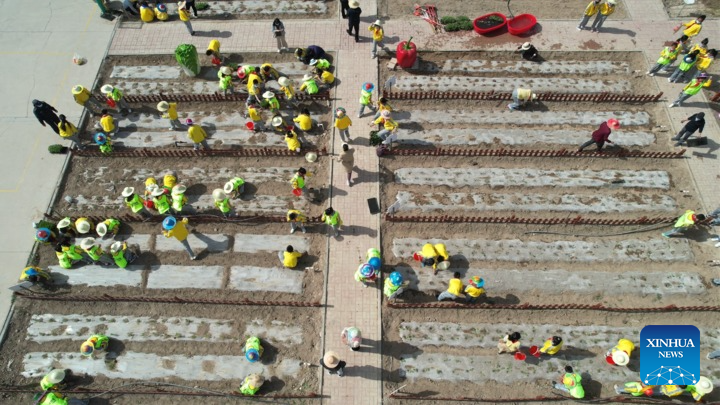
An aerial drone photo taken in May 2022 shows students planting vegetables at No.23 Primary School in Xingqing District of Yinchuan, northwest China's Ningxia Hui Autonomous Region. (Xinhua/Liu Jie)
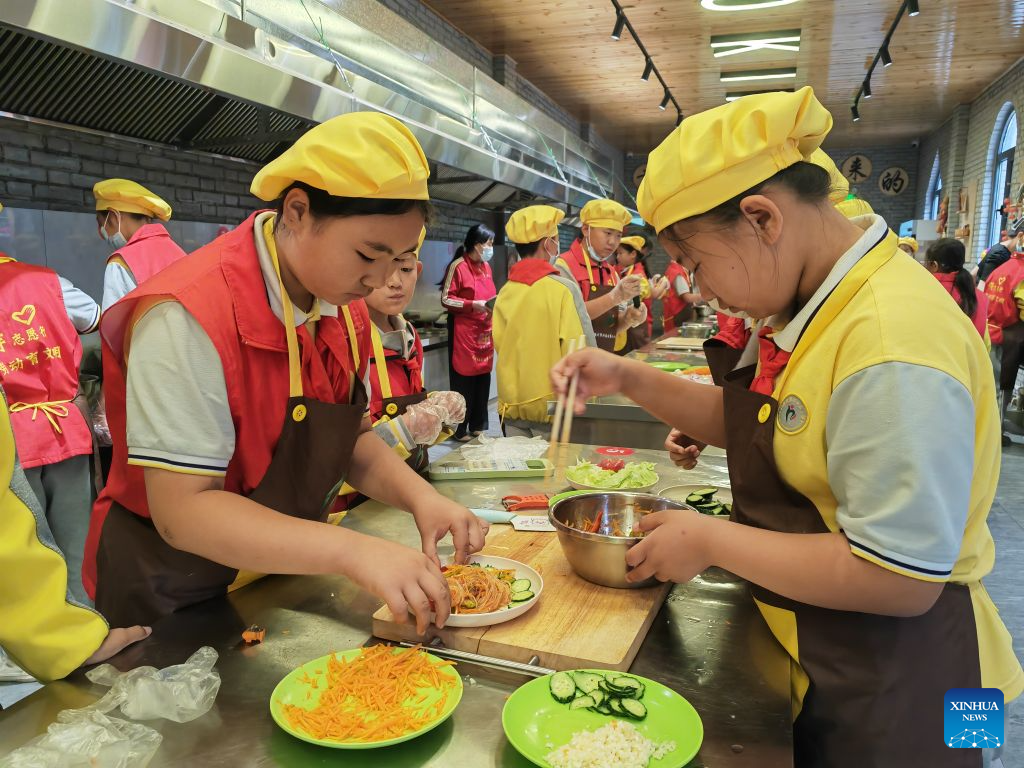
Students learn to make cold dishes at No.23 Primary School in Xingqing District of Yinchuan, northwest China's Ningxia Hui Autonomous Region, May 21, 2026. (Xinhua/Ai Fumei)
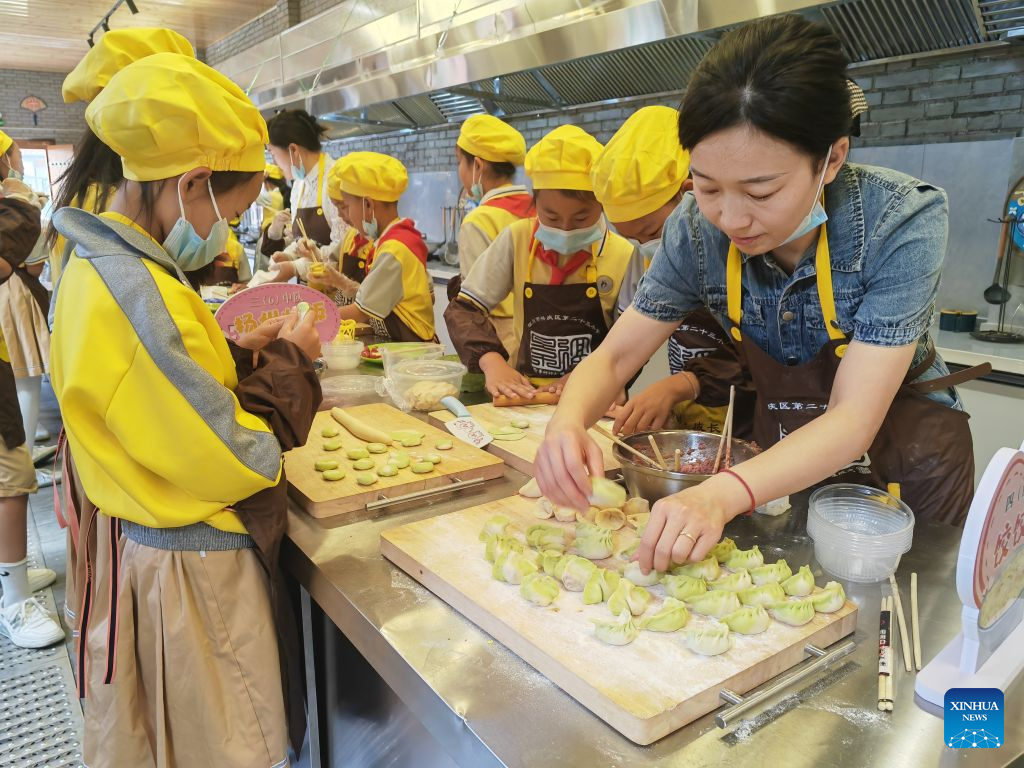
Students learn to make dumplings at No.23 Primary School in Xingqing District of Yinchuan, northwest China's Ningxia Hui Autonomous Region, May 31, 2024. (Xinhua/Ai Fumei)
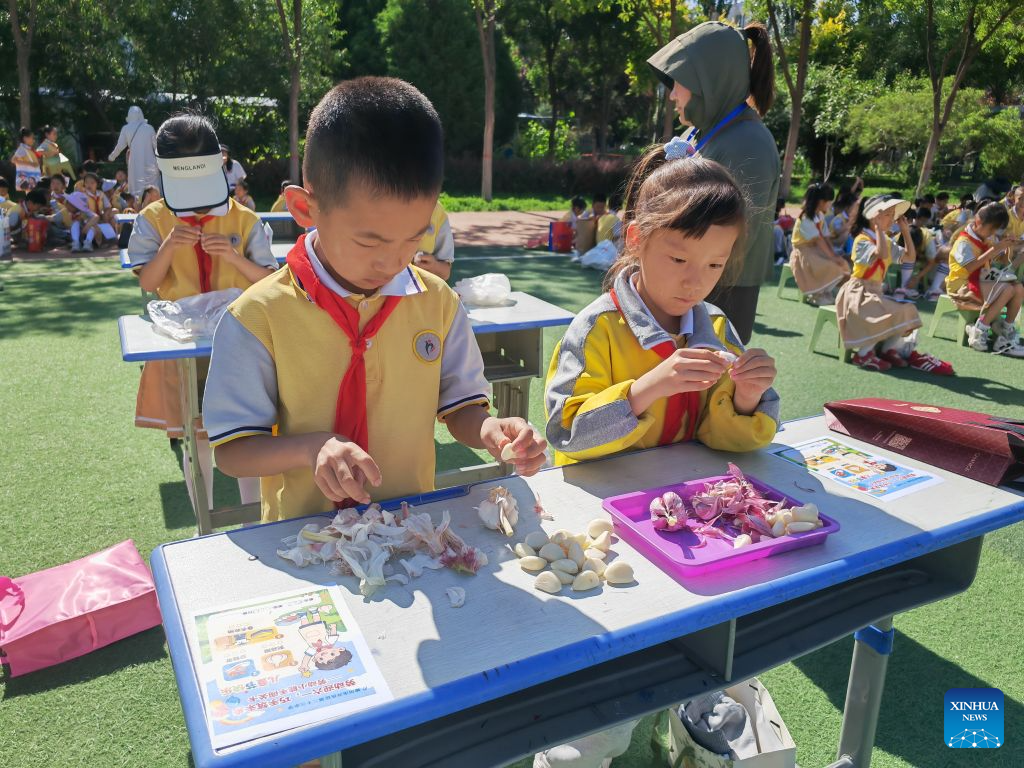
Students compete peeling the garlic during a labor skills competition on International Children's Day at Lijing Campus of No.23 Primary School in Yinchuan, northwest China's Ningxia Hui Autonomous Region, June 1, 2026. (Xinhua/Ai Fumei)


