* China has made significant strides in halting desert expansion through its decades-long afforestation campaign, known as the Three-North Shelterbelt Forest Program.
* With the progress of the program, 53 percent of China's treatable sandy land has been effectively managed through afforestation.
* Data from the National Greening Commission shows that by 2025, China had established 3,071 "Internet Plus Voluntary Tree Planting" bases nationwide, drawing more than 33 million total visits.
HOHHOT, June 17 (Xinhua) -- Sixty-year-old Yin Yuzhen is excited about an upcoming visit by her old American friend Ronald Sakolsky, whose charitable act 27 years ago sparked a miraculous green change.
In 1999, Sakolsky donated 5,000 U.S. dollars to support Yin's reforestation work on the fringe of the Maowusu Sandy Land, the fourth-largest sandy area in China. The over 50,000 saplings planted with that funding have now grown into a lush forest of towering trees, locking away sand and turning the barren fringe into a vibrant space.
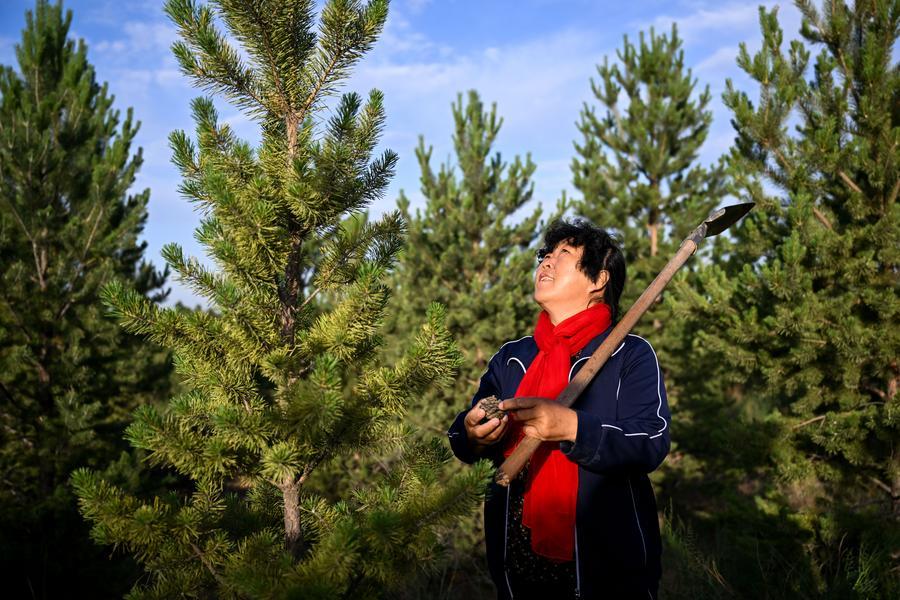
When Sakolsky came across the emotional video Yin posted online last month to reconnect with the American donor and share the good news, he decided to visit the forest with his children this August, to see the fruits of their shared environmental effort decades ago in China's Inner Mongolia Autonomous Region.
"To all the people that have texted me and followed me regarding Yin Yuzhen's story and the Inner Mongolia forest, I am humbled beyond words. I am not the hero of this story, Ms. Yuzhen is the miracle maker," Sakolsky said on his Facebook account.
Sakolsky first met Yin by chance when he worked as an exchange teacher in China. By then, Yin had spent more than a decade battling desertification that had severely threatened her livelihood, even half burying her house during sandstorms. "I'd rather wear myself out planting trees than let sand defeat me," she vowed.

Moved by her challenging tree-planting work on the desert fringe, Sakolsky donated money to support her project. Yin sewed a pair of embroidered insoles overnight to express her gratitude.
Thanks to government efforts and local residents' incessant work, 70,000 mu (roughly 4,667 hectares) of former desert near Yin's home has been planted with 8 million trees.
Yin's decades-long fight against desertification is just one microcosm of the sweeping ecological transformation across China.
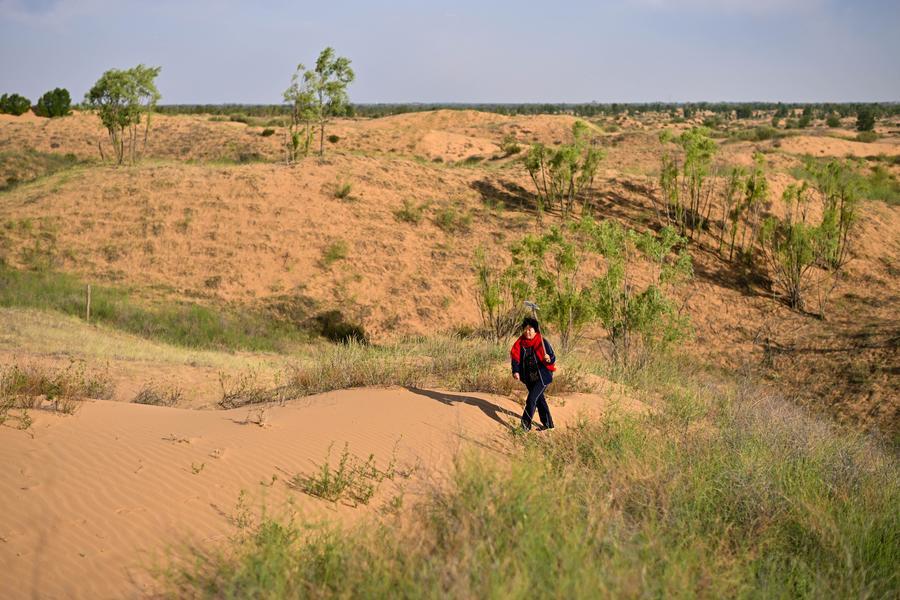
Wednesday marked the World Day to Combat Desertification and Drought. China has made significant strides in halting desert expansion through its decades-long afforestation campaign, known as the Three-North Shelterbelt Forest Program, initiated in 1978 to combat desertification across the northwest, north and northeast of the country. This largest afforestation project globally is still underway.
Over the decades, China has set up special funds, offered preferential tax policies and mobilized farmers and locals in afforestation campaigns. With the progress of the program, 53 percent of China's treatable sandy land has been effectively managed through afforestation. The country is not only the first in the world to achieve "zero growth" in land degradation and a "double reduction" in desertified and sandy land areas, but has also transformed its role from a recipient of international desertification control aid to a key contributor to global ecological governance.
MORE VOLUNTEERS
Today, apart from dedicated local farmers like Yin, China's afforestation campaign also attracts large numbers of environment-conscious volunteers, especially among young urban dwellers and international students.
Forest coverage rate in Minqin, a county in northwest China's Gansu Province, has reached 18.28 percent, up from just 3 percent in the 1950s. More than seven decades of sustained reforestation has yielded a 380-kilometer peripheral forest and grass zone, effectively stopping the expansion of two big deserts.
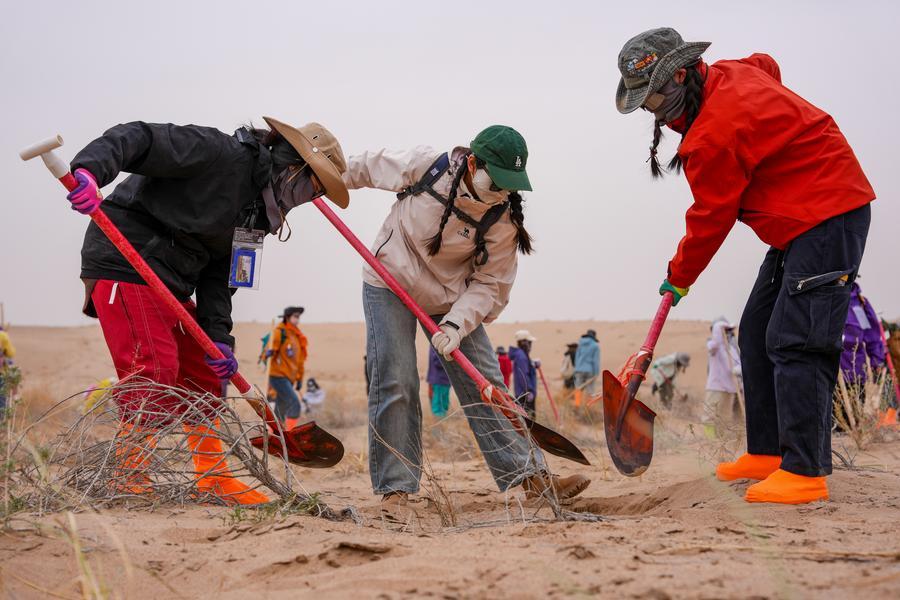
Jiang Liling, deputy director of Minqin's Bureau of Forestry and Grassland Administration, noted that more than 100,000 locals take part in voluntary tree-planting each spring and autumn annually.
This year, local authorities rolled out an innovative dual-track afforestation framework: a WeChat mini-program serves as an online registration hub for volunteers signing up for Minqin's planting projects, pairing digital tree adoption with hands-on field cultivation.
Touched by promotional short videos documenting Minqin's decades-long war against desertification, 28-year-old Shanghai office worker Zhu Wanyin opted to spend her annual leave planting trees in Minqin this year, ditching her usual coastal beach getaways.
"When I focus solely on manual labor, all stress and worries melt away. Every finished task delivers tangible fulfillment and unadulterated joy. Surrounded by peers with the same aspirations, I feel far more attuned to nature," she said.
Since February, over 30,000 volunteers like Zhu have traveled to Minqin at their own cost for the signature campaign "Plant a Tree in Minqin." Roughly 80 percent of participants are college students and young professionals aged 20 to 35, alongside a cohort of international volunteers.
French exchange student Marie Fitoussi, 29, learned of the initiative through classmates and traveled to Minqin to plant trees, leaving with an uplifting new sense of empowerment.
"Each of us is a tiny force on our own, but united we can hold back the sand and build a greener tomorrow," she said.
See Thou Kai Ain, 30, journeyed all the way from Malaysia, taking flights and buses to pitch in.
"Every sapling we put in the ground is a glimmer of hope. Transforming desert into oasis is well worth every bit of effort," she said, encouraged by the afforestation practices in China to curb desertification.
Data from the National Greening Commission shows that by 2025, China had established 3,071 "Internet Plus Voluntary Tree Planting" bases nationwide, drawing more than 33 million total visits.
"Public engagement in national desertification prevention and control has grown increasingly diversified," said Zhu Qiantao, professor at Lanzhou University of Finance and Economics, located in Gansu. He added that for younger generations, joining anti-desertification work has evolved into a rewarding lifestyle, a personal identity marker and a path to a meaningful life purpose.
"Combating desertification is a long-distance relay race that demands unwavering dedication handed down through generations. Sustained ecological restoration is only possible when we pool wisdom and manpower from every sector of society," said Jiang, the county forestry official.
(Video reporters: Peng Yuan, En Hao, Ren Yanxin, Cheng Nan, Guo Gang, Lu Ying, Duo Lei, He Jin; video editors: Hong Ling and Luo Hui)■