WUHAN, June 17 (Xinhua) -- Malaysian graduate student Chew Sien Ping is no stranger to venturing beyond the boundaries of medicine. For him, artificial intelligence (AI) isn't just a tool; it's a fast track that cuts through complexity and unlocks new possibilities.
"I work on interdisciplinary projects involving medicine and engineering. AI helps me quickly integrate information from different fields and perspectives," said Chew, who is researching molecular imaging for complex eye diseases and visual brain-computer interfaces at Shanghai Jiao Tong University.
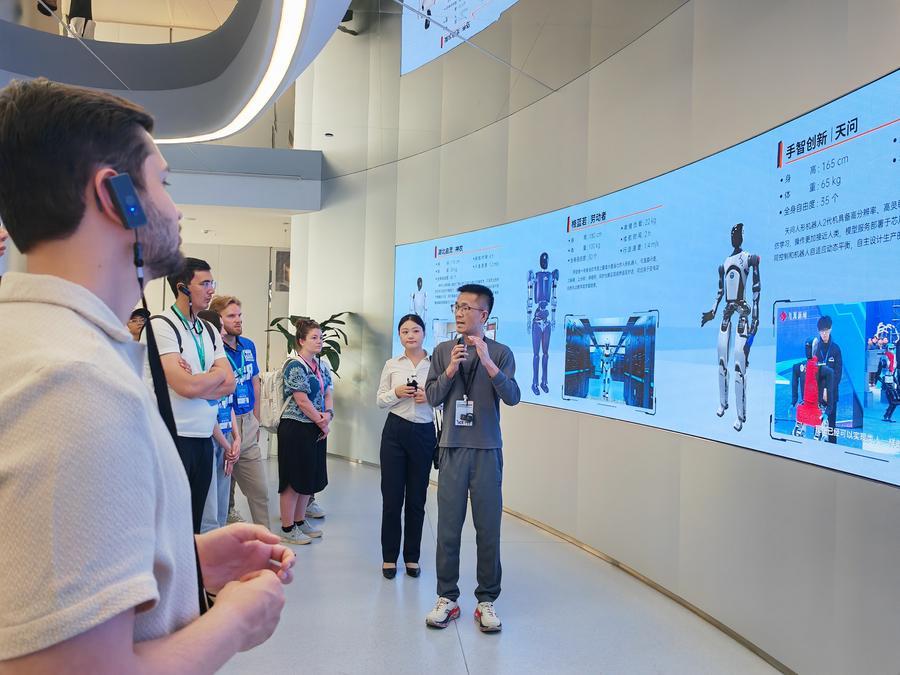
Chew was among more than 500 participants from UN agencies, international youth organizations and over 120 countries and regions attending the 2026 World Youth Development Forum, which was held this week in Wuhan, capital of central China's Hubei Province.
Participants at the forum engaged in lively discussions on how AI is transforming research, entrepreneurship, education and social development.
During the forum's Acceleration Week for Global Youth Development Programs, organizers selected more than 170 youth development projects from over 70 countries and regions. The initiatives were grouped into eight categories, including "AI Plus."
Among the most talked-about innovators was Brazilian economist Felipe Bailez, whose team developed Palver Intelligence, an AI-powered platform designed to monitor and analyze information flows across social media and traditional media.
"We monitor the entire information ecosystem, including Facebook, Instagram, Twitter (now rebranded as X), YouTube, WhatsApp, and also television and radio," Bailez said. "With this data and AI, we can understand if there's disinformation or fake news, and then we help Brazilian companies and the government navigate this really confusing ecosystem."
While some participants focused on cutting-edge innovation, others highlighted AI's potential to narrow longstanding development gaps.
"With AI's data resources and capabilities, many things that once appeared impossible or required enormous resources are becoming possible," said Gao Yongkai, a graduate student from Hong Kong University of Science and Technology (Guangzhou).
Gao's team established an AI learning corner inside a village bookstore in Guangzhou, the capital of south China's Guangdong Province, benefiting over 3,500 residents.
The corner offers free AI guidance in writing, oral English training and science education and encourages students to use AI tools to document and promote local culture.
Addressing the forum, A Dong, first secretary of the Secretariat of the Communist Youth League of China Central Committee, described young people as the generation best positioned to shape the future of AI.
"We hope young people from all countries can work together to launch more impactful development projects, bridge development gaps, promote more inclusive economic globalization and build a world of shared prosperity," he said. ■