
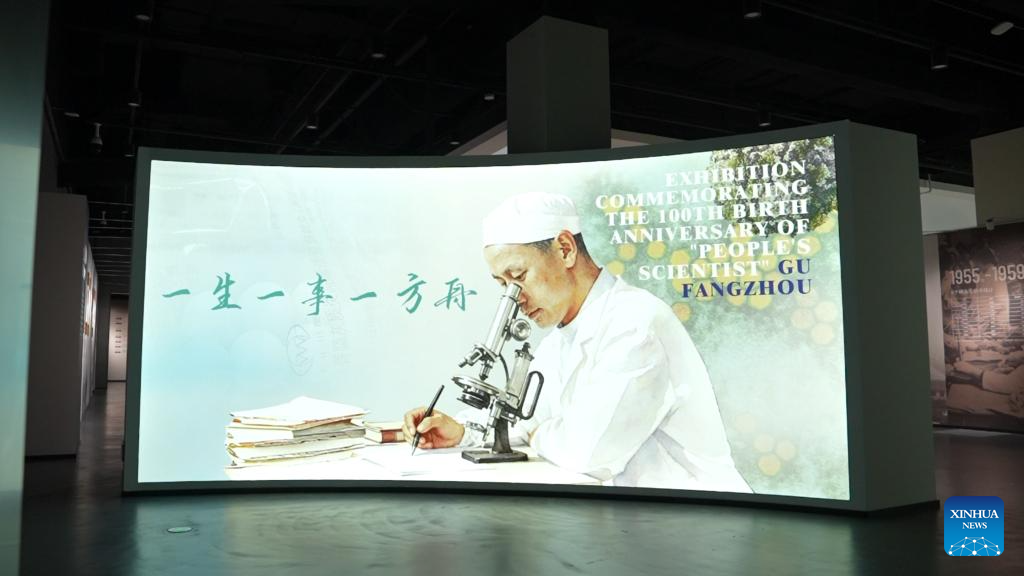
This undated photo shows a themed installation depicting Chinese virologist Gu Fangzhou at an exhibition commemorating his 100th birth anniversary in Beijing, capital of China. Chinese virologist Gu Fangzhou's heroism in swallowing an untested vaccine and then secretly feeding it to his infant son ultimately gave rise to China's oral polio vaccine, a "sugar pill" that would protect millions of children. (Xinhua)
BEIJING, June 16 (Xinhua) -- Chinese virologist Gu Fangzhou's heroism in swallowing an untested vaccine and then secretly feeding it to his infant son ultimately gave rise to China's oral polio vaccine, a "sugar pill" that would protect millions of children.
Although the story is decades old and the disease long been wiped out in China, Gu has never been a forgotten icon. His name remains inseparable from the breathtaking gamble.
On Tuesday, an exhibition commemorating the 100th anniversary of the late scientist's birth opened in Beijing, and his name has once again appeared in news outlets across the country.
Gu Liedong, the son who took that first dose, still feels proud to have participated in his father's scientific work in such an extraordinary way, over 60 years ago.
"I have no memory of it. It was only later, through media reports and family members, that I learned I was the first child to receive the vaccine," the son recalled in a recent interview. "I feel very honored that I could make a small contribution to his work."
Born on June 16, 1926, Gu devoted his life to fighting poliomyelitis, a highly-contagious disease that paralyzed thousands of children across mid-20th-century China. In 1955, a severe outbreak ravaged many cities, including Shanghai and Qingdao. At the time, no vaccine existed to prevent it. Parents carried their limp sons and daughters to Gu and his colleagues, begging for help.
In 1957, Gu was tasked with developing a polio vaccine. To produce it, Gu and his team went to the remote southwestern province of Yunnan, where they built laboratories inside mountain caves.
After animal trials, they needed to test the experimental vaccine on humans. Gu drank the first vial himself. He did not get sick. But adults often carry natural antibodies, so the real test required children. Later, Gu brought his infant boy to the lab and fed him the vaccine, without telling his wife.
"If my own child won't take it, how can I ask other people's children to take it?" Gu said.
The baby stayed healthy. Moved by Gu's example, his colleagues vaccinated their own children, the nation's first kids to receive the polio shots.
"My father rarely talked about his own achievements at home," said Gu Lienan, Gu's second son. "But if you understood what he went through: giving up a comfortable life in Beijing and moving the entire family, including his mother, his wife and his children, to a remote mountain valley in Yunnan, then you would realize that his decision to test the vaccine on himself and on his own child was not a sudden heroic act, but a determined choice."
By the end of 1960, the first batch of 5 million doses of the liquid vaccine had been rolled out in 11 cities across China. In those cities, the peak of polio outbreaks gradually began to subside.
As the epidemic receded, however, Gu saw a new challenge. The vaccine's refrigeration requirements made it difficult to reach remote areas, and children did not like injections or taking bitter medicine.
After intensive experiments, Gu's team transformed the liquid vaccine into a white sugar pill, much more palatable for kids. It could also be stored longer than the liquid form.
With the help of the vaccine, in 1990, China began implementing its plan to eradicate polio across the country. In 2000, the World Health Organization declared China polio-free.
Gu's given name "fangzhou" means "ark" in Chinese. Netizens dubbed him "Sugar Pill Grandpa" after his story spreading online. Gu died in January 2019, and months later he was awarded the national honorary title of "People's Scientist."
Despite his monumental achievement, Gu remained humble. "I only did one thing in my life," he once said, "and that was to make a small sugar pill."
The modest Chinese scientist has also received international recognition.
At the end of last year, the 43rd UNESCO General Conference adopted a resolution to commemorate the 100th anniversary of his birth, celebrating his scientific dedication and global public health. China, France and Italy will jointly host centennial celebrations in his honor.
During those arduous years of research, Gu and his wife, also a virologist, were immersed in the lab day and night, leaving their two sons with a childhood that was often lonely.
In the eyes of Gu Lienan, his father never bragged. The image lingered in his mind was a scientist immersed himself in experimental work, data analysis and reading foreign-language literature.
"The outside world calls him a hero," the son said. "But in our family, he was an ordinary person." ■
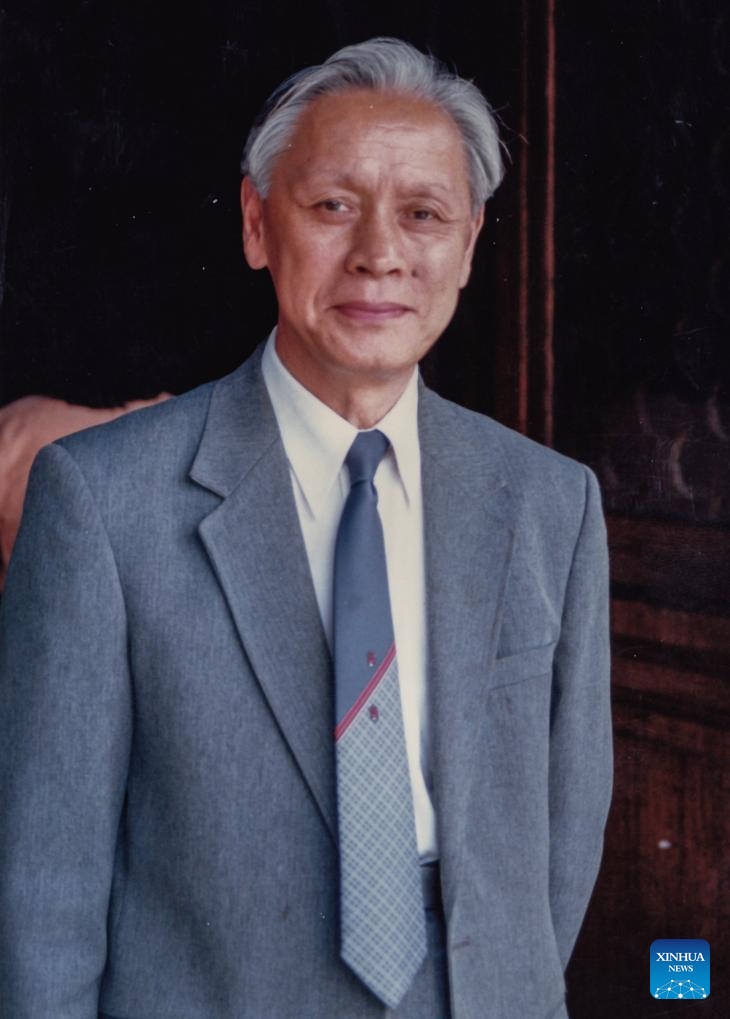
This file photo shows a portrait of Chinese virologist Gu Fangzhou. Chinese virologist Gu Fangzhou's heroism in swallowing an untested vaccine and then secretly feeding it to his infant son ultimately gave rise to China's oral polio vaccine, a "sugar pill" that would protect millions of children. (Xinhua)


