
China's experience indicates that urban infrastructure should not be a mere collection of separate projects, but a unified system that serves the people, an Azerbaijani expert has said.
by Liu Shuchen, Orkhan Muradov
BAKU, June 16 (Xinhua) -- China's decades of urban development offer valuable experience for developing countries seeking sustainable and livable city environments, an Azerbaijani expert has said.
Emin Gasimov, director of Azerbaijan's Center for the Study of China's Global Initiatives, Development and Culture, made the remarks in an interview with Xinhua ahead of the 13th World Urban Forum held in Baku last month under the theme "Housing the world: Safe and resilient cities and communities."
China regards housing as the foundation for building livable, safe and resilient cities, which is highly consistent with the forum's theme, Gasimov said.

China accumulated rich practical experience in affordable housing, old neighborhood regeneration, large-scale transport infrastructure, digital governance, green solutions, and public service improvement, said the expert.
China is going beyond house repairs by upgrading utility networks, public spaces, residential courtyards, recreational areas, and facilities for the elderly and children, he added.
"Between 2014 and 2025, I visited China on many occasions. I personally witnessed how the urban environment has been transforming: transportation has become far more convenient, public spaces are much better planned and organized, and the quality of daily services has been steadily improved," he said.
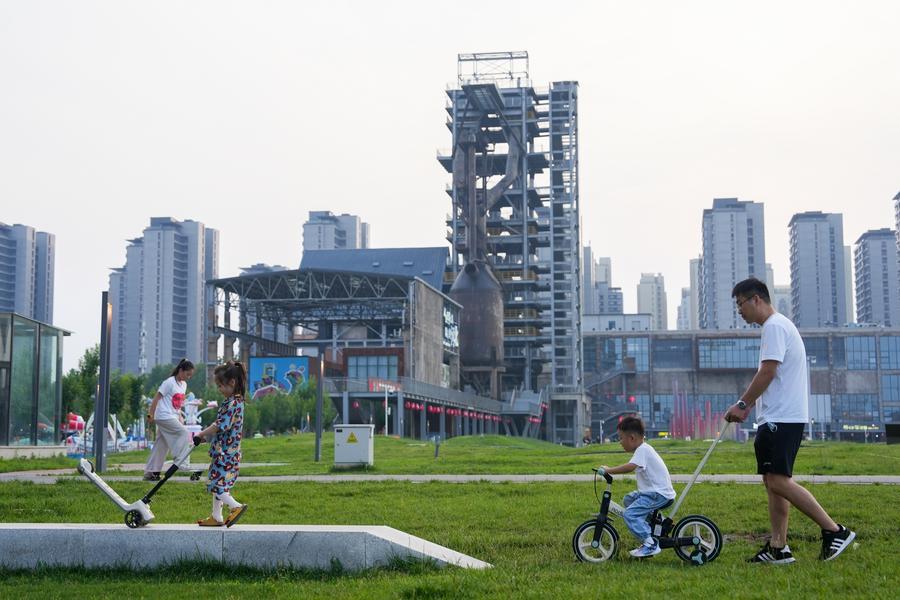
He cited China's eastern metropolitan Shanghai's "15-minute community life circle" concept as a prime example, under which residents can access essential daily, social, cultural, and transportation services within a short walk from their homes. He also highlighted Xiong'an New Area in northern China's Hebei Province as a model next-generation city where housing is integrated from the outset with public services, ecological protection, transportation, and modern management.
China's experience indicates that urban infrastructure should not be a mere collection of separate projects, but a unified system that serves the people, he said, adding that this is precisely where the practical value of the Chinese model lies for cities seeking rapid, sustainable, and modern development.
Specifically, China's urban management experience under high-load conditions is particularly valuable for Baku, with Shanghai demonstrating that the sustainable development of a megacity requires not only the construction of new districts, but also the continuous improvement of urban governance -- especially through better coordination of transportation systems, municipal utilities, public security, ecological protection, and overall urban services, Gasimov said.

"China's practice shows that a sustainable city is one that effectively integrates economic growth, ecological protection, technological innovation, public services, and human dignity. This approach is of particular importance to the world today, especially for developing countries," he said. ■