
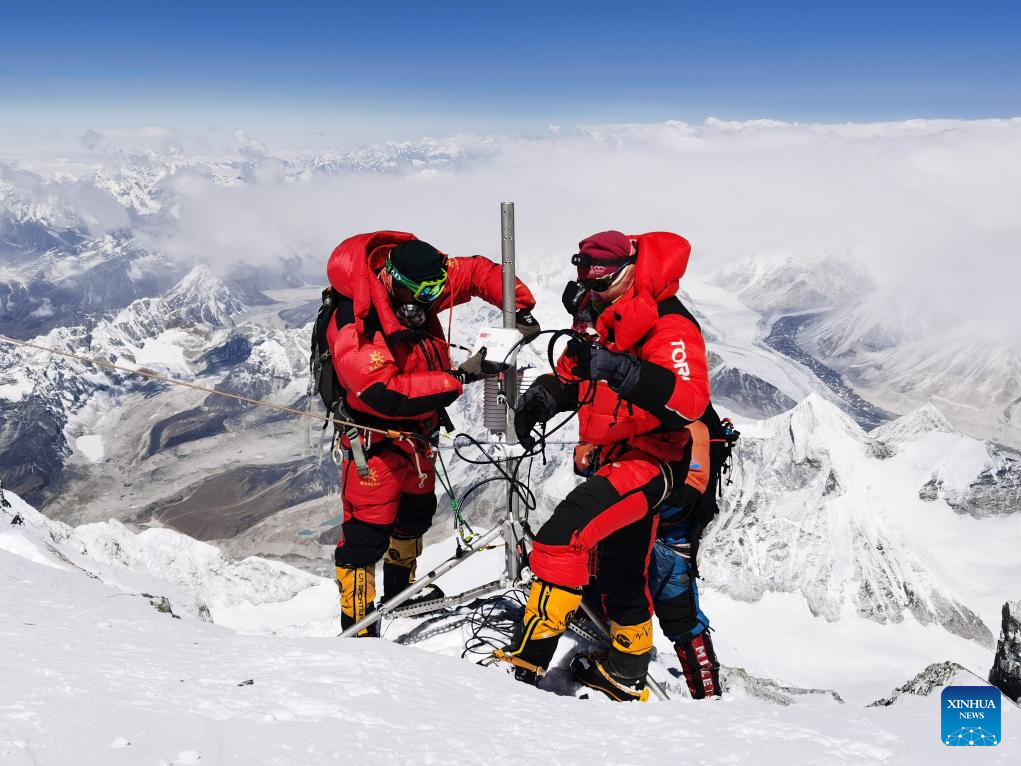
This photo taken on May 4, 2022 shows researchers setting an automatic weather station at an altitude of 8,830 meters on Mount Qomolangma. (Xinhua/Sonam Dorje)
by Xinhua writer Zhou Yulong
LHASA, June 16 (Xinhua) -- Qomolangma, the world's highest peak standing at 8,848.86 meters above sea level, was once a distant and untouchable symbol that I read about in my geography textbook and could only admire from afar.
Never did I expect that years later, I would stand on the highlands of Xizang Autonomous Region in southwest China, and follow researchers as they conducted field visits at the Qomolangma scientific observation station.
Through the trip, I witnessed the profound changes taking place there and the unwavering dedication of generations of scientists.
My journey to the station started in the regional capital Lhasa. As we headed southwest and climbed higher, the landscape changed visibly. Lush greenery faded, replaced by bare mountains, gravel lands and snow-capped peaks looming on the horizon.
The toughest stretch lay on the winding road to the mountain pass at an altitude of 5,210 meters. As the car wound its way upward through a series of hairpin turns, my stomach kept churning.
Just as I was overwhelmed by severe dizziness and nausea, we finally arrived at our destination, officially named the National Field Observation and Research Station (Xizang Dingri) for Qomolangma Special Atmospheric Processes and Environmental Change.
Perched 4,276 meters above sea level and over 30 km from the Qomolangma base camp in Dingri County, the site is plagued by thin air, incessant winds and extreme temperature swings between day and night.
Staring at the barren highland landscape while struggling with altitude sickness, I couldn't help but wonder what inspired scientists to build and remain committed to a field observation station in such harsh conditions.
Ma Yaoming, the station's founder and a leading expert on plateau atmospheric research, helped me find the answer.
As "the water tower of Asia," the Qinghai-Tibet Plateau sustains major rivers, and its ecological shifts impact global water security. Ma explained that the intricate environmental changes of the plateau cannot be decoded via short-term expeditions or fragmented data. Only sustained, long-term on-site monitoring can truly capture its evolutionary patterns.
The station traces its roots to 2005, when early researchers juggled station construction and field observations, living and working in flimsy tents.
Ma still remembers a night when gales ripped open their tents while they were sleeping.
"We woke abruptly on folding beds, staring up at a bare, star-studded sky with no shelter overhead. I thought I was dreaming," Ma told me. The team then fumbled for flashlights, rushed to safeguard instruments and helium cylinders, a device that is used to fill a sounding balloon, and chased after the tents that had been swept away.
The station now looks completely different after two decades of development. The tattered tents have given way to robust two-story buildings and improved research and living facilities. What began with a focus on atmospheric physics has become a comprehensive Earth system science observation platform covering the atmosphere, glaciers, hydrology, ecology and geophysics.
I was delighted to discover an on-site greenhouse growing leeks, mint, and other greens, a rare luxury for anyone dining at such an altitude. A simple meal of freshly picked leek scrambled eggs offered a warm and tangible glimpse into the station's vastly improved living conditions.
In 2021, the station was officially recognized as a national field scientific observation and research station, joining China's national-level research infrastructure. Now, nine staff members work year-round at the station, handling long-term field monitoring and logistical support to ensure its smooth operation. Additional researchers also stay at the station on a regular basis.
To experience their daily research work firsthand, I joined the station's researchers on a field trip to a 5,200-meter meteorological observation site near the Qomolangma base camp the next day.
We had to climb a dirt slope on foot. After just a few steps, my breathing grew heavier. My heart beat faster, and before I knew it, my pace had slowed. By the time I finally made it up the slope, I was panting and wanted nothing more than to stop and catch my breath.
The researchers beside me, however, moved as if they were on familiar ground. Carrying equipment on their backs, they checked instruments and cables with practiced ease. Some even broke into a light jog, turning back to tell me, "Take your time. If you feel unwell, drink some cola. It'll make you more comfortable."
For me, the short uphill trek was already a challenge; for them, it was just another day in the field.
It was then that I came to realize that those plain-looking data -- wind speed, wind direction, temperature and humidity -- are never easy to obtain. Behind each one are years of fieldwork in the Qomolangma region, from maintaining instruments in snowstorms to collecting samples in freezing conditions.
Researchers' dedication has fueled the growth of the Qomolangma scientific observation system. From the main station, researchers have built observation sites at different altitudes along the peak's northern slope, forming a vertical profile for comprehensive Earth system observation.
During China's second Qinghai-Tibet Plateau scientific expedition launched in 2017, eight automatic weather stations were erected on the northern slope, including one at 8,830 meters, boasting the world's highest of its kind. In a major breakthrough, a domestically developed atmospheric observation floating airship ascended near the station to 9,032 meters, setting a new world record for atmospheric science observation.
Since its establishment, the station has welcomed research teams from Japan, Germany, the Netherlands, Nepal and other countries, with collaborations covering areas such as meteorological disaster prevention, earthquake risk reduction and polar climate.
For two decades, researchers have endured relentless wind and cold at this remote highland outpost. Their hard-won plateau data crosses borders, documenting local ecological changes and delivering valuable Chinese insights for global climate governance. ■
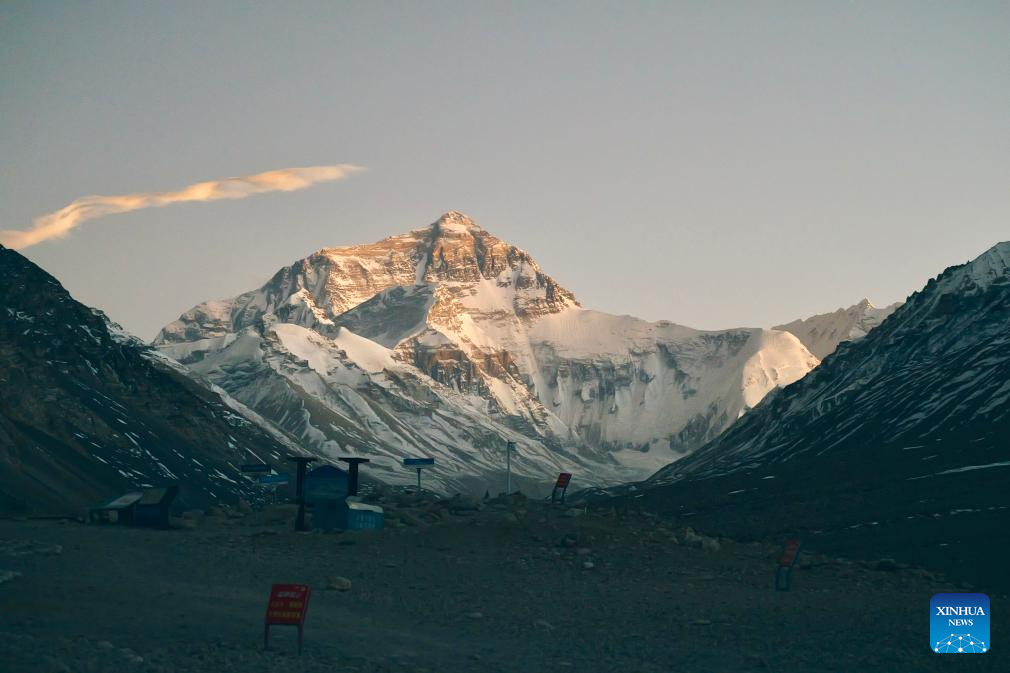
This photo taken on Dec. 23, 2025 shows a view of the Mount Qomolangma at sunset in southwest China's Xizang Autonomous Region. (Xinhua/Zhou Yulong)
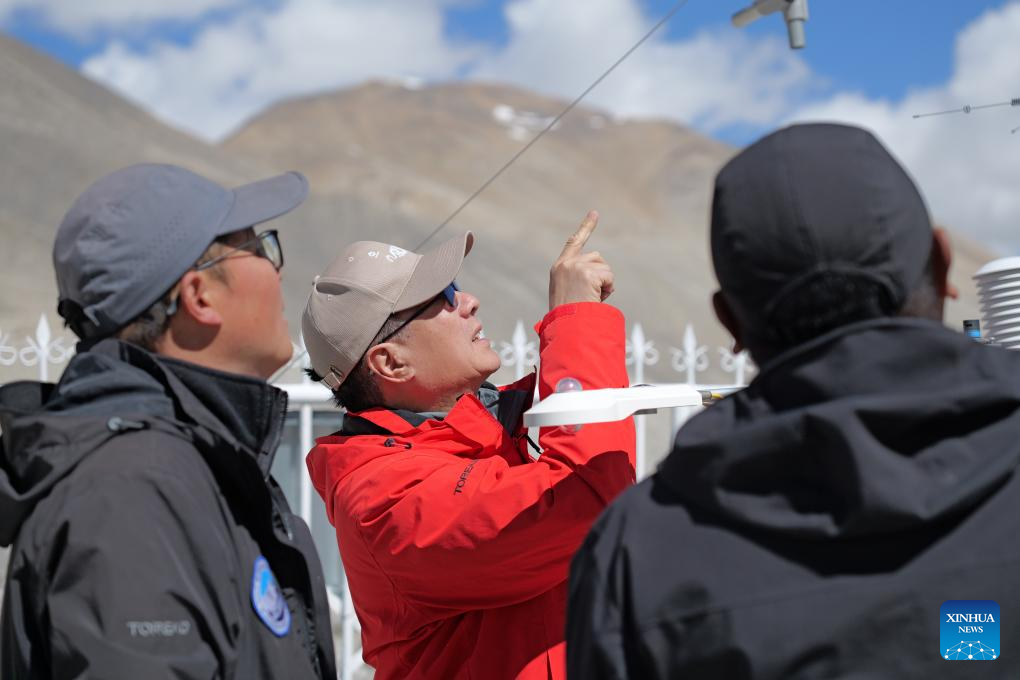
This photo taken on June 4, 2026 shows Ma Yaoming (2nd L), founder of the National Field Observation and Research Station (Xizang Dingri) for Qomolangma Special Atmospheric Processes and Environmental Change, checking devices with researchers in southwest China's Xizang Autonomous Region. (Xinhua/Zhou Yulong)


