
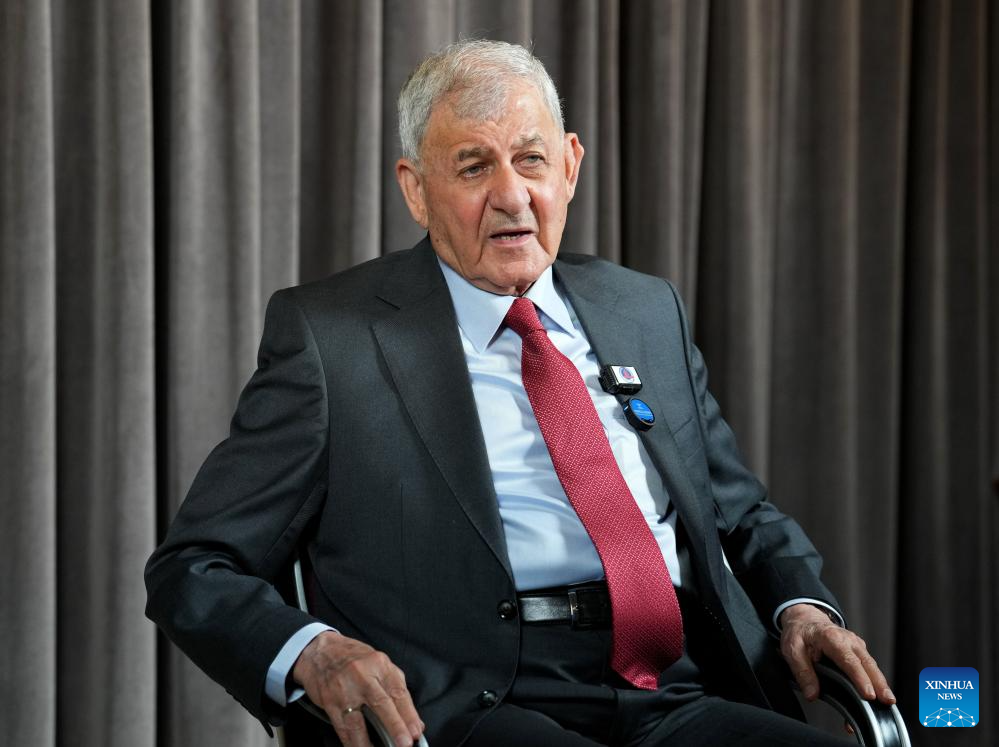
Former Iraqi President Abdul Latif Rashid speaks during an exclusive interview with Xinhua in Beijing, capital of China, June 11, 2026. (Xinhua/Li An)
BEIJING, June 12 (Xinhua) -- China's practice of promoting human rights through development is truly admirable, former Iraqi President Abdul Latif Rashid has said in an exclusive interview with Xinhua.
Speaking on the sidelines of the 2026 Forum on Global Human Rights Governance in Beijing, Rashid noted that the forum's convening ahead of the 40th anniversary of the adoption of the United Nations (UN) Declaration on the Right to Development carries profound significance.
"The right to development is a basic human right," he said. "All the people are entitled to participate in development, to contribute and to enjoy economic, social, cultural and political development."
Rashid noted that the all-round advancement of science, technology and the economy forms the cornerstone of human rights protection, and that genuine development must be people-centered, with the right to development reflected in everyday life.
Social progress must go hand in hand with social justice, otherwise, any achievement in politics, social governance and livelihood improvement will be unattainable, he said.
On his third visit to China, Rashid said he had been witnessing China's rapid progress in urban development, infrastructure upgrading and overall social progress.
Having visited multiple Chinese universities and research institutions, he expressed deep admiration for China's outstanding education system and scientific research capabilities.
Rashid attributed China's profound, far-reaching and remarkable development to its safe and stable social environment, as well as to the Chinese people's commitment to their own civilization and history and their pursuit of a brighter future. He pointed in particular to the role of visionary leadership bound by deep bonds of trust with the people, and to the broad and steadfast public support that leadership enjoys.
On the broader question of global human rights governance, Rashid commended China's efforts to improve international relations and advance human rights. Drawing on Iraq's own experience, he observed that his country has endured decades of war, sanctions and terrorism, which has convinced him that peace and stability are the prerequisites for development, and development in turn is the bedrock of human rights.
He also spoke highly of China's constructive role in Iraq's post-war reconstruction and expressed gratitude for China's valuable support in energy, infrastructure and other areas.
On global challenges, Rashid called for stronger coordination and cooperation across the international community. The transition to a green economy, he argued, must be just and balanced, respecting the needs of developing countries and their peoples' right to development and stability.
"The right to development should be regarded as a common right of all humanity, not a privilege monopolized by a few nations," he said. He further said he hoped that China would enjoy further progress and prosperity and that more countries could benefit from China's advances in economy, science and culture. ■


