SHENZHEN, June 12 (Xinhua) -- As darkness fell over Shenzhen in south China, more than 1,000 drones rose into the night sky.
The aircraft arranged themselves into glowing images of Tintin, the Smurfs and the Atomium, drawing applause from a visiting Belgian political and business delegation gathered below.
For many cities, a spectacle like this would be a special event. But in Shenzhen, China's technology hub and the birthplace of drone-manufacturing giant DJI, it is becoming close to ordinary.
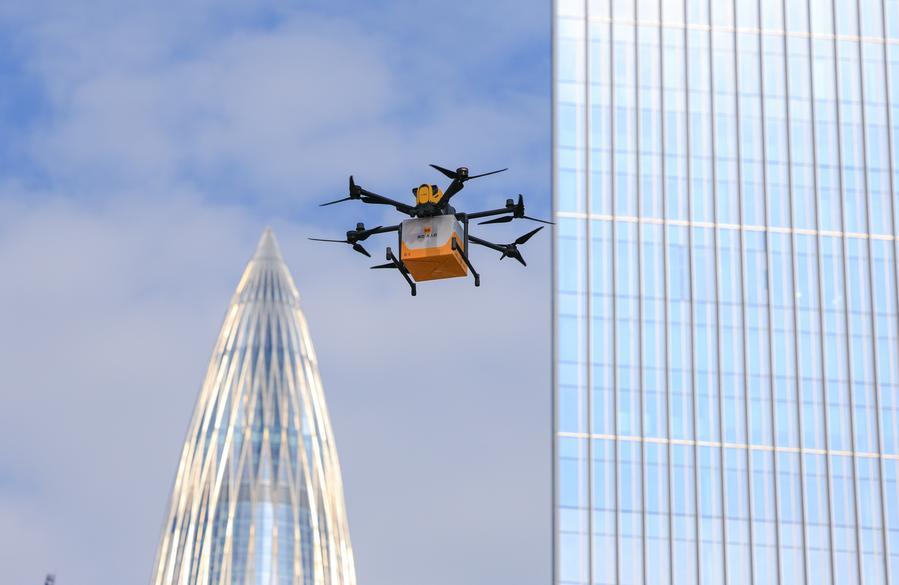
A few kilometers away, drones buzz overhead carrying takeout meals. In some parks and residential communities, small drone pickup stations stand alongside vending machines and bicycle racks. An expanding network of aerial routes is transporting food, medicine and other goods above the traffic-clogged streets.
The scene offers a glimpse of what Shenzhen hopes will become the next chapter in its development -- the low-altitude economy, a fast-growing sector that includes drone manufacturing, logistics and urban management services.
The foundations for that ambition were laid decades ago.
Adjacent to Hong Kong, Shenzhen in Guangdong Province was one of China's first special economic zones. What was once a fishing village evolved into a global manufacturing powerhouse, with assembly lines churning out computers, phones and other gadgets for global brands.
Among the entrepreneurs drawn to that boom was Gao Jianmin.
In the 1990s, Gao, now chairman of High Great, the company behind the drone show, came to Shenzhen and entered the market for mobile phone display models. With precise craftsmanship, his factory quickly gained a foothold, securing orders from major brands including Motorola and Samsung.
But as markets shifted quickly and smartphones became widely popular, the seeds of transformation had already been planted.
Then came an unexpected opportunity. After reading a magazine article about quadcopters, Gao became fascinated by the emerging technology. Together with several younger colleagues, he began exploring whether drones could become the company's next growth engine.
Their timing proved fortunate. In 2013, Shenzhen startup DJI launched its Phantom camera drone, helping create a new category of consumer electronics and fueling a global drone boom. A year later, High Great was founded. It moved into drone manufacturing and assembly, later launching its own performance drones.
"We saw broad potential for drone formation shows in cultural tourism and entertainment, so we chose to focus on this niche," said Li Chenliang, business director of High Great.
The bet paid off. High Great's drones have appeared at events ranging from China's Spring Festival Gala to the Beijing Winter Olympics, while its performances have illuminated skies across Europe, the Middle East and beyond.
The city has also been laying the groundwork for broader commercial applications of drone technology.
In 2019, Shenzhen introduced regulations for civilian light and micro drones, becoming China's first city to enact local legislation specifically for drone management.
Despite concerns about safety and public acceptance, food-delivery giant Meituan opened its first drone-delivery route to real customers in Shenzhen two years later.
Today, the service has become increasingly common. Around lunchtime at an intelligent transfer station in Shenzhen's Longhua District, a drone descends onto a rooftop platform. A robotic arm loads a package onto the aircraft, and within seconds, it is back in the air, heading toward its destination.
"The low-altitude logistics network is accelerating our expansion," said Mao Yinian, vice president of Meituan and head of its drone business. "The city's supply chain significantly reduces operating costs, while local consumers are highly willing to try new things and provide feedback."
Previously, a drone airport required at least 80 square meters of space and a large open area overhead, making locations expensive and difficult to secure, Mao said. The company's new transfer hub occupies just 1.4 square meters, allowing small shops to join the network.
China's outline of the 15th Five-Year Plan (2026-2030) calls for fostering the sound and orderly development of the low-altitude economy.
Official data show that around 70 percent of China's consumer drones and half of its industrial drones are produced in Shenzhen. The city has built more than 1,200 low-altitude takeoff and landing facilities and opened 310 logistics routes. Cargo drones completed more than 1 million flights in 2025, up 29 percent from a year earlier.
Jack Lin, a young entrepreneur from Taiwan, chose Shenzhen as the base for his aviation startup in 2024.
His company has developed what it says is Asia's first ultra-light, fully electric single-seat flying kart. The first 500 orders came from customers in the Middle East and Southeast Asia.
"Many university students in Shenzhen are passionate about drones," Lin said. "We receive a huge number of internship applications, and that steady flow of young talent is helping drive the growth of both our company and the industry."
"Shenzhen's rise as a low-altitude economy hub is no accident," said Yang Jincai, president of the Shenzhen UAV Industry Association. "It grew out of more than four decades of industrial accumulation, as the city moved from basic manufacturing to innovation-driven, smart manufacturing." ■