
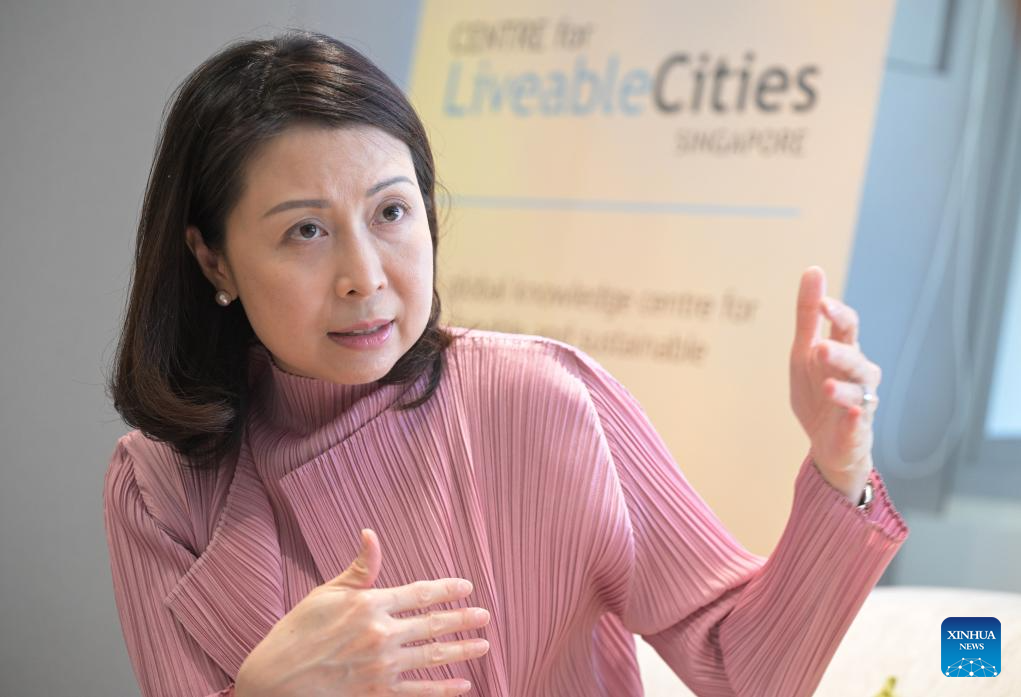
Elaine Tan, research director at the Centre for Liveable Cities, receives an exclusive interview with Xinhua in Singapore on May 26, 2026. (Photo by Then Chih Wey/Xinhua)
SINGAPORE, June 12 (Xinhua) -- Singapore's urban planning system is internationally recognized for its long-term vision. But for Elaine Tan, research director at the Centre for Liveable Cities, a think tank under Singapore's Ministry of National Development, its true strength lies in something more concrete: translating future risks into land-use decisions made today.
"Singapore is a low-lying island city-state," Tan told Xinhua in an interview ahead of the World Cities Summit 2026, scheduled for June 14-16 in Singapore. "We need to accommodate the needs of both a city and a country."
She said Singapore faces several major challenges at the same time, including rising sea levels, heavier rainfall, limited land, dependence on imported resources and an aging population.
Instead of treating these issues separately, Singapore's planning system integrates them across different levels of planning, from long-term strategy to land-use decisions on the ground.
"Every single plot of land you see in Singapore, it's actually planned for," Tan said.
In recent years, Singapore has also used the concept of "regenerative cities" in its planning discussions. The concept, which will be featured at this year's World Cities Summit, focuses on whether projects can deliver multiple benefits while addressing the original problem, Tan said.
One example is the Long Island project, a planned 800-hectare reclaimed area along Singapore's eastern coast. First announced in 2019, it aims to protect Singapore from rising sea levels and storm surges, while also creating new space for housing and recreation.
By 2100, Singapore's sea level could rise by up to 1.15 meters, Tan said, with storm surges adding further risk during extreme weather.
Instead of treating coastal protection as a separate project, planners are integrating it into future urban development. The project is expected to add around 20 kilometers of waterfront space and parks, while incorporating barrages that can pump stormwater out during periods of high tide, said Tan.
While planning is led by government agencies, public participation is also playing a growing role in Singapore's planning process. More than 200,000 people took part in recent nationwide consultations on land use, Tan said. But she said public feedback is not only about participation numbers.
In a study of the Cambridge Road area, one of Singapore's low-lying neighborhoods, planners initially focused on flood risks. But residents pointed to another issue: heat.
"With their local knowledge, they actually told us that flooding wasn't the issue they felt most immediately," Tan said. "Heat was a larger issue."
As a result, the project was adjusted accordingly. Residents proposed greening a corridor linking parts of the neighborhood to a nearby market, an important social hub for the community. The changes helped reduce heat, improve walkability and strengthen local connections.
The lesson, Tan said, is that planning increasingly engages a wider range of participants. Government agencies remain responsible for long-term strategy and regulation, while residents, businesses, researchers and community groups all bring different perspectives.
"Nobody has a monopoly on ideas, and it takes collective action and a coordinated approach," she said. ■


