LANZHOU, June 11 (Xinhua) -- On a mountain trail in China, when a young woman suddenly lost consciousness, Joel Mikael Walker acted before the crowd around him had time to decide what to do.
The German student of traditional Chinese medicine (TCM), bent down beside her, tapped the inside of her elbows and stimulated several acupoints. He watched for signs that the body was responding. Several minutes later, when the woman's pulse could be felt again, he allowed himself to relax.
A video of the rescue soon went viral online. Many Chinese viewers were struck not only by Walker's command of TCM techniques, but also by the way he spoke: a blond-haired German speaking fluent Chinese, and often in a Henan dialect that made him sound, to many, unexpectedly local.
Walker, 31, has been studying TCM in central China's Henan Province for over a decade.
Recently invited to attend a Sinologist conference in Dunhuang, northwest China's Gansu Province, Walker said his years in China had changed his understanding of Chinese culture. It was not, he said, a fixed collection of symbols preserved behind museum glass, but a living body of thought that continues to address the spiritual dilemmas people are currently facing, especially in a world marked by uncertainty.
His fascination began almost accidentally, in his youth, when he first encountered the ideas of yin and yang and the five elements. The fragments Walker read were enough to unsettle him.
"The way of thinking, which understands the universe as a dynamically balanced whole, gave me an unprecedented shock," he recalled.
That shock eventually carried him to Henan, a province often described as part of the heartland of Chinese civilization. The early days were difficult. The language was unfamiliar, daily habits were different, and the specialized vocabulary of TCM could be demanding even for native Chinese speakers.
At first, Walker said, he could hardly pronounce terms such as yin-yang and the five elements properly. Soon he was memorizing herbal prescriptions, identifying acupoints and learning diagnostic methods.
What sustained Walker, beyond curiosity and passion, was the holistic worldview embedded in TCM. He began to see that TCM was not merely a set of techniques for treating illness. Behind it was a larger way of thinking about the relationship between life and nature.
"The concept of yin and yang teaches me conflict doesn't necessarily lead to confrontation, it can also be transformed," Walker said. "The principle of seeking harmony without uniformity offers a valuable answer to how different civilizations can coexist peacefully."
For Walker, the lessons gradually moved beyond the clinic. The holistic view emphasized in TCM helped him better understand how many Chinese people think about the body, family, social relations and balance in daily life.
That understanding has also shaped his public life. Completing his undergraduate and graduate studies in TCM, Walker now shares his life in China and insights on TCM and Chinese culture in Chinese, German and English through social media. On Douyin, the Chinese version of TikTok, he has amassed nearly 1.8 million followers.
The contrast is part of his appeal: a German who discusses TCM in Mandarin, chats with patients in Henan dialect and explains Chinese ideas to audiences both inside and outside China.
Some people have asked whether audiences outside China can truly understand what he talks about. Walker believes they can.
"Chinese culture speaks to some of the most fundamental challenges faced by all humanity," he said. "True wisdom knows no East or West."
Standing before the undulating dunes of Dunhuang, Walker said everyone should visit this cultural crossroads along the ancient Silk Road at least once in their lifetime. To him, Dunhuang was not only a destination, but also a window through which to understand how civilizations met.
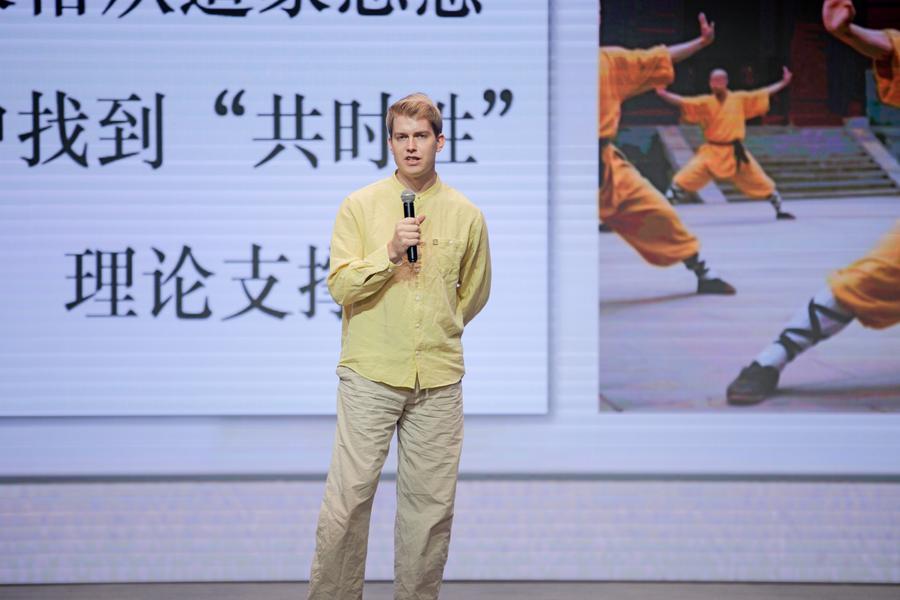
Speaking to more than 300 scholars and cultural figures from around 70 countries at the conference's opening ceremony, Walker said Chinese culture has irreplaceable value in an age marked by persistent conflicts, strained relations between humanity and nature, and widespread spiritual anxiety.
"Those wisdoms are not only China's wealth," he said. "They are the wealth of all humanity."
After more than ten years in China, Walker said his life had become a process of learning from Chinese culture, and of being accepted and changed by it. What began with an early fascination has taken him from classrooms and clinics in Henan to social media platforms and, now, to Dunhuang, where the history of the ancient Silk Road still frames conversations about exchange between civilizations.
"Today, the world more than ever needs dialogue rather than confrontation and understanding rather than prejudice. Chinese culture has much to offer in this regard," said Walker. ■