
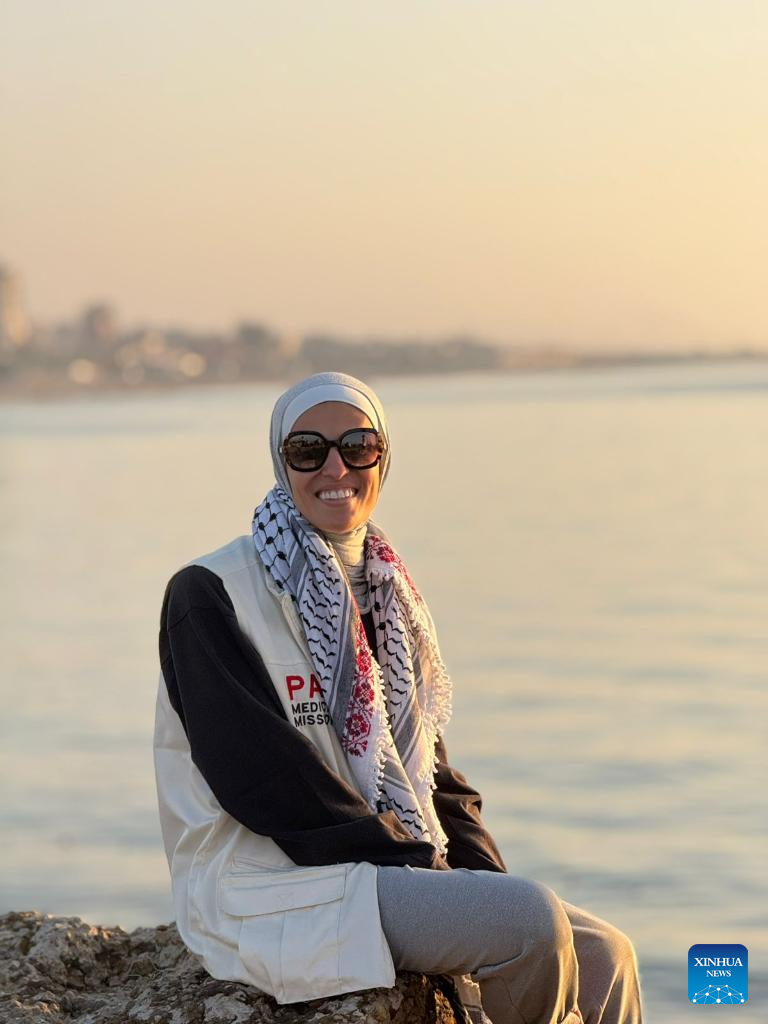
This file photo taken in March 2024 shows Asil Jallad sitting by the Mediterranean Sea in Gaza. (Xinhua)
by Asil Jallad
AMMAN, June 11 (Xinhua) -- "Thousands of women in Gaza are suffering, and they need us," I told the Jordan Medical Association when they initially said obstetricians weren't a priority in war zones.
Weeks later, the green light came.
On the morning of March 16, I stood before my two children, both under 10 years old. I am 38, and I had never left them before.
For a moment, my heart wavered like a candle in the wind. But I remembered who I was and where I came from. I'm a doctor, originally from Tulkarem in the West Bank, and my family came to Jordan as refugees. Duty, I have learned, is a language spoken not in the mouth, but in the bones.
Each night before leaving, I tucked my children into their safe, warm beds, and felt guilty -- guilty for having the privilege of safety while less than 200 km away, other mothers and children were losing their lives.
Arriving in Gaza was like stepping into an entirely different reality.
I was stationed at an International Medical Corps field hospital in Al-Mawasi, Khan Younis, in the southern Gaza Strip. The hospital was a cluster of tents and caravans set among vast displacement camps. Inside those tents, we delivered babies. Outside, the earth trembled from time to time, a reminder that even as we ushered life into the world, death was never far away.
Despite limited resources, the women's clinic alone attended to 100 to 120 patients a day.
During my time there, I helped deliver 500 babies, 10 to 15 births every day. But these were not normal deliveries.
Basic medical supplies? Severely restricted. Painkillers for natural childbirth? None. Equipment for emergency cesarean sections? A luxury we could only dream of. We often drew hearts around such items on supply lists, knowing they might never arrive. Yet, we performed the surgeries anyway, because a mother's life does not wait for permission.
One woman came to me with a hemoglobin level of four. Anywhere else in the world, she would have been in an intensive care unit, surrounded by beeping machines and fluorescent light. In Gaza, she was pale as moonlight, walking on her own two feet to fetch water and food for her children.
I watched her leave the tent. She did not look back.
In the displacement camps, conditions were dire. Each tent, often home to an entire family of about 12 people, offered little more than thin fabric against the sky. A single toilet -- often no more than a hole ringed by a car tire -- served 30 to 40 tents. There was no privacy. No hygiene. No dignity.
The war has stripped expectant mothers of almost everything: routine checkups, proper nutrition, medication, and the chance to carry a pregnancy without constant fear.
Some women had been bleeding for three months. In Gaza, there were no blood tests, no laboratory analyses to determine the cause. Even when a diagnosis could be made, treatment was often unavailable.
Pregnant women with critically low hemoglobin levels struggled to eat even one meal a day. The lack of food, clean water, and supplements placed both mothers and newborns at grave risk.
We did not know whether some mothers would even be able to breastfeed. Dehydration and malnutrition had stolen that certainty from them.
Yet despite the harsh conditions, Gazan women showed remarkable resilience. They endured. They rose. They refused to break.
"Why do you want to get pregnant now, in the middle of this?" I once asked a patient. The bombs had been falling for months. She was thin and tired.
"To compensate for the ones we lost," she answered.
That answer stayed with me. It still lives in my chest.
Other women came to ask how to get pregnant, because six months of war can also mean six months lost from a woman's biological clock. But hope? Hope, I have learned, is a river that carves new paths through the hardest stone.
Some women who had struggled with infertility for years in peacetime suddenly conceived during the war, as if life, confronted with so much death, had decided to fight back.
What I felt there, I still cannot fully untangle. I do not know whether they benefited more from me, or I from them.
I was humbled by their affection. They called me a hero. But they are the true heroes amid the chaos of war: the women walking miles with anemia in their blood and new life in their bellies; the women giving birth on a cot inside a nylon tent, then leaving hours later to make room for the next mother because there were no beds to spare.
We lost no lives during my stay. No mothers. No newborns. In Gaza, that is not merely a statistic. It is a miracle.
Being the first Arab female obstetrician to enter Gaza during this phase of war felt like a heavy crown to wear. But it mattered. The women felt safe speaking to me. We shared the same identity, the same soul, the same unspoken understanding of what it means to be a woman in a world that so often forgets our bodies have their own needs -- periods, hormones, pregnancies, births -- even when war is raging.
"Many male doctors can do this duty," they told me. "But there must be a female doctor."
Now, in 2026, I write this from Amman. The world seems to be looking elsewhere: other headlines, other wars, other crises washing over memory like waves over sand. But the war in Gaza has not ended. We are seeing chronic health problems, blood clots, and the looming shadow of birth defects, which some fear may be linked to the unknown components of bombs dropped years ago.
Media coverage has faded. People are forgetting. The world has a short memory and a long list of sorrows.
But I remember.
Behind every clinical statistic, I remind myself, is a real woman trying to bring new life into a world that often seems to have forgotten her.
I am waiting for the day the gates open again.
For me, going back is not a choice; it is a duty.
And when I return, I will look for the woman with a hemoglobin level of four. I will ask whether her children are well. I will tell her that I wrote about her once, and that someone, somewhere, remembered.
Editor's note: Asil Jallad is a Jordanian obstetrician.
The views expressed in this article are those of the author and do not necessarily reflect the positions of Xinhua News Agency.
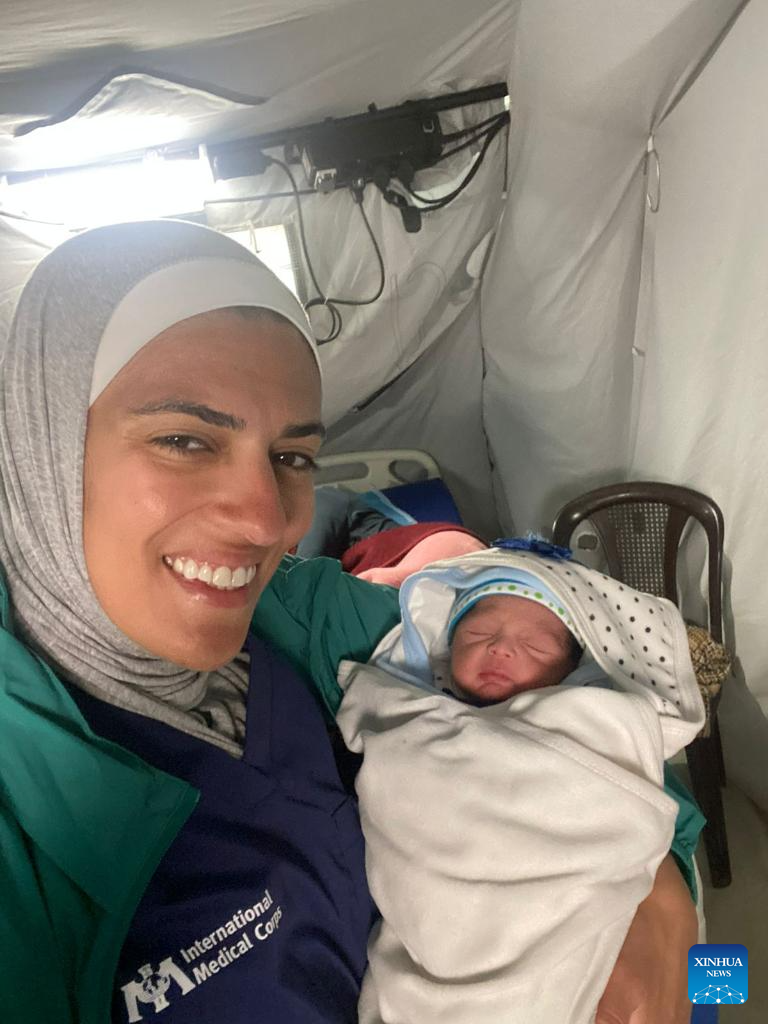
This file photo taken in March 2024 shows Asil Jallad holding a newborn she has helped deliver in Gaza. (Xinhua)


