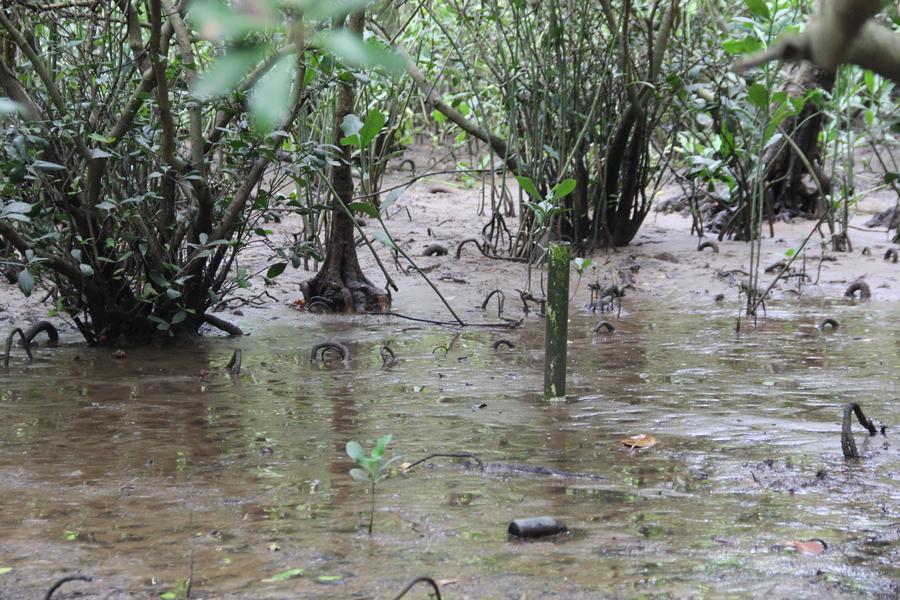
GUANGZHOU, June 9 (Xinhua) -- At Jinlong Primary School in south China's Guangdong Province, second-graders were busy sketching mangroves, imagining tiny crabs scuttling among the roots. "Mangroves are like a kindergarten for little crabs," one pupil said.
The lush mangroves that now inspire these schoolchildren were once dismissed by locals in Tantou Village, Guangdong's Nansha District, as nothing more than common shoreline weeds.
"When we were kids, we often ran to the beach to catch fiddler crabs and river shrimp. We thought these mangroves were just ordinary water plants," said Huang Jinhua, Party secretary of the village.
The villagers' perception shifted dramatically in 2019, when a powerful typhoon struck the area. "The water level rose so fast that we thought the sea would overflow the embankment. We were ready to evacuate people. But unexpectedly, the tide slowly receded," Huang recalled.
Realizing that mangroves act as "coastal guardians" that stabilize shorelines and purify nearshore waters, villagers began taking part in regular beach cleanups and carrying out pest and disease control for the plants.
Furthermore, a more systematic and scientific conservation effort took root following an unexpected encounter.
In 2022, a group of strangers appeared near the village's mangrove forest during a routine patrol. The villagers grew instantly alert, approached the visitors and shouted, "What are you doing? Don't cut the trees!"
To their surprise, the "strangers" turned out to be researchers from the Guangzhou Marine Carbon Peaking and Carbon Neutrality Research Association, who had arrived to survey the mangroves.
"We had earlier spotted the mangroves using drones and remote sensing technology. They were growing well but lacked proper scientific management, so we came to conduct field surveys," said Du Yuyan, secretary general of the association.
The confrontation quickly turned into cooperation. With support from the United Nations Development Programme, the association helped build a 300-meter mangrove science corridor in 2023, featuring 46 display panels along the wetland.
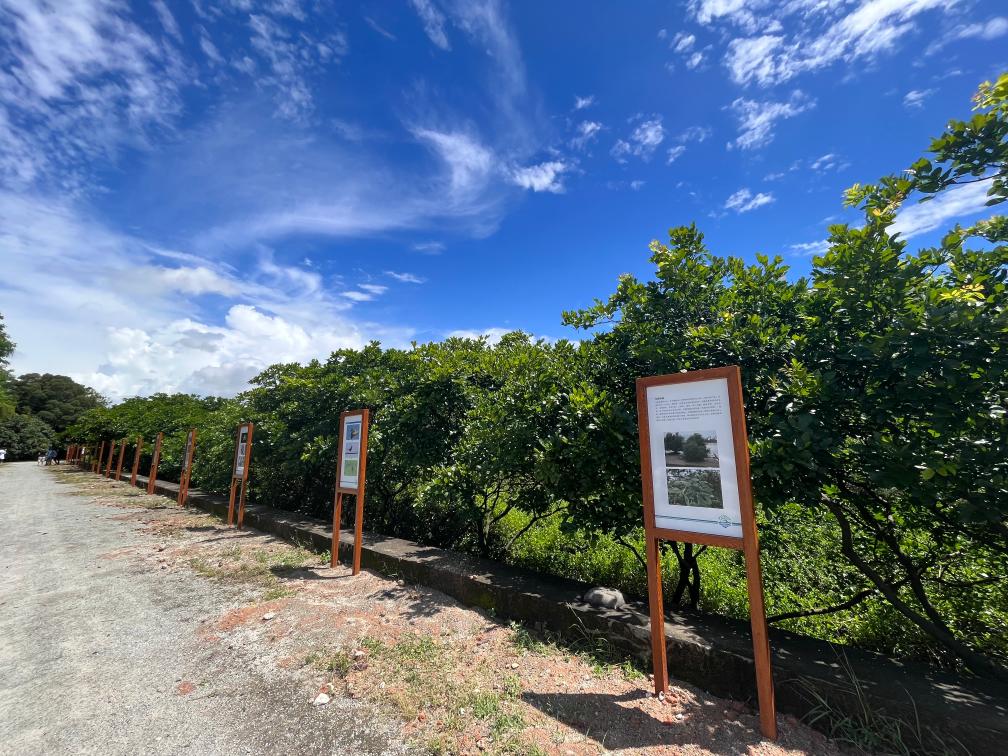
"Seeing a public welfare organization travel so far and dedicate itself to protecting our mangroves inspired us to step up our efforts," said Song Meiying, deputy Party secretary of Tantou Village.
Part of these efforts included transforming the local library into a marine science base with over 1,000 specialized books and forming a volunteer team of more than 50 local women and children to serve as science interpreters.
Academics have also joined in mangrove conservation. Liang Xiaoting, an associate professor at the Guangdong Eco-Engineering Polytechnic, was so moved by the natural mangroves during a summer clean-up that she spontaneously grabbed a microphone and began explaining the ecological value of mangroves to those nearby.
Liang regularly volunteers in Nansha and leads her students in developing ecological courses for primary and secondary schools.
The regular clean-ups made the village and the association realize that trash collection alone was never enough. They launched a "waste-to-wealth" initiative. For instance, collected plastic waste was recycled into silk-like scarves, which were gifted to volunteers as a tangible reminder of their efforts.
"Our volunteers come from across the Guangdong-Hong Kong-Macao Greater Bay Area, including many young people from Hong Kong and Macao who join our beach clean-ups," said Huang. "We want to build a small station near the wetland so that people doing clean-ups or field research can rest and recharge."
The efforts in Tantou reflect a broader national success story. During the 14th Five-Year Plan period (2021-2025), China's mangrove area expanded to 465,000 mu (31,000 hectares), making the country one of the few countries in the world to record a net increase in mangrove coverage.
Mangroves, alongside seagrass and coral reefs, are globally recognized as one of the three main marine coastal ecosystems. They play a critical role in supporting offshore fisheries, purifying the environment, and enhancing carbon sequestration.
Tantou's efforts have aligned with China's national mangrove conservation strategy. In 2025, China released and implemented its first technical group standards for the precise ecological restoration of mangroves to promote their protection and sustainable development.
China has made significant strides in green development during the 14th Five-Year Plan period, with increased forest coverage, improved biodiversity and greater harmony between humans and nature. ■