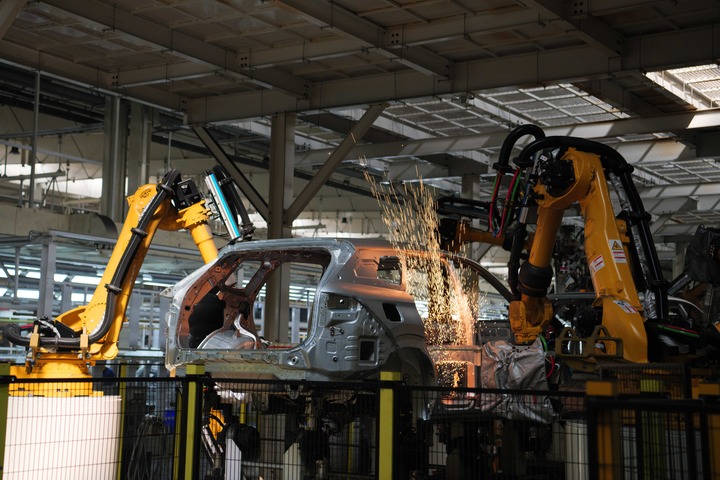
HANGZHOU, June 8 (Xinhua) -- Inside the sprawling welding workshop of Geely's new energy vehicle plant in Yiwu, east China's Zhejiang Province, a new industrial scene is taking shape.
Rows of home-grown heavy-payload industrial robots can be seen executing high-speed welding tasks with seamless precision, their mechanical arms dancing amid showers of sparks.
This development amounts to more than just an upgrade on a single assembly line, as it represents a critical breakthrough for China's high-end equipment sector.
For years, automotive body welding was considered the ultimate proving ground for robotic performance -- a domain long dominated by foreign manufacturers and largely inaccessible to domestic brands. Now, Chinese-made industrial robots are entering this arena at scale.
Siasun Robot & Automation Co., Ltd., based in the city of Shenyang in northeast China, a national hub for robot industrialization, spearheaded this shift alongside Geely, one of the country's top automakers.
After nearly four years of collaboration and overcoming more than 1,000 technical hurdles, the two companies successfully deployed almost 100 Siasun industrial robots on Geely's main welding lines. This system has earned full automaker approval, paving the way for broader adoption across mainstream carmakers.
"Siasun's large-scale application of industrial robots in Geely's primary welding lines serves as a prime example of China's robotics industry moving up the value chain," said Hao Yucheng, an intelligent manufacturing expert. "Through systematic innovation over a decade, China has successfully forged a distinctive path for its industrial robot sector."
This ascent is being propelled by robust top-level designs, including the 14th Five-Year Plan for robot industry development and the ongoing "AI Plus" initiative. Backed by supportive policies and surging market demand, China has emerged as the world's largest producer of robots.
From January to October 2025 alone, the country manufactured a record-high 602,700 industrial robots, marking a year-on-year increase of 28.8 percent, according to the National Bureau of Statistics.
As domestic technologies mature, Chinese-made robots are increasingly winning global recognition. Customs data reveals that in the first quarter of 2026, China's total exports of separately listed robots reached 11.32 billion yuan (approximately 1.67 billion U.S. dollars), penetrating 148 countries and regions. Notably, industrial robot exports surged by 42 percent during this period, underscoring the growing international competitiveness of China's advanced manufacturing sector.
"By exporting these products, China is also sharing technological expertise," Hao noted. "Through localization, this helps elevate intelligence capabilities and drive deeper smart integration within the global community." ■