
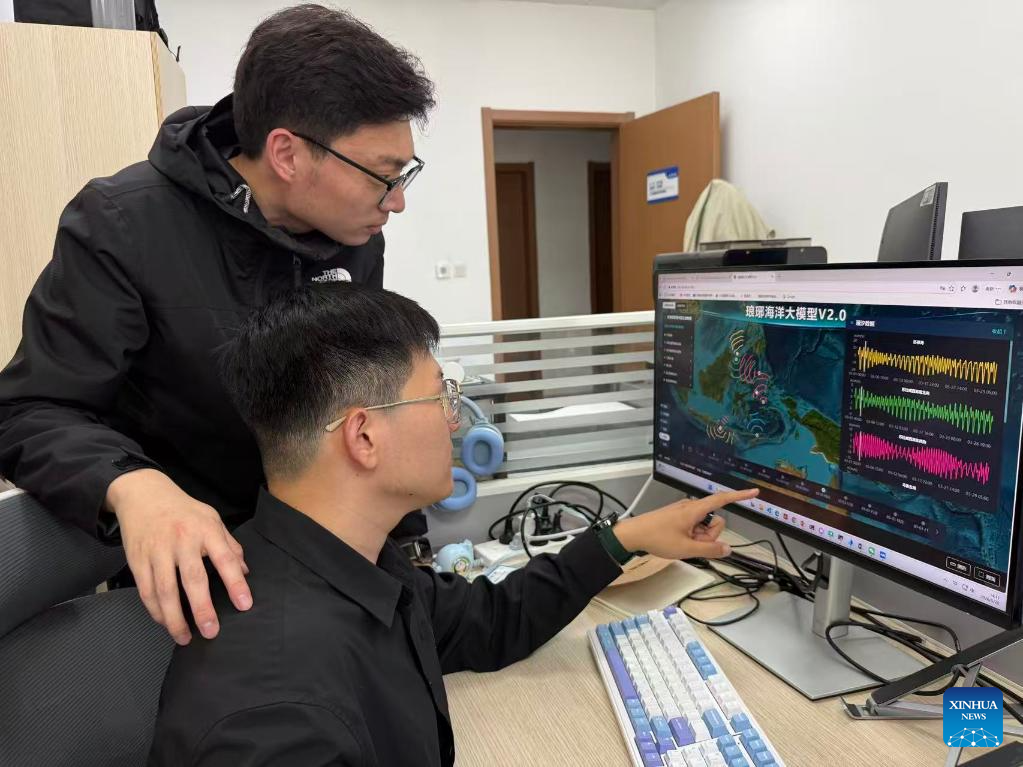
Members of the AI oceanography research team at the Institute of Oceanology under the Chinese Academy of Sciences are pictured while developing the LangYa 2.0 AI model in Qingdao, east China's Shandong Province, May 20, 2026. (Photo by Zhang Yiyi/Xinhua)
QINGDAO, June 6 (Xinhua) -- A year after issuing its first ocean forecasting AI system, Chinese scientists on Saturday rolled out LangYa 2.0, a major upgrade that moves beyond basic sea variables to predict complex marine phenomena including typhoons, extreme rainfall and storm surges.
The new model was unveiled at the ongoing Fourth China Digital Earth Conference in Qingdao, a coastal city of east China's Shandong Province.
LangYa 2.0, developed by the Institute of Oceanology under the Chinese Academy of Sciences (IOCAS), moves far beyond its predecessor. LangYa 1.0, launched in late 2024, could forecast basic ocean variables, such as temperature, salinity and currents, for a period of one to seven days. It was a notable breakthrough, in that it boosted efficiency to a level 10,000 times that of conventional methods.
LangYa 2.0 changes the game entirely thanks to its enhanced capabilities.
Imagine an AI that does not just tell you the temperature of the sea, but warns you where a typhoon will suddenly turn, when a storm surge will slam the coastline, or how Arctic sea ice will spread months in advance. That's what LangYa 2.0 does, according to Wang Fan, president of IOCAS.
LangYa 2.0 marks a leap from global ocean state forecasting to intelligent prediction of complex marine phenomena, making ocean forecasts perceptible, actionable, and decision-ready, said Wang.
It will provide intelligent support for marine disaster prevention, shipping safety, polar navigation, and climate response, he added.
The upgraded system now predicts six key marine phenomena -- typhoons, extreme rainfall, storm surges, internal solitary waves, mesoscale eddies, and sea ice.
It does so via six specialized vertical sub-models, each trained on unique datasets and physical mechanisms. Together, they form what the research team calls "a diagnostic AI," which is not just a tool that helps a human expert, but one that delivers direct, actionable forecasts.
"Version 1.0 tells you what the sea temperature is. Version 2.0 tells you where a vortex might form and when a storm surge will arrive," Wang explained. "It's the difference between a tool that helps a doctor read a scan and an AI that reads the scan and gives you the diagnosis directly."
Take typhoons for example. The typhoon module fuses atmospheric and oceanic fields, satellite cloud imagery and historical typhoon tracks. It is specifically designed to handle two notoriously hard-to-predict behaviors: rapid intensification and sudden turning. For coastal communities, those few hours of extra warning can mean the difference between evacuation and disaster.
For offshore engineering, LangYa 2.0 can identify internal solitary waves -- the powerful, hidden currents that can damage oil platforms.
It forecasts their evolution over the following 30 days and allows users to query speed, amplitude and other key parameters for the coming week, according to the research team.
Even before its official release, version 2.0 has begun to prove its worth.
Independently validated by the Sea Ice Prediction Network, an international collaboration of scientists and research institutions dedicated to improving seasonal forecasts of Arctic sea ice, LangYa 2.0 ranked first among multiple global models in the 2025 seasonal forecast for September Arctic sea ice extent, which refers to the area of ocean covered by ice.
It delivers monthly-scale predictions at three-kilometer resolution, which is critical for Arctic shipping routes, climate research and polar navigation safety, the team noted.
The research team said LangYa 2.0 connects multi-source observations, physical understanding and AI reasoning to drive marine forecasting toward faster, more precise and more interactive services.
Their future plans include expanding into climate and ecological interdisciplinary models, as well as exploring marine intelligent agent pathways, turning LangYa from a forecasting tool into a comprehensive marine intelligence platform, the researchers revealed.
The model's name, LangYa, is drawn from China's ancient Cihai encyclopedia, meaning a precious, jade-like treasure. It is also a nod to the ancient LangYa terrace, located just 20 kilometers from the Qingdao release site, where Chinese astronomers once observed the sky to determine the changing seasons.
Millennia later, the same spirit of observation, now powered by AI, is transforming how humanity understands and predicts the oceans. ■
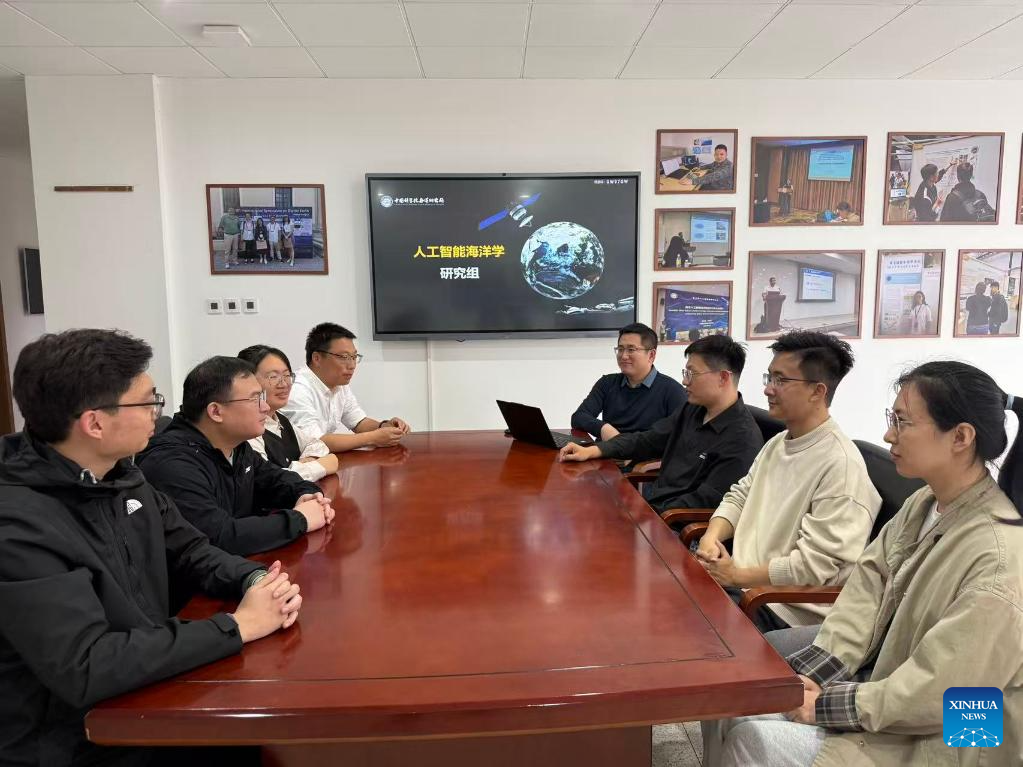
Members of the AI oceanography research team at the Institute of Oceanology under the Chinese Academy of Sciences discuss the LangYa 2.0 AI model in Qingdao, east China's Shandong Province, May 20, 2026. (Photo by Zhang Yiyi/Xinhua)
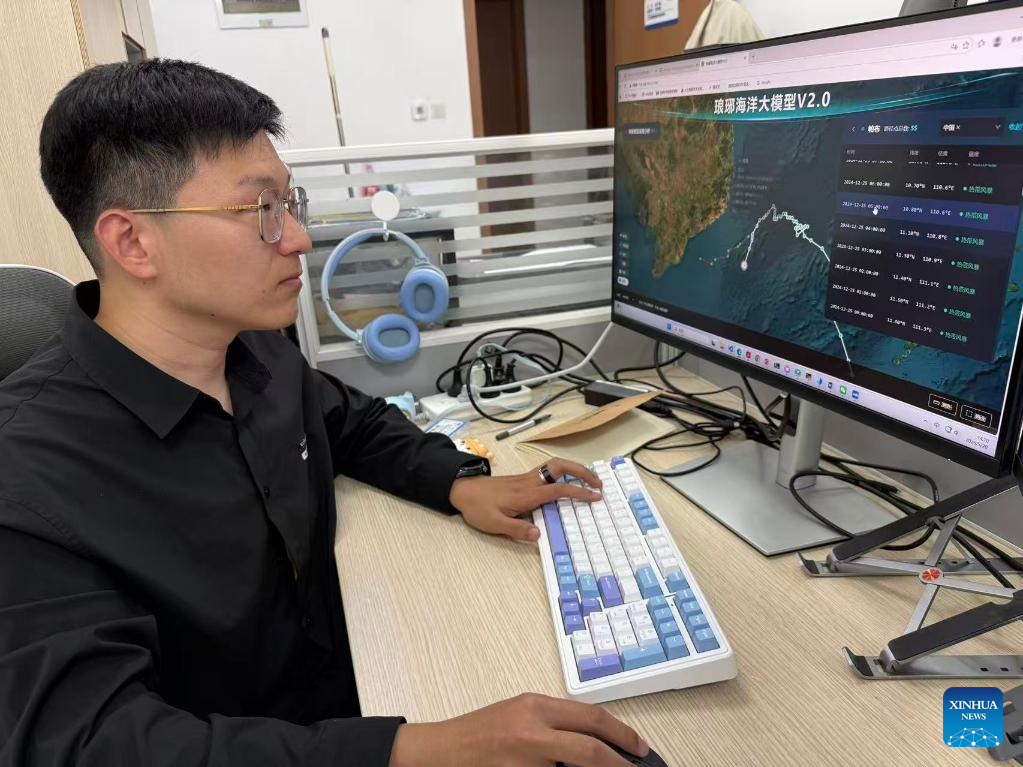
A member of the AI oceanography research team at the Institute of Oceanology under the Chinese Academy of Sciences is pictured while developing the LangYa 2.0 AI model in Qingdao, east China's Shandong Province, May 20, 2026. (Photo by Zhang Yiyi/Xinhua)


