
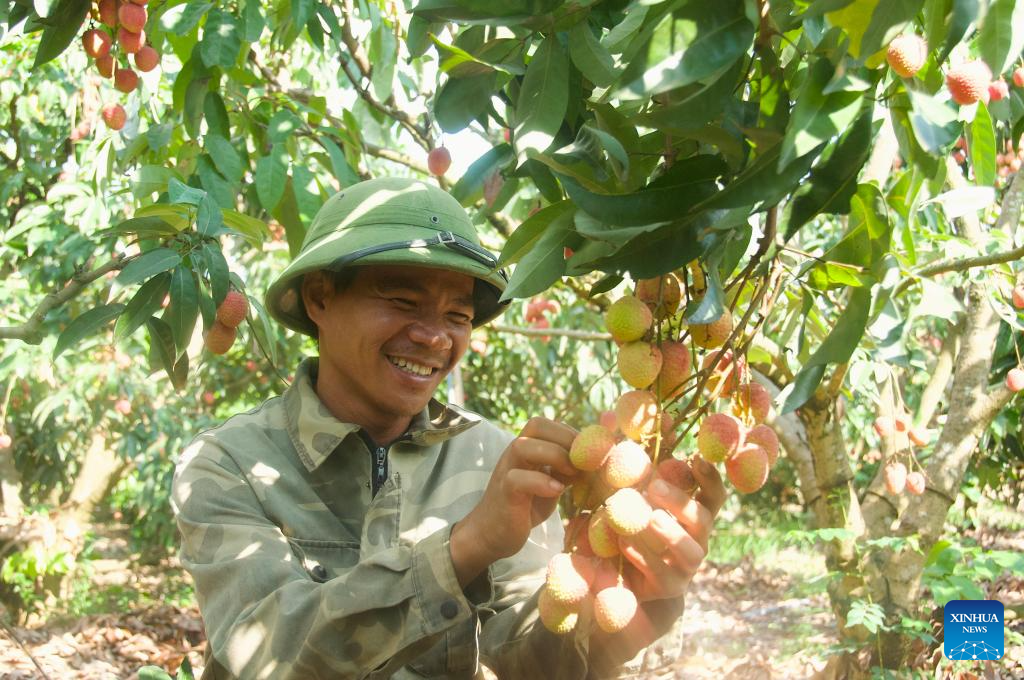
A farmer checks lychees in Bac Ninh Province, Vietnam, May 28, 2026. (Photo by Vu Tran Kien/Xinhua)
HANOI, June 1 (Xinhua) -- At 1 a.m. local time, while most of the village was still asleep, farmer Tran Van Bon was already in his lychee orchard in Vietnam's northern province of Bac Ninh, moving between rows of trees heavy with ripening fruit.
Working under the glow of headlamps, Bon and his family carefully picked bunches of bright red lychees before dawn, when the fruit is at its freshest.
A few hours later, the fruit would begin its journey to China, Vietnam's largest export market for lychees.
In late May, the first container trucks carrying lychees departed from Bac Ninh, bound for China, marking the start of this year's export season and bringing renewed hope to thousands of growers across the province.
Bac Ninh is Vietnam's largest lychee-producing province, with 29,800 hectares of orchards, according to the Vietnamese Ministry of Agriculture and Environment.
Favorable soil and climate conditions have made the region one of the country's most important fruit-growing hubs.
For Bon, who has cultivated lychees for two decades in Nam Duong commune, the Chinese market has become increasingly vital to his family's livelihood.
Although unfavorable weather cut yields by nearly half compared with last year, stronger prices have helped offset the losses.
"This year, lychees sold to Chinese traders are priced at around 50,000 to 70,000 Vietnamese dong (about 1.9 to 2.7 U.S. dollars) per kilogram," Bon said while sorting freshly harvested fruit into baskets.
Prices this year are about twice as high as last year, when a bumper crop drove down rates.
"To be eligible for export to China, the fruit must meet quality standards, be free of borer damage at the stem end and have an appealing appearance," Bon said.
China has remained the major export destination for Bac Ninh lychees for many years.
According to the provincial Department of Agriculture and Environment, the province currently has 243 lychee-growing area codes covering more than 17,450 hectares that have been approved for export to various international markets.
Of these, over 120 growing area codes, covering over 16,190 hectares, are registered for exports to the Chinese market this year.
Pham Van Thinh, vice chairman of the Bac Ninh Provincial People's Committee, estimated that lychee exports to China could reach between 40,000 and 50,000 tons this year.
Across Nam Duong commune, the harvest season has transformed quiet rural roads into busy trading routes. Trucks line up near collection points while farmers rush to pick, sort and pack fruit for cross-border shipment.
Local farmer Tran Van Binh shares the same optimism.
Binh expects to earn between 200 million and 300 million Vietnamese dong (about 7,900 to 11,900 U.S. dollars) from exporting lychees to China this season.
Despite lower yields, growers like Bon and Binh said stable demand from China has helped sustain their incomes and ease concerns over finding buyers.
China has been Vietnam's top trading partner for more than two decades. In 2025, Vietnam's fruit and vegetable exports to China exceeded 5 billion dollars, accounting for more than 64 percent of its total fruit and vegetable exports. Vietnam durian and fresh coconut exports have become highly sought-after in China.
As trucks loaded with freshly harvested lychees continue heading north toward China, farmers across Bac Ninh are embracing the season with cautious confidence.
"Now that Chinese traders are buying lychees in large quantities, we no longer worry about the market for our fruit. We can focus on growing and caring for lychees to meet export standards," Binh said. ■


