
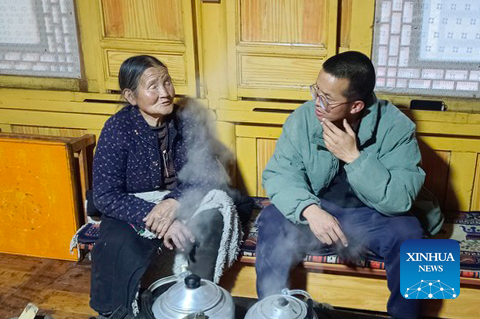
Khandro Tsering (R) talks to a villager to collect folk story materials in Huangnan Tibetan Autonomous Prefecture, northwest China's Qinghai Province, Feb. 12, 2025.(Xinhua)
XINING, May 31 (Xinhua) -- As Khandro Tsering watched his third-grade students' eyes light up while listening to him read out "Harry Potter and the Sorcerer's Stone" in vivid Tibetan, the young man from northwest China's Qinghai Province was taken back to those happiest childhood memories of drifting through the folk tales and legends softly told by his grandmother.
That was the moment he decided to write a book of fairy tales for children -- to enrich their imaginations and educational development, while honoring his own Tibetan culture and memorializing his beloved late grandma.
Growing up in a family in the Tibetan Autonomous Prefecture of Huangnan in Qinghai, the 32-year-old writer had no access to electronic devices, comic books or animation. Instead, he was surrounded by six gifted storytellers: his grandma and her five sisters.
Tales of mountain gods and fearless young warriors filled his childhood. He was not only enchanted by the classic folklore passed down across generations, but also came to better understand the real world through those fictional depictions.
"In granny's stories, I learned to be kind, brave and always keep a deep reverence for life," said Khandro Tsering, now also a middle school teacher based in the Tibetan Autonomous Prefecture of Golog in Qinghai.
In his book "The Story of Kunga Dondrup and Lotus Conch," protagonist Kunga Dondrup is granted three wishes by the Lotus Conch. He firstly wishes for a peaceful world, then for his mother to be saved, but leaves the third wish undecided.
"I want to share with all my young readers that true happiness cannot be won by greed, but through sticking to one's original motivation and embracing a greater love for the world," the writer told Xinhua.
He carries on this storytelling tradition of weaving landscapes of his hometown, everyday life and simple wisdom into narratives. The loyal Tibetan mastiff, sacred mountains and lakes, and even the unique rhythms of Tibetan poetry, are well preserved and inherited in his work.
Written over six years in Tibetan, the work was later translated into Chinese by him. Striving to maintain the original rhyme of the language and connotation of Tibetan proverbs, Khandro Tsering said that despite all the difficulty, he hopes the warmth of the story could be delivered in either language after his rounds of revision.
From an avid story listener to a passionate folklore collector and fairy tale creator, Khandro Tsering's experience reflects that of many young ethnic minority writers from Qinghai.
Just like many children in the Tibetan regions of the province, he grew up reading local Tibetan literature journals and newspapers, learning writing techniques from these, while entering literary competitions organized by the publications.
One of the influential journals is "Sbrang char", meaning "dew" in Tibetan. Since its establishment in 1981, it has held a writing contest once every three years and introduced special awards for emerging talents. To date, the platform has nurtured over 60 award-winning authors.
The development of ethnic minority literature is supported by state funding, said Palden, chief editor of "Sbrang char". Every year, the Ministry of Finance allocates special subsidies to ethnic publishing houses for the compilation and publication of books in minority languages.
Now, Khandro Tsering has gone beyond writing down stories with pen and paper. Last year, he traveled across more than 10 villages in his hometown, gathering folk tales from local elders and turning them into animated videos with Tibetan and Chinese subtitles, with the help of AI.
After he posted clips on social media, many viewers enthused over his work, commenting on how he had vividly brought Tibetan legends to life.
"Many villagers could only remember half of those stories. I reimagined the missing parts in a fairy-tale style, so that these nearly-forgotten tales can reenter children's lives," he said. ■


