
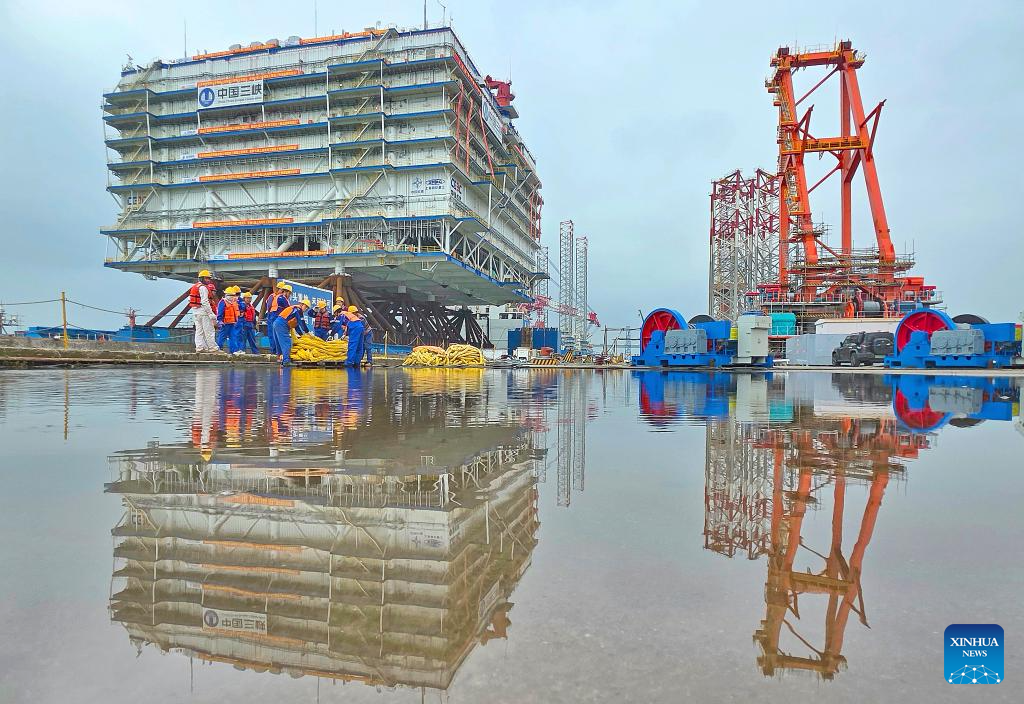
This photo taken with a mobile phone shows workers working near the world's largest and most powerful offshore converter station in Nantong, east China's Jiangsu Province, May 27, 2026. The 25,000-tonne facility, officially named "Hai Feng Zhi Xin" or "Heart of the Sea Wind" in English, set sail from Nantong of Jiangsu province on a semi-submersible vessel. It will travel 1,090 nautical miles to an offshore wind farm off Yangjiang City in south China's Guangdong province, where it will be installed via a precision float-over method requiring millimeter-level construction accuracy, China Media Group (CMG) reported on Thursday.(Photo by Xu Congjun/Xinhua)
BEIJING, May 28 (Xinhua) -- The world's largest and most powerful offshore converter station departed an eastern Chinese port on Wednesday, set to resolve a core technical bottleneck restricting the development of the country's far-offshore wind power sector.
The 25,000-tonne facility, officially named "Hai Feng Zhi Xin" or "Heart of the Sea Wind" in English, set sail from Nantong of Jiangsu province on a semi-submersible vessel. It will travel 1,090 nautical miles to an offshore wind farm off Yangjiang City in south China's Guangdong province, where it will be installed via a precision float-over method requiring millimeter-level construction accuracy, China Media Group (CMG) reported on Thursday.
Built on an innovative technical model tailored for large-scale deep-sea wind power development, the facility marks China's entry into the era of ultra-high-voltage direct current (UHVDC) transmission for offshore wind projects.
It is the world's first offshore converter station capable of handling 2,000 megawatts at a voltage of 500 kilovolts, according to the CMG report.
In offshore wind farms, individual turbines generate electricity in alternating current (AC), yet AC power suffers severe energy loss during long-distance transmission via submarine cables. The "Heart of the Sea Wind" facility collects power generated by 163 wind turbines, raises the voltage, and converts it to direct current (DC), which can travel hundreds of kilometers underwater with minimal energy loss. This makes large-scale deep-sea wind power commercially viable.
The station measures 85.5 meters in length, 82.5 meters in width, and 44 meters in height, covering an area equivalent to a standard football pitch and standing as tall as a 15-story building.
Inside, it houses a sophisticated system of electrical, ventilation, and fire-control equipment, all specially reinforced to withstand the high-salt, high-humidity conditions of the deep ocean, said the report.
Unlike traditional offshore wind farms built in relatively shallow waters close to shore, deep-sea wind projects face far harsher marine conditions and require advanced transmission solutions. Until now, the lack of an efficient and stable power delivery method has been a major barrier to moving wind farms farther out to sea, where wind resources are stronger and more consistent.
The "Heart of the Sea Wind" is designed to operate without a permanent crew, using remote monitoring and intelligent maintenance systems. Its successful commissioning will provide a replicable technical model for future deep-sea wind power development in China and beyond.
Upon completion of installation, the station will begin delivering electricity to Guangdong province, one of China's most energy-intensive regions, helping cut coal consumption and reduce carbon emissions along the country's southern coastal areas.
The deployment of the "Heart of Sea Wind" is not an isolated breakthrough. It represents the latest milestone in China's continuous progress toward greater self-reliance in offshore wind power technology.
In February, the world's first 20-megawatt offshore wind turbine was successfully connected to the grid in east China's Fujian Province, with all core components domestically manufactured. Shortly after that, the world's largest floating offshore wind platform by single-unit capacity finished installation in the waters off Yangjiang. The project adopted independently developed polyester fiber mooring lines for the first time, each capable of withstanding a tensile force of about 1,300 tonnes.
China's 15th Five-Year Plan (2026-2030) sets a target of 100 gigawatts in installed offshore wind power capacity by 2030. As near-shore resources become increasingly saturated, the industry is accelerating its expansion into deep-sea territories. ■
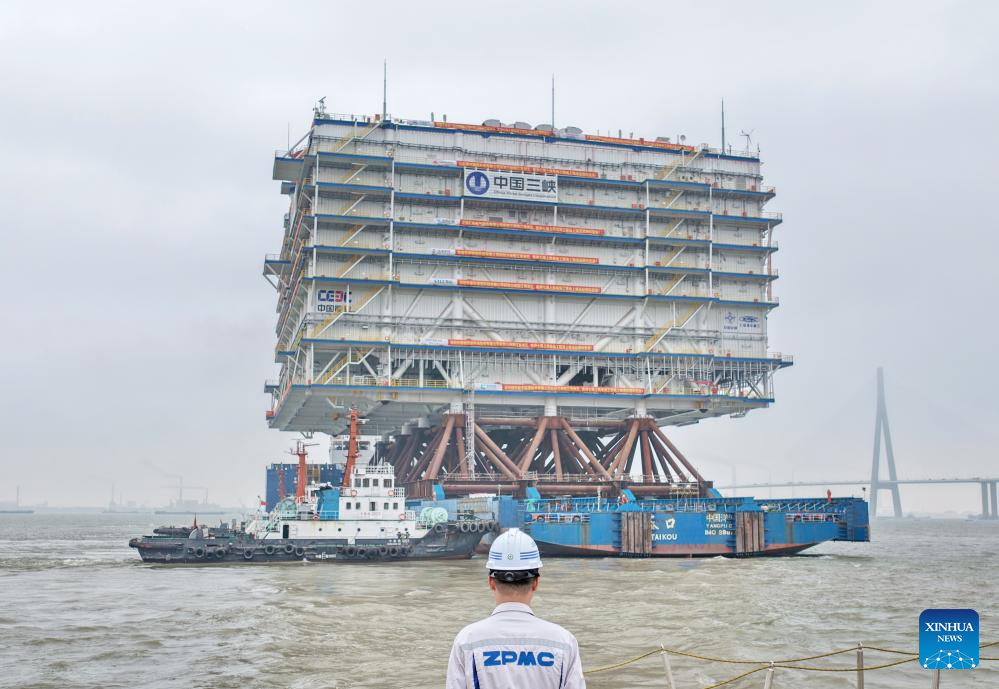
An aerial drone photo taken on May 27, 2026 shows the world's largest and most powerful offshore converter station setting sail on a semi-submersible vessel from Nantong of east China's Jiangsu Province.
The 25,000-tonne facility, officially named "Hai Feng Zhi Xin" or "Heart of the Sea Wind" in English, set sail from Nantong of Jiangsu province on a semi-submersible vessel. It will travel 1,090 nautical miles to an offshore wind farm off Yangjiang City in south China's Guangdong province, where it will be installed via a precision float-over method requiring millimeter-level construction accuracy, China Media Group (CMG) reported on Thursday.(Photo by Xu Congjun/Xinhua)
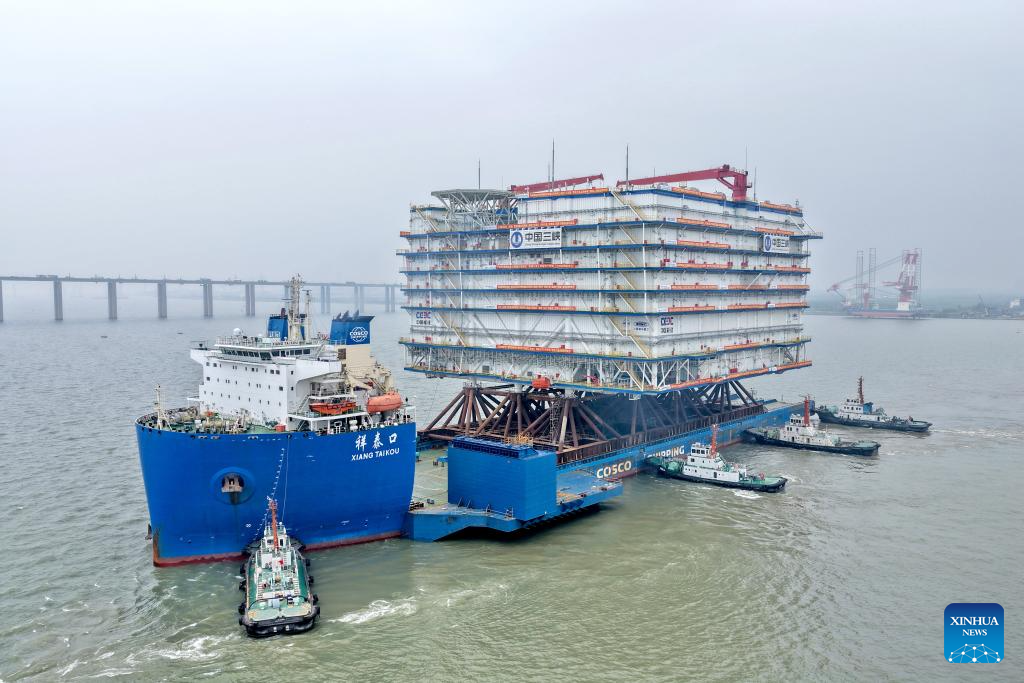
An aerial drone photo taken on May 27, 2026 shows the world's largest and most powerful offshore converter station setting sail on a semi-submersible vessel from Nantong of east China's Jiangsu Province.
The 25,000-tonne facility, officially named "Hai Feng Zhi Xin" or "Heart of the Sea Wind" in English, set sail from Nantong of Jiangsu province on a semi-submersible vessel. It will travel 1,090 nautical miles to an offshore wind farm off Yangjiang City in south China's Guangdong province, where it will be installed via a precision float-over method requiring millimeter-level construction accuracy, China Media Group (CMG) reported on Thursday.(Photo by Xu Congjun/Xinhua)
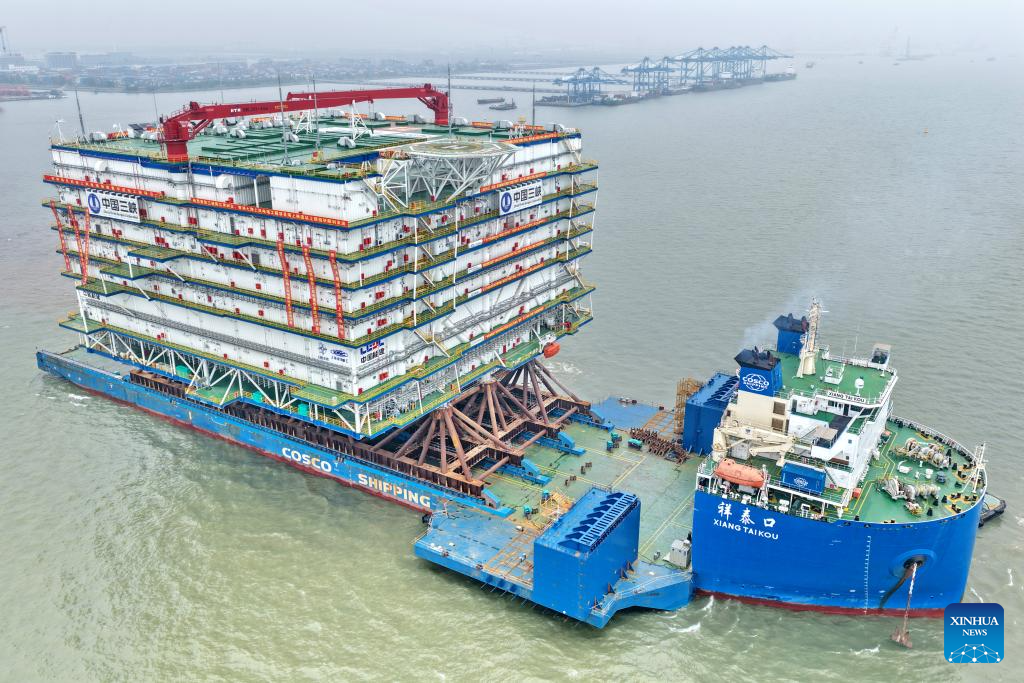
An aerial drone photo taken on May 27, 2026 shows the world's largest and most powerful offshore converter station setting sail on a semi-submersible vessel from Nantong of east China's Jiangsu Province.
The 25,000-tonne facility, officially named "Hai Feng Zhi Xin" or "Heart of the Sea Wind" in English, set sail from Nantong of Jiangsu province on a semi-submersible vessel. It will travel 1,090 nautical miles to an offshore wind farm off Yangjiang City in south China's Guangdong province, where it will be installed via a precision float-over method requiring millimeter-level construction accuracy, China Media Group (CMG) reported on Thursday.(Photo by Xu Congjun/Xinhua)
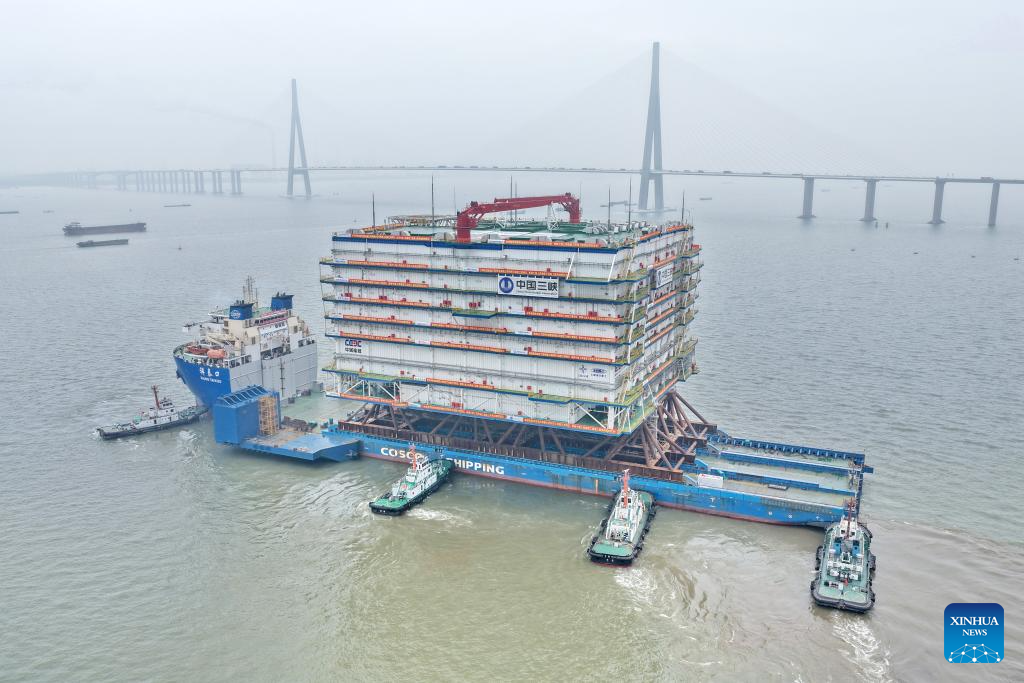
An aerial drone photo taken on May 27, 2026 shows the world's largest and most powerful offshore converter station setting sail on a semi-submersible vessel from Nantong of east China's Jiangsu Province.
The 25,000-tonne facility, officially named "Hai Feng Zhi Xin" or "Heart of the Sea Wind" in English, set sail from Nantong of Jiangsu province on a semi-submersible vessel. It will travel 1,090 nautical miles to an offshore wind farm off Yangjiang City in south China's Guangdong province, where it will be installed via a precision float-over method requiring millimeter-level construction accuracy, China Media Group (CMG) reported on Thursday.(Photo by Xu Congjun/Xinhua)


